
 1,2,3,
- 1US Naval Observatory, Washington DC, United States of America (michael.efroimsky@gmail.com)
- 2Department of Geophysics, Faculty of Mathematics and Physics, Charles University, Prague, Czech Republic
- 3King Abdullah University of Science and Technology, Thuwal, Saudi Arabia
- 4California Institute of Technology, Pasadena, CA, USA
- 5Institute of Geochemistry and Petrology, ETH Zürich, Zürich, Switzerland
The dwarf planet Pluto and its largest moon Charon represent a fully tidally evolved system: their orbital eccentricity is almost zero and their respective rotational periods are equal to the mutual orbital period. Due to Pluto’s unusually high obliquity (119.6°, i.e., high-obliquity retrograde rotation), the similarly tilted, equatorial orbits of its satellites, and the similar sizes of Pluto and Charon, the system is believed to have originated in a giant oblique impact (e.g., Canup, 2005; Arakawa et al., 2019). In this scenario, Charon formed on a tight orbit above the synchronous radius, and evolved by tidal recession from the primary, which was endowed with a large angular momentum and thus fast rotation. A recent, alternative scenario proposes formation by collisional capture (Denton et al., 2025), resulting in Charon’s emplacement on an initially circular close-in orbit and a primordial synchronisation at a high spin rate.
A tidally evolving binary is subjected to surface stresses that are strongly dependent on the mutual distance and, for small orbital separations, may lead to the formation of tidally-oriented fractures in the ice shell, similar to those on Enceladus or Europa. However, the orientation of fractures identified on images from the New Horizons mission is not correlated with expected tidal stresses and has instead been attributed to ocean freezing, which would have postdated the full orbital evolution (Rhoden et al., 2020). Moreover, an initially quickly rotating Pluto (and Charon) consistent with the giant impact scenarios would lead to a considerable rotational bulge that would only be able to relax before present in the case of a thin lithosphere and a weak ice shell above a subsurface ocean (McKinnon et al., 2025). Pluto and Charon also show comparable ice-to-rock fractions, which puts strong limitations on the formation mechanism. The estimated compositions can only be reconciled with a grazing, low-velocity collision of two undifferentiated objects (Canup, 2005) or by the collisional capture model of Denton et al. (2025).
In this work, we adopt the hypothesis that the Pluto-Charon binary was formed by a standard capture, similar to the case of Neptune and Triton. Although Pluto is much smaller than Neptune, a capture of a similarly sized satellites has been shown as feasible, at least in the case of terrestrial planets (Williams & Zugger, 2024; Makarov & Goldin, 2024). We assume that Charon was initially emplaced on a retrograde orbit with respect to Pluto’s rotation and its tidal action gradually led to Pluto’s spin reversal.
To model the rotational and orbital evolution of two tidally interacting differentiated bodies, we implement the evolution equations of Boué & Efroimsky (2019) and calculate the frequency-dependent tidal Love numbers of both Pluto and Charon using the normal mode theory approach (e.g., Sabadini & Vermeersen, 2004). We also self-consistently evaluate the ongoing tidal dissipation in both partners, following Efroimsky & Makarov (2014). Among the studied parameters are the effect of different initial spin rates of the partners, different initial orbital eccentricities, as well as the role of the ice shell viscosity and the presence of a subsurface ocean on both Pluto and Charon. A test run with varied initial spin rate is depicted in Figure 1.
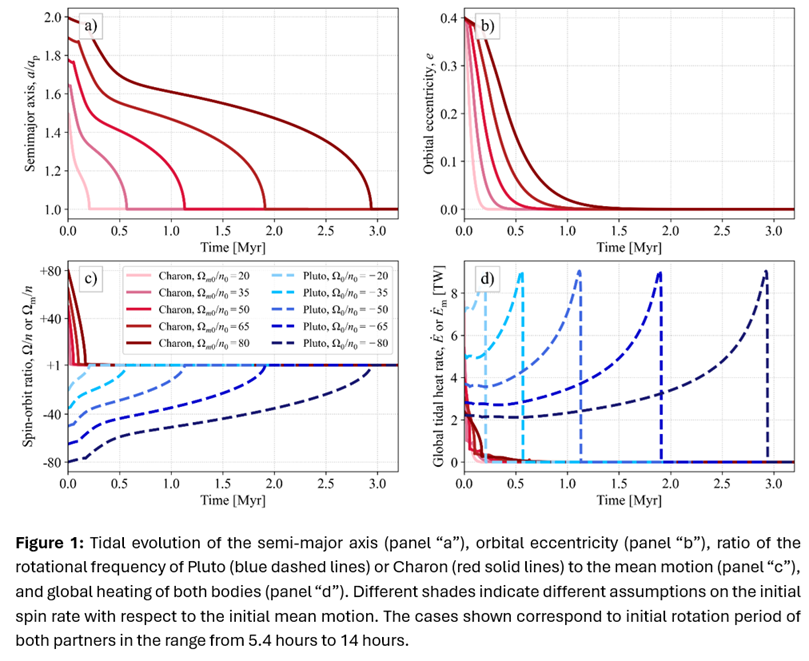
In all studied cases, the tidal evolution is concluded within several millions of years, on timescales that are two orders of magnitude longer than in the tidal recession scenario (formation by impact). Evolution from a greater distance also leads to two orders of magnitude decrease in tidal heating and tidal stresses with respect to the tidal recession scenario, potentially explaining the lack of tidally oriented fractures. While Pluto’s spin rate evolves on the same time scales as the binary’s orbit and eventually attains retrograde rotation, Charon’s despinning is very rapid (Figure 1c). Depending on the ice shell viscosity, it may get temporarily locked into higher spin-orbit resonances (such as 3:2 or 2:1) that are stable for tens of thousands of years.
Although our model is currently limited to the evolution of the Pluto-Charon binary and does not explain the formation and orbital evolution of Pluto’s smaller satellites, it shows that a tidal evolution from a wider separation following Charon’s capture is a viable alternative that can be reconciled with some of the observed features (missing tidally oriented fractures, Pluto’s retrograde rotation). It also illustrates the dynamical effect of a retrograde secondary on the primary’s rotation, which might have played a role in the tidal evolution of other solar system bodies, such as Venus (Makarov & Goldin, 2024).
Acknowledgements
M.W. has been supported by the Czech Science Foundation grant number 23-06513I.
References
[1] Canup, R. (2005), Science, 307(5709): 546-550, doi: 10.1126/science.1106818.
[2] Arakawa, S., Hyodo, R., Genda, H. (2019), Nature Astronomy, 3: 802-807, doi: 10.1038/s41550-019-0797-9.
[3] Denton, C. A., Asphaug, E., Emsenhuber, A., Melikyan, R. (2025), Nature Geoscience, 18: 37-43, doi: 10.1038/s41561-024-01612-0.
[4] Rhoden, A. R., Skjetne, H. L., Henning, W. G., et al. (2020), Journal of Geophysical Research: Planets, 125: e2020JE006449, doi: 10.1029/2020JE006449.
[5] McKinnon, W. B., Schenk, P. M., Singer, K. N., et al. (2025), Progress in Understanding the Pluto System: 10 Years After Flyby, LPI Contribution No. 3059, 2025, id.7045.
[6] Williams, D. M. and Zugger, M. E. (2024), The Planetary Science Journal, 5(208), doi: 10.3847/PSJ/ad5a9a.
[7] Makarov V. V. and Goldin A. (2024), Universe, 10, 15, doi: 10.3390/universe10010015.
[8] Boué, G. and Efroimsky, M. (2019), Celestial Mechanics and Dynamical Astronomy 131(7), doi: 10.1007/s10569-019-9908-2.
[9] Sabadini, R. and Vermeersen, B. (2004), Global Dynamics of the Earth: Applications of Normal Mode Relaxation Theory to Solid-Earth Geophysics. Kluwer Academic Publishers, Dordrecht, the Netherlands. ISBN 1-4020-2135-6.
[10] Efroimsky M. and Makarov V. V. (2014), The Astrophysical Journal, 795(6), doi: 10.1088/0004-637X/795/1/6.
How to cite: Efroimsky, M., Walterová, M., Gevorgyan, Y., Bagheri, A., Makarov, V. V., and Khan, A.: Tidal evolution of the Pluto-Charon binary in a capture scenario, Europlanet Science Congress 2026, The Hague, The Netherlands, 7–11 Sep 2026, EPSC2026-465, https://doi.org/10.5194/epsc2026-465, 2026.


