EPSC Abstracts
Vol. 19, EPSC2026-473, 2026, updated on 02 Jul 2026
https://doi.org/10.5194/epsc2026-473
Europlanet Science Congress 2026
© Author(s) 2026. This work is distributed under the Creative Commons Attribution 4.0 License.

From disruption to creation: contact binary formation in tidal chains of heterogeneous rubble piles
 1,2,3,1,3
- 1Space Research & Planetary Sciences, Physics Institute, University of Bern, Bern, Switzerland (john.wimarsson@unibe.ch)
- 2Institute for Astronomy, University of Edinburgh, Royal Observatory, Edinburgh, EH9 3HJ, UK
- 3Department of Aerospace Science and Technology, Politecnico di Milano, Milano, Italy
There is strong evidence of rubble-pile asteroids and comets being tidally disrupted by planets in our Solar System. First and foremost, the destruction of comet Shoemaker-Levy 9 was directly observed as it flew by Jupiter at a distance of 1.33 Jovian radii and was disrupted into 21 fragments due to the overwhelming tidal forces [1]. Second, observations form of crater chains on the moons of Jupiter that likely originate from impacts with fragments from a disruption event [2]. Third, population studies further indicate that tidal disruption of near-Earth objects (NEOs) by terrestrial planets would explain discrepancies between the observed and predicted NEO populations [3]. While analytical models can approximate the tidal distance at which a given rubble pile structurally fails [4], numerical simulations using discrete elements emphasise that the nature of granular mechanics introduces complex dynamical behaviour during the disruption process [5]. For example, computational rubble-pile models consisting of non-spherical elements with randomised packing have significantly higher internal strength [5,6].
In this work, we expand on this topic, showing that the choice of particle-size frequency distribution (SFD) also strongly affects the outcome of a given disruption event. Further, we find that tidal chains serve as efficient environments for the formation of contact binaries via low-velocity mergers, providing a complementary mechanism to mergers between fragments created in sub-catastrophic impacts [7].
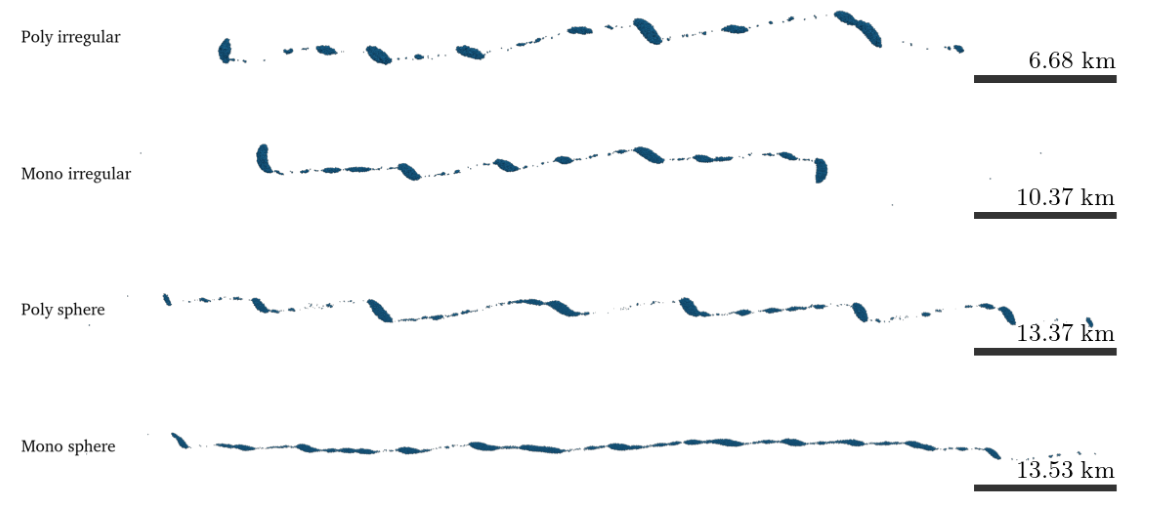
Figure 1: Tidal chains generated from tidal disruption of four different progenitors with identical hyperbolic orbits. The progenitors have irregular or spherical particles, and polydisperse or monodisperse SFDs. Each chain has been aligned with the inertial x-axis of the equatorial plane of the planet. Note the difference in scale, showing the variance in length.
Each disruption simulation was modelled using the discrete element method N-body code GRAINS [8], which can use both spherical and irregularly shaped particles. We generated four progenitors with different configurations and let them undergo close encounters with Earth on hyperbolic orbits defined by the periapse distance, q, and the encounter velocity at infinite separation, v. While the resulting mass distributions of fragments are comparable for the four different progenitors when q < 1.7 planetary radii, R, there is a distinct variance further out. In Figure 1, we show the tidal chain 6.3 h after the periapsis passage when q = 1.8R and v = 2 km/s. It is evident that using irregularly shaped particles with a polydisperse SFD leads to a more confined and less continuous tidal chain, where the largest fragment is more massive compared to the other cases. Hence, the heterogeneous internal structure makes both the progenitor and its fragments more stable against disruption.
The inherent mechanical strength of the rubble piles consisting of boulders of varying size also plays a role during mergers that occur between remnants in the tidal chain. Given that the individual fragments have velocities that only deviate slightly from the group velocity, there are many cases of bodies remaining gravitationally bound and merging. The same mechanism without a collision can also produce highly eccentric binary systems [9]. We find that more than 150 mergers between fragments across 36 simulations with a mass ratio of at least 0.1 all occur in the sub-escape-velocity regime. The combination of a low impact velocity and significant internal strength allows both the target and impactor to retain their initial shape and create distinct bilobate features in many cases [10]. We show two examples of bilobate objects formed in a tidal chain that remain structurally stable by the end of the simulation in Figure 2.
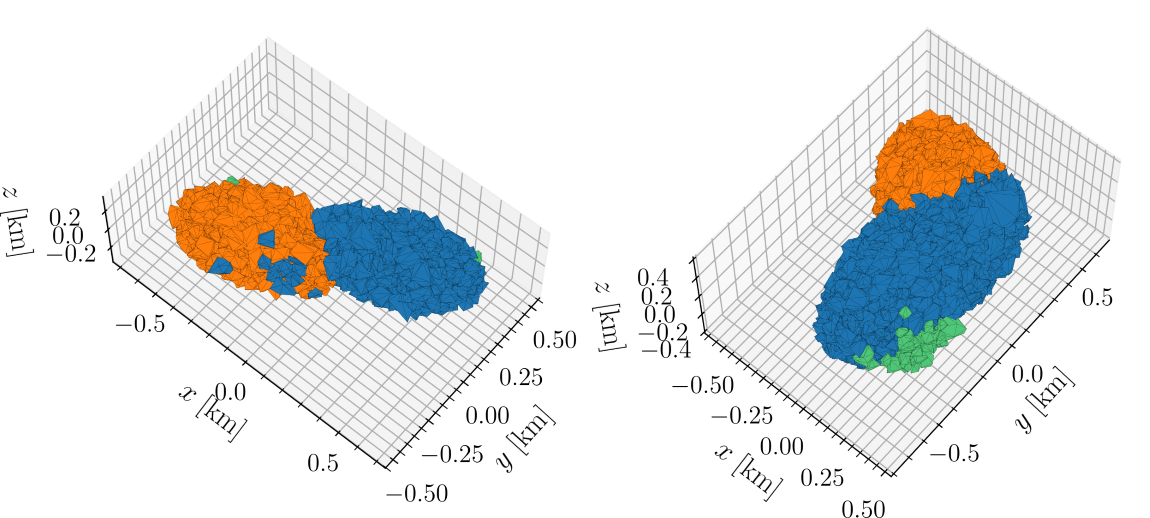
Figure 2: Two bilobate objects formed in a tidal chain from a disruption event. The colours of a given particle indicate if it originates from the target (blue), the impactor (orange) or from other sources (green).
The number of known bilobate objects in the NEO population is steadily growing, from both radar observations [e.g. 11] and in-situ imaging [12], highlighting that contact binaries are common in the Solar System. One such object with a seemingly bilobate shape is Apophis [13], which will approach the Earth within a distance of 32,000 km in 2029. It is likely that Apophis has undergone previous close encounters with Earth [14], which means tidal disruption provides a solid explanation for its unusual shape. Upcoming missions such as RAMSES [15] that will visit Apophis during its fly-by will be an excellent opportunity to better constrain its shape and bulk density, providing further insights into its origin.
J.W. and F.F. acknowledge funding from the Swiss National Science Foundation (SNSF) Ambizione grant No. 193346. M.J. acknowledges support from SNSF project No. 200021_207359.
References
1. Sekanina et al. (1994), Astronomy & Astrophysics, 289, 607-636.
2. Schenk et al. (1996), Icarus, 121, 249-274.
3. Granvik & Walsh (2024), The Astrophysical Journal Letters, 960, L9.
4. Holsapple & Michel (2006), Icarus, 183, 331-348.
5. Movshovitz et al. (2012), The Astrophysical Journal, 759, 93-104.
6. Zhang & Michel (2020), Astronomy & Astrophysics, 640, A102.
7. Jutzi & Asphaug (2015). Science, 348, 1355-1358.
8. Ferrari et al. (2020), MNRAS, 492, 749-761.
9. Walsh & Richardson (2006), Icarus, 180, 201-216.
10. Wimarsson et al. (2025), Astronomy & Astrophysics, 704, A29.
11. Cannon et al. (2026). MNRAS, 548, stag543.
12. Demura et al. (2006). Science, 312, 1347-1349.
13. Brozović et al. (2018). Icarus, 300, 115–128.
14. Brož et al. (2026). Astronomy & Astrophysics, 708, A162.
15. Lazzarin et al. (2025). EPSC-DPS 2025, 806.
2. Schenk et al. (1996), Icarus, 121, 249-274.
3. Granvik & Walsh (2024), The Astrophysical Journal Letters, 960, L9.
4. Holsapple & Michel (2006), Icarus, 183, 331-348.
5. Movshovitz et al. (2012), The Astrophysical Journal, 759, 93-104.
6. Zhang & Michel (2020), Astronomy & Astrophysics, 640, A102.
7. Jutzi & Asphaug (2015). Science, 348, 1355-1358.
8. Ferrari et al. (2020), MNRAS, 492, 749-761.
9. Walsh & Richardson (2006), Icarus, 180, 201-216.
10. Wimarsson et al. (2025), Astronomy & Astrophysics, 704, A29.
11. Cannon et al. (2026). MNRAS, 548, stag543.
12. Demura et al. (2006). Science, 312, 1347-1349.
13. Brozović et al. (2018). Icarus, 300, 115–128.
14. Brož et al. (2026). Astronomy & Astrophysics, 708, A162.
15. Lazzarin et al. (2025). EPSC-DPS 2025, 806.
How to cite: Wimarsson, J., Cannon, R. E., Frizzell, E., Jutzi, M., and Ferrari, F.: From disruption to creation: contact binary formation in tidal chains of heterogeneous rubble piles, Europlanet Science Congress 2026, The Hague, The Netherlands, 7–11 Sep 2026, EPSC2026-473, https://doi.org/10.5194/epsc2026-473, 2026.


