
 1,1,2,
- 1Departamento de Geodinámica, Estratigrafía y Paleontología, Universidad Complutense de Madrid, Spain
- 2Departamento de Biología y Geología, Física y Química Inorgánica, ESCET, Universidad Rey Juan Carlos, Spain
- 3Department of Earth and Planetary Sciences, Washington University in St. Louis, Missouri, USA
Introduction
Tessera terrains represent the oldest preserved units on the Venusian surface, covering approximately 8% of the planet [1]. The largest tessera occurrences correspond to crustal plateaus, which are elevated, quasi-circular regions with steep edges and flat tops [2]. Geophysical observations, including small gravity anomalies, low gravity-to-topography ratios, and shallow apparent compensation depths (ADC), suggest that these plateaus are supported by a thickened crust [3]. However, topographic elevations vary across regions; for instance, Ovda Regio exceeds 4 km above the planetary datum, while Alpha Regio rises to ~2 km [4]. Tessera terrain is defined by complex structural patterns, resulting in high radar brightness due to surface roughness [5]. The most penetrative fabric consists of ribbons, which are sets of long, narrow grabens typically spaced 1-5 km apart [6,7]. Deciphering ribbon evolution is essential for understanding the first recorded tectonic deformations of the Venusian lithosphere. This study presents a structural analysis of the morphology of individual ribbon-bounding faults and uses the results to estimate regional extensional strain caused by ribbons across Ovda and Alpha Regio.
Morphological Constraints on Fault Geometry
This study surveyed 130 normal fault scarps across eight tessera regions using NASA Magellan SAR data from Cycle 1 imagery. Analyzing apparent scarp width against radar incidence angle revealed a critical inflection point where scarp widths reach a minimum within an incidence angle range of 33º to 36º. This inflection point is significant because theoretical radar geometry indicates that it can be explained by the transition from radar layover, where the topographic slope is greater than the incidence angle, to radar foreshortening, where the slope is less than the incidence angle [8]. This provides a robust constraint indicating that the current slope of ribbon scarps globally lies within the range of 33º to 36º. This finding was independently validated using Cycle 1 and 3 images to measure radar distortions on 29 scarps in Ovda Regio, yielding fault scarp slopes of 33.9º ± 1.4º via radar parallax. These values are consistent with the 36.4º ± 1.2º slopes reported for normal faults developed on Venusian volcanic plains [9]. We also estimated a representative average height for these ribbon-bounding faults of 396.2 m, representing the graben depth. Assuming a standard fault dip of ~60º the calculated average horizontal extension, or heave, is approximately 228.7 m per fault. Because these consistently shallow slopes (roughly 35°) are much lower than the 60º dip expected for fresh Andersonian normal faults, they provide clear evidence of extensive post-formation scarp degradation.
Ribbon Regional Strain and Geodynamic Implications
Ovda Regio and Alpha Regio were subdivided into a 200x200 km grid where strain calculations were performed. Within each cell, we targeted the zones with highest density of normal faults to estimate the maximum tectonic extension accommodated by ribbons. We used the representative average fault throw and heave derived from our structural analysis, assuming pure dip-slip kinematics and initial fault dip of 60º. Total extension was computed along transects perpendicular to each fault set and, in regions where two distinct graben orientations intersected, calculating the cumulative strain from both sets. These regional strain values were visualized using deformation ellipses, where the size and color intensity represent the magnitude of stretching (Fig. 1). This regional structural analysis revealed fundamentally different extensional regimes. Ovda Regio exhibits a highly heterogeneous structural pattern with radial and concentric ribbon sets, characterized by strong spatial variability and central elevated regions largely devoid of extensional structures. In contrast, the smaller Alpha Regio displays a pervasive fabric of mutually orthogonal ribbons accommodating more homogeneous extension across the entire plateau.
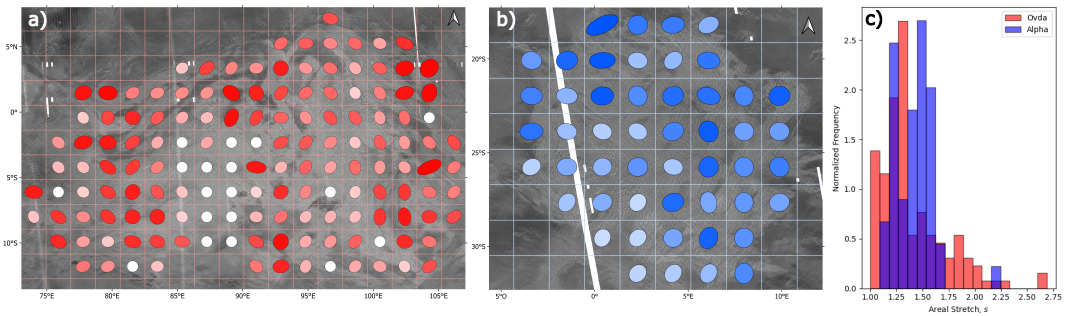
Figure 1: Finite strain distribution across (a) Ovda Regio and (b) Alpha Regio. The orientation of the major axis indicates the principal direction of strain, while ellipse size and color intensity scale with the magnitude of the stretching value (s). (c) Normalized frequency distribution of the areal stretch (s) for Ovda Regio (red bars) and Alpha Regio (blue bars). Overlapping areas are shown in purple. The x-axis represents the magnitude of the stretch (s), and the y-axis represents the normalized frequency of occurrence within the study areas.
We have compared the areal stretch with crustal thickness at each point of the grid (Fig. 2). The data revealed high dispersion, particularly in Ovda Regio, where the greater scatter reflects a heterogeneous transition from areas with no extension to highly stretched zones. Alpha Regio displays a more homogeneous strain pattern, possibly reflecting more uniform lithospheric properties associated with a small crustal plateau. Various tectonic and magmatic processes that contribute to crustal thickening or thinning explains this scattered distribution, which precludes a simple statistical correlation between these parameters. This study establishes ribbons as quantitative markers of the divergent tectonic evolution of Venusian crustal plateaus by using fault-scale geometries to quantify plateau-scale strain.
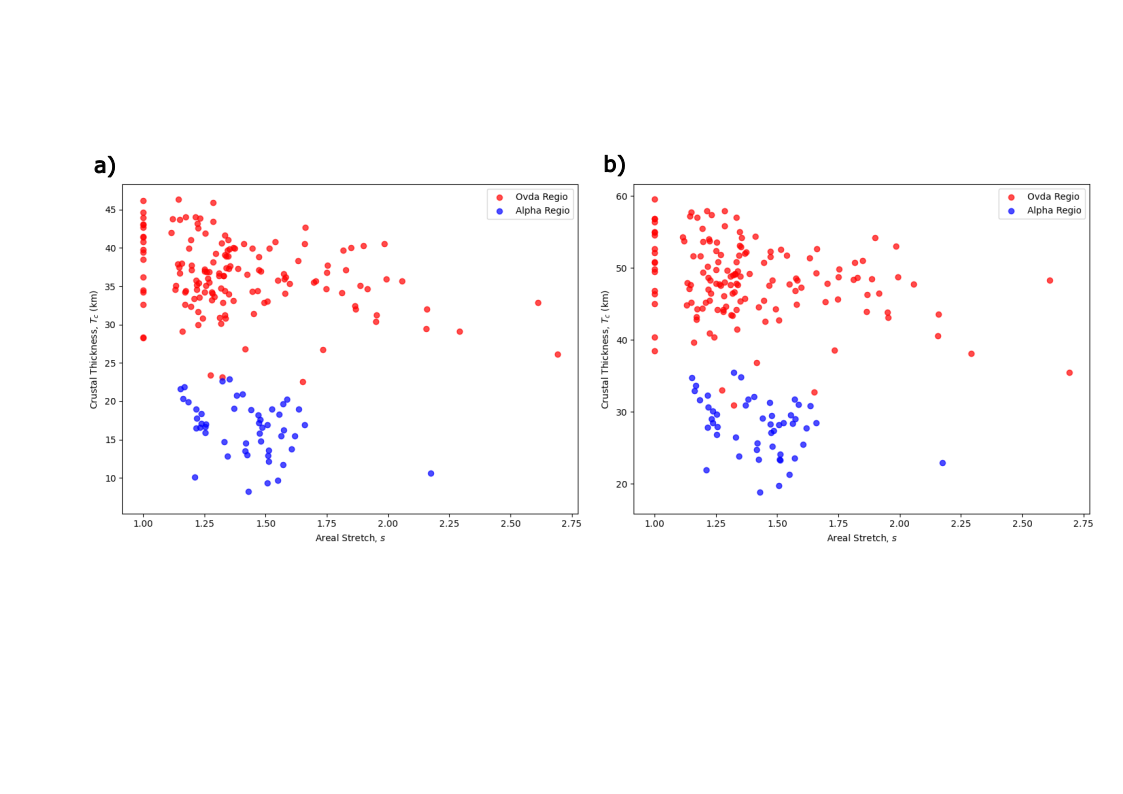
Figure 2: Correlation between crustal thickness (Tc) and areal stretch (s) calculated for each 200x200 km grid cell. Red circles represent Ovda Regio and blue circles represent Alpha Regio. Tc values are based on the global gravity-topography inversion model from (a) [10] and (b) [11].
Bibliography
[1] Ivanov, M.A., Head, J.W. (1996). JGR, 101, 14861-14908.
[2] Hansen, V.L., Banks, B.K., Ghent, R.R., (1999). Geology 27, 1071-1074.
[3] Grimm, R.E. (1994). Icarus, 112, 89-103.
[4] Bindschadler, D.L., Schubert, G., Kaula, W.M. (1992). JGR, 97, 13495-13532.
[5] Barsukov, V.L., et al. (1986). JGR, 91, D378-D398.
[6] Hansen, V.L., Willis, J.J. (1996). Icarus, 123, 296-312.
[7] Hansen, V.L., Willis, J.J. (1998). Icarus, 132, 321-343.
[8] Connors, C. (1995). JGR, 100, 14361-14381.
[9] Connors, C.D., Suppe, J. (2001). JGR, 106, 3237-3260.
[10] Maia, J., Wieczorek, M.A. (2022). JGR: Planets, 127, e2021JE007028.
[11] Jiménez-Díaz, A., et al. (2015). Icarus, 260, 215-231.
How to cite: Álvarez-Lozano, J., Romeo, I., Jiménez-Díaz, A., Uzkeda, H., Byrne, P. K., and Ruiz, J.: Quantifying Tectonic Extension in Venusian Tesserae: From Fault Scarp Geometry to Regional Strain Analysis, Europlanet Science Congress 2026, The Hague, The Netherlands, 7–11 Sep 2026, EPSC2026-48, https://doi.org/10.5194/epsc2026-48, 2026.


