
 1,2,3,5,5
- 1Telespazio UK Ltd for ESAC/ESAC, Villanueva de la Cañada, Spain (max.mahlke@ext.esa.int)
- 2Laboratoire J-L Lagrange, Observatoire de la Côte d’Azur, Boulevard de l’Observatoire, Nice, France
- 3University of Bern, Physics Institute, Space Research and Planetary Sciences, Sidlerstrasse 5, CH-3012 Bern, Switzerland
- 4German Aerospace Center (DLR), Robert-Hooke-Straße 7, 28359 Bremen, Germany
- 5Max Planck Institute for Solar System Research, Justus-von-Liebig-Weg 3, 37077 Göttingen, Germany
PRIAMOS (PRImordial Asteroid Mission to understand the Origin of the Solar system) is an asteroid sample return mission that will rendezvous with a D-type Near-Earth Asteroid (NEA), characterise its surface, and return a regolith sample to Earth [1]. Unlike prior sample return missions, PRIAMOS will return rocky material not represented by meteorites and coming from the unexplored archive of the far-outer Solar System. The analyses of the returned sample in ground-based laboratories will pave the way to a holistic understanding of the origin of the Solar System, the dynamical processes that shaped its evolution, and the origin of Earth as a habitable planet.
To achieve the scientific objectives of PRIAMOS, we seek a suitable D-type target in near-Earth space. D-type asteroids are primarily classified by two key criteria [2]: (i) their spectral slope in the visible part of the spectrum is featureless with a steep red component and a possible convex shape longward of 1.5 μm (refer to Fig. 1), and (ii) a low albedo (average of 0.06). Because spectra are only available for a small subset of asteroids, the classification is often based on photometry, which has a larger uncertainty given the lower spectral resolution. It is important to note that the certainty of any classification depends critically on the quality of the data used. Therefore, the ultimate classification should be done using spectra, as is the case for our baseline target.
The procedure to identify our baseline target 2011 AM24 was as follows. Out of the almost 40,000 known NEAs we selected all asteroids that have at some point been classified as a D-type, regardless of the classification scheme and underlying observational method. There are 44 NEAs that satisfy this condition. All of these candidates were then evaluated for the reachability and return trajectories. Based on this mission analysis, we have selected 2011 AM24, the target with the most favourable orbital transfers (including a backup launch window with an identical return date to Earth) and physical properties, including a diameter of ~500 m , comparable to the previous targets of sample return missions (~530x300 m for Itokawa, ~550 m for Bennu, ~1 km for Ryugu), and low albedo of 0.045, which is comparable to cometary nuclei.
We will present the known properties of the PRIAMOS baseline target and the associated reachability. Additionally, we will present the possibilities to further characterise the target in the future.
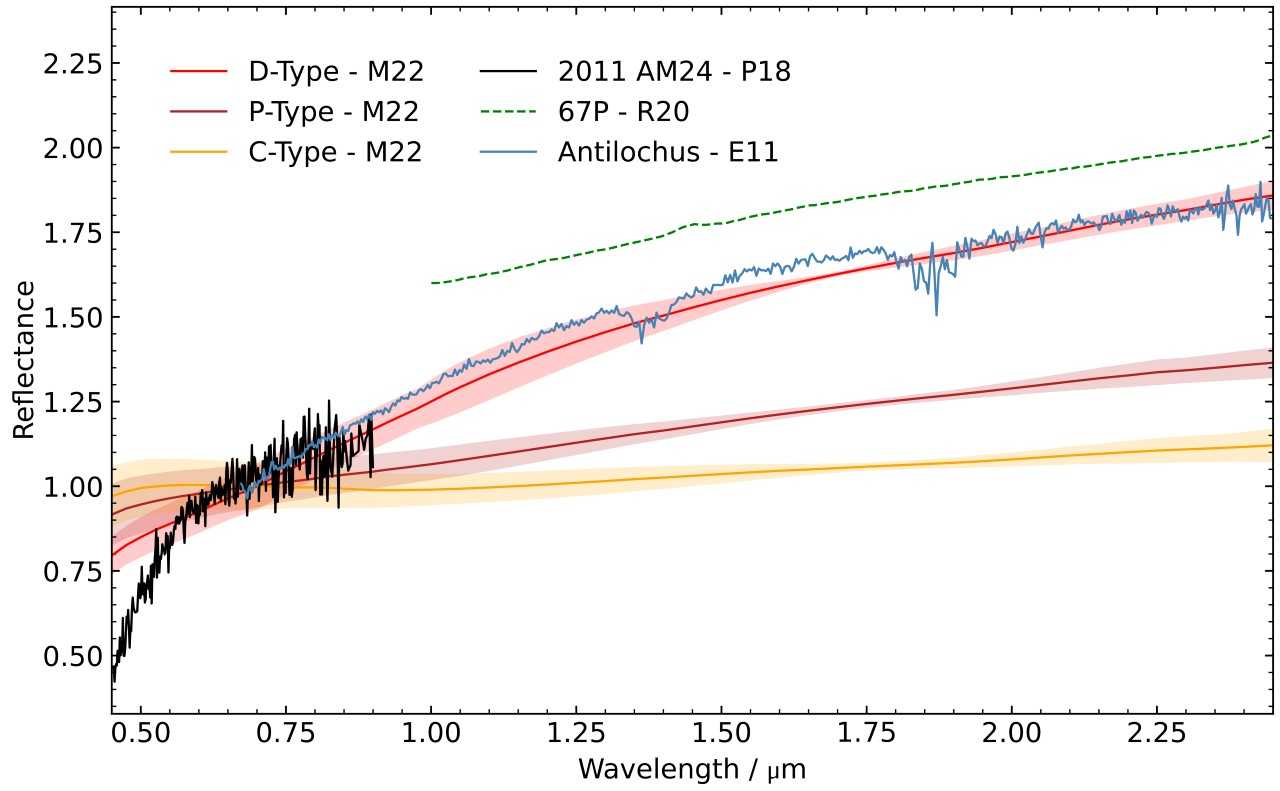
Figure 1: The spectrum of 2011 AM24 (from P18 - [3]) in comparison to the class templates of D-, P-, and C-types (from M22 - [1]) and the spectra of 67P (from R20 - [4]) and Jupiter Trojan (1583) Antilochus (from E11 - [5]).
References
1. Kleine T., Marschall R., Martin, H. and the PRIAMOS team, EPSC-DPS2025, 2025, 1500
2. Mahlke M., Carry B., Mattei P.-A., A&A, 2026, 665, A26.
3. Perna D., Barucci M. A., Fulchignoni M., et al., PSS, 2018, 157, 82-95
4. Raponi A., Ciarniello M., Capaccioni F., et al., NatAst, 2020, 4, 500-505
5. Emery J., Burr D. M., Cruikshank D. P., AJ, 2011, 141, 25
How to cite: Mahlke, M., Carry, B., Marschall, R., Hallmann, M., Kleine, T., and Stenzel, O.: Identification of the PRIAMOS sample-return target for ESA’s M8 mission, Europlanet Science Congress 2026, The Hague, The Netherlands, 7–11 Sep 2026, EPSC2026-482, https://doi.org/10.5194/epsc2026-482, 2026.


