SB13 | Composition and physical properties of asteroids: observational and experimental perspectives

SB13

Composition and physical properties of asteroids: observational and experimental perspectives
Convener: Irina Belskaya | Co-conveners: Yurii Kruhlyi, Oleksandra Ivanova
Orals FRI1
| Fri, 11 Sep, 08:30–09:48 (CEST)|Room Sun (Amare Studio)
Orals FRI2
| Fri, 11 Sep, 11:00–12:24 (CEST)|Room Sun (Amare Studio)
Posters THU-POS
| Attendance Thu, 10 Sep, 18:00–19:30 (CEST) | Display Thu, 10 Sep, 08:30–19:30|Foyer 3, F3.76–78
Fri, 08:30
Fri, 11:00
Thu, 18:00
Asteroids preserve a record of the formation and evolution of the Solar System, encoded in their composition and physical properties. Over the past decades, significant progress has been achieved through a combination of telescopic observations, laboratory analyses of meteorites, and in-situ measurements by space missions. These complementary approaches provide critical constraints on asteroid mineralogy, surface processes, internal structure, and evolutionary pathways. The aim of this session is to bring together observational and experimental studies addressing the composition and physical characteristics of asteroids across different populations.

Orals FRI1: Fri, 11 Sep, 08:30–09:48 | Room Sun (Amare Studio)

Chairperson: Oleksandra Ivanova
08:30–08:45
|
EPSC2026-8
|
ECP
|
On-site presentation
Raphaël Lallemand, Josselin Desmars, Bruno Sicardy, Ziyu Liu, Paolo Tanga, Luana Liberato, Benoit Carry, Alex Siakas, and Yücel Kiliç and the co-authors

Multiple systems are now recognised as a common outcome of small-body-evolution in the Solar System. As of today, we estimate the fraction of binaries at ~15% of Near-Earth objects and Transneptunian objects population [1, 2]. A similar fraction hase been estimated among small Main-Belt objects (D <10 km) [3]. These binary systems provide key access to fundamental parameters of Solar System remnants and planetary formations such as the bulk densities, mass and internal structure [4]. However, the current knowledge of these populations remains strongly biased by observational limitations. In particular, main-belt binary systems are still poorly characterised, since current techniques preferentially detect either widely separated binaries through direct imaging or close and bright systems via photometry and radar [5,6]. In this context, the high-precision astrometry of the Gaia mission has revealed a new population of candidate binaries exhibiting dynamical signatures consistent with unresolved companions [8,9]. The present work is part of the GaiaMoons program and aims to characterise a sample of 622 potential binary asteroid targets and to confirm or refute their binary nature. The properties of these candidates were derived from the high-precision photometric and astrometric observations provided by the Gaia satellite.
Stellar occultations emerge as one of the most effective methods to confirm their binary nature and to improve the current census of intermediate-size systems. Stellar occultations occur when three bodies align : an observer, an occulting Solar System object, and a background star. The occulting object passes in front of the star, creating a shadow detectable by the observer. As the object moves, the shadow also moves along way, creating an occultation path on the surface of the Earth. This method allows to have access to its physical parameter such as its volume with a sub-kilometric precision [9,10]. Between October 2023 and March 2026, 176 observations were successfully carried out for more than a hundred targets. These events were subsequently analysed in the context of the available literature and previously reported observations [11].

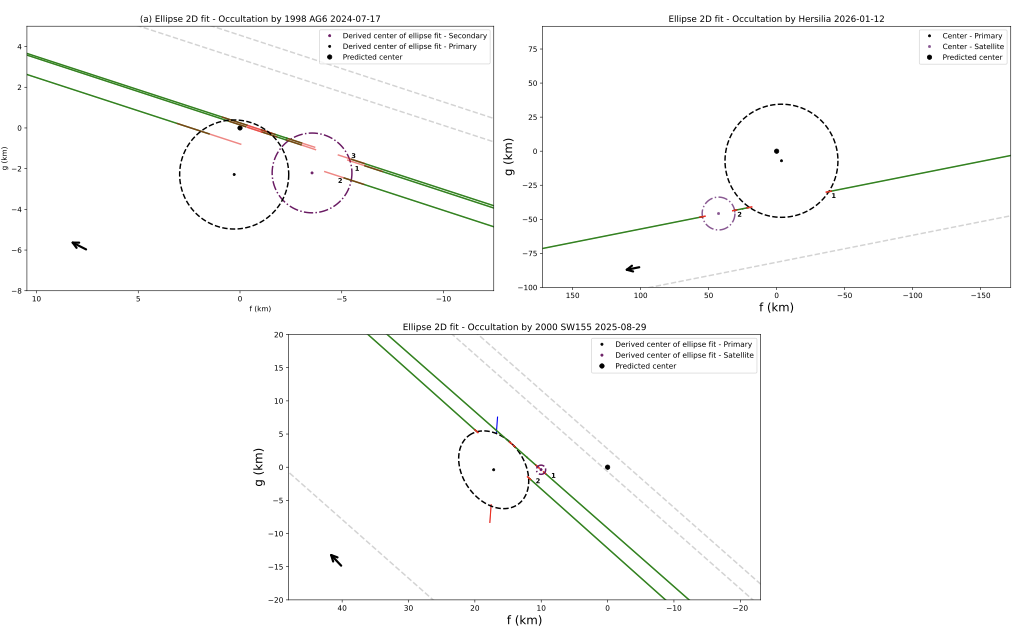
Out of 176 observations, 79 led at least to one positive observation. Among them, 24 objects have undergone unprecedented occultation observation campaigns. A detailed presentation will be made for objects showing strong indications of binary or contact binary features namely (35420) 1998 AG6, (206) Hersilia and (36882) 2000 SW155 (see Figure 1). These key stellar occultation campaigns illustrate the efficiency of mixing highly precise Gaia data with stellar occultation to characterise new binary or contact binary systems.

Figure 1: Sky-plane projection of the stellar occultation events of (35420) 1998 AG6 on 2024/07/17 (top left), (206) Hersilia on 2026/01/12 (top right) and (36882) 2000 SW155 on 2025/08/29 (center down). The green lines stand for positive observations while grey dottd-lines stand for negative ones. Red segments represent timing uncertainties for immersion and emersion. Primary and satellites fits are displayed by black and purple dotted-line ellipses. Numbers are displayed to distinguish drops. The arrow shows the direction of the object in the sky plane.

In the end, resulting dataset provides, for the vast majority of these objects, unique physical and astrometric constraints, as they had never been observed through stellar occultations before.  GaiaMoons illustrates how stellar occultation campaigns, associated to Gaia observations, generate a self-improving cycle to find new binary systems : probe size and shape to constrain future observations. By standardising this approach, we deliver critical data in unexplored parameter spaces, resolving long-standing observational ambiguities.


Acknowledgement


This work was supported by the project GaiaMoons of the Agence Nationale de Recherche (France), grant ANR-22-CE490002. The GaiaMoons team gratefully acknowledges the amateur communities of IOTA, IOTA/ES, IOTA/EA, TTOA, and Planoccult for their essential support, dedication, and significant contributions to this work. The properties of Solar System Object are from the service SsODNet.ssoCard of the Space Service (SE-OP) of Laboratoire Temps Espace at Paris Observatory through its Solar System Portal (https://ssp.imcce.fr) with the python library rocks (https://github.com/maxmahlke/rocks). This work has made use of data from the European Space Agency (ESA) mission Gaia (https://www.cosmos.esa.int/Gaia), processed by the Gaia Data Processing and Analysis Consortium (DPAC, https://www. cosmos.esa.int/web/Gaia/dpac/consortium). The authors would like to thank the Action Pluriannuelle Incitative (API) Pro-Am initiated and supported by Paris Observatory in the ROADIES program context. Z. Liu and D. Hestroffer thank the Academie Spatial program for their support. Part of observations were funded by the Scientific Research Projects Coordination Unit of Istanbul University with project numbers: BAP-3685 and FBG-2017-23943. Felipe Braga-Ribas acknowledges CNPq grant 316604/2023-2 and the financial support of the NAPI “Fenômenos Extremos do Universo” of Fundação de Apoio à Ciência, Tecnologia e Inovação do Paraná. M.A. thanks grants CNPq 427700/2018-3, 310683/2017-3, and 473002/2013-2, and FAPERJ E-26/210.705/2024. Y. Kilic, J.L. Ortiz, N. Morales and P. Santos-Sanz acknowledge financial support from the Severo Ochoa grant CEX2021-001131-S funded by MICIU/AEI/10.13039/501100011033. P. Santos-Sanz and Y. Kilic acknowledge financial support from the Spanish I+D+i project PID2022-139555NB-I00 (TNO-JWST) funded by MCIN/AEI/10.13039/501100011033. TUG100 Telescope at the Antalya TUG Site of the Türkiye National Observatories has been utilized, and we express our gratitude for the support provided by the Türkiye National Observatories and all its staff.


[1] Pravec et al., 2007, Icarus, Photometric survey of binary near-Earth asteroids.
[2] Noll et al., 2008, The Solar System Beyond Neptune, Binaries in the Kuiper Belt.
[3] Ćuk et al., 2010, Icarus, Orbital evolution of small binary asteroids.
[4] Fuentes-Muñoz, 2025, The Astrophysical Journal, Asteroid Mass Estimation by Mutual Perturbations During Close Encounters After Gaia Focused Product Release.
[5] Ostro S. J., 2002, Asteroids III, Asteroid Radar Astronomy.
[6] Grundy et al., 2019, Icarus, Mutual orbit orientations of transneptunian binaries.
[7] Liberato et al., 2024, Astronomy & Astrophysics, Binary asteroid candidates in Gaia DR3 astrometry.
[8] Liberato et al., 2026, Astronomy & Astrophysics, submitted.
[9] Desmars et al., 2019, Astronomy & Astrophysics, Pluto's ephemeris from ground-based stellar occultations.
[10] Rommel et al., 2020, Astronomy & Astrophysics, Stellar occultations enable milliarcsecond astrometry for Trans-Neptunian objects and Centaurs.
[11] Lallemand et al. 2026, Astronomy & Astrophysics, submitted.


How to cite: Lallemand, R., Desmars, J., Sicardy, B., Liu, Z., Tanga, P., Liberato, L., Carry, B., Siakas, A., and Kiliç, Y. and the co-authors: Detection And Characterisation of Binary Asteroids Candidates through Stellar Occultations , Europlanet Science Congress 2026, The Hague, The Netherlands, 7–11 Sep 2026, EPSC2026-8, https://doi.org/10.5194/epsc2026-8, 2026.

08:45–09:00
|
EPSC2026-975
|
ECP
|
On-site presentation
Ihor Kyrylenko, Yurii Kruhlyi, and Oleksiy Golubov

The study investigates the dynamical evolution of selected groups of small bodies of the Solar System using numerical simulations. The research focuses on the orbital evolution of Main Belt asteroids, near-Earth asteroids (NEAs), and meteoroids to reconstruct their dynamical history and identify bodies of common origin. The motion of these objects is studied under the combined influence of solar and planetary gravity, as well as non-gravitational forces such as the Yarkovsky and YORP effects. These mechanisms enable the identification of dynamically associated asteroid pairs and clusters, as well as the determination of their potential source regions. In the context of the global problem of asteroid hazard, the research also contributes to the identification of potentially hazardous objects, which is essential for risk assessment and the development of mitigation strategies.

Numerical modeling serves as the main tool for trajectory analysis and forecasting the long-term evolution of minor bodies. The application of numerical integration techniques permits solving the equations of motion of these bodies, whose complex and often chaotic dynamics are difficult or impossible to treat analytically due to nonlinearities and sensitivity to initial conditions. For this reason, numerical methods are the main methodological approach employed in this study. 

A primary focus of this work is the identification and characterization of asteroid pairs, which are gravitationally unbound, genetically related bodies originating from disruptive events such as rotational fission, collisions, or the decay of binary systems. Initially formed on highly similar orbits, their components gradually diverge due to planetary perturbations and the Yarkovsky effect. The methodology relies on isolating candidate pairs based on their proximity in the space of osculating orbital elements, followed by statistical significance assessments and backward numerical integrations of their dynamics.  To account for observational uncertainties, multiple orbital clones for each candidate are generated. A pair's formation age is established by identifying past epochs where the clones demonstrate close encounters, characterized by minimal relative distances and velocities. 

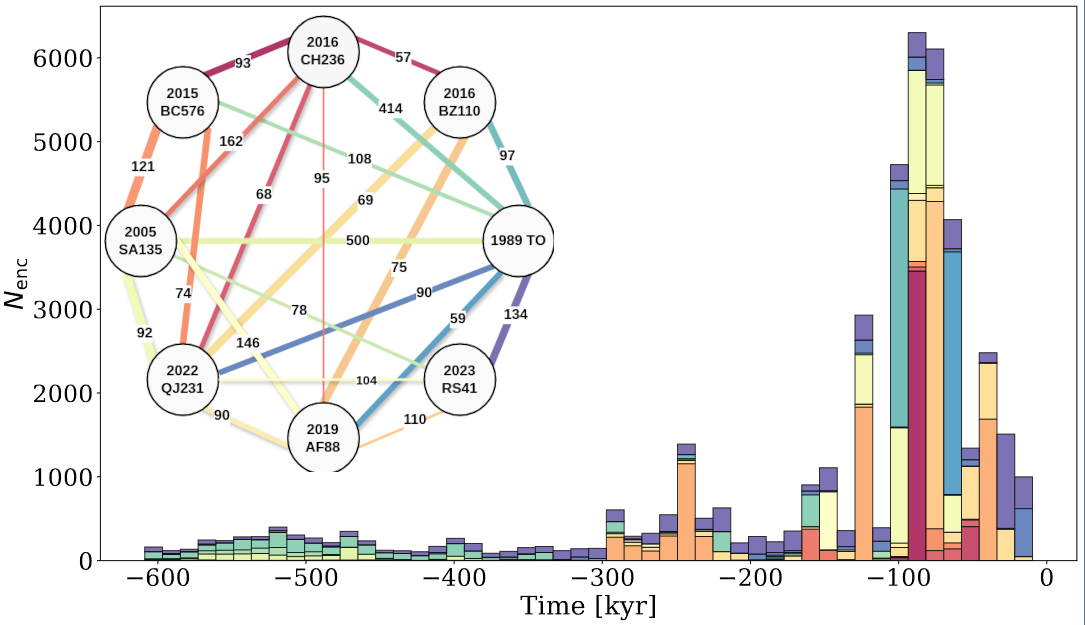
The approach was validated using a test sample of known asteroid pairs with previously determined formation ages. After that, a comprehensive survey of the inner region of the main asteroid belt was conducted with phase-space distances of d ≤ 25 m/s, which yielded the discovery of 50 previously uncatalogued asteroid pairs. The estimated formation ages of these pairs span from 2,000 to 1 million years. Notably, the study identified one of the youngest known asteroid pairs with very close encounters. For this pair, the simulations explicitly incorporated the mutual gravitational attraction between the components, which was demonstrated to be an important factor in accurately modeling its orbital evolution (Fig. 1). Additionally, the search led to the discovery of a new asteroid cluster consisting of eight members, with an estimated formation age of 70,000 to 100,000 years (Fig. 2). It is assumed to be a part of the (25) Phocaea family, as the main body of the cluster 21028 (1989 TO) belongs to this family.

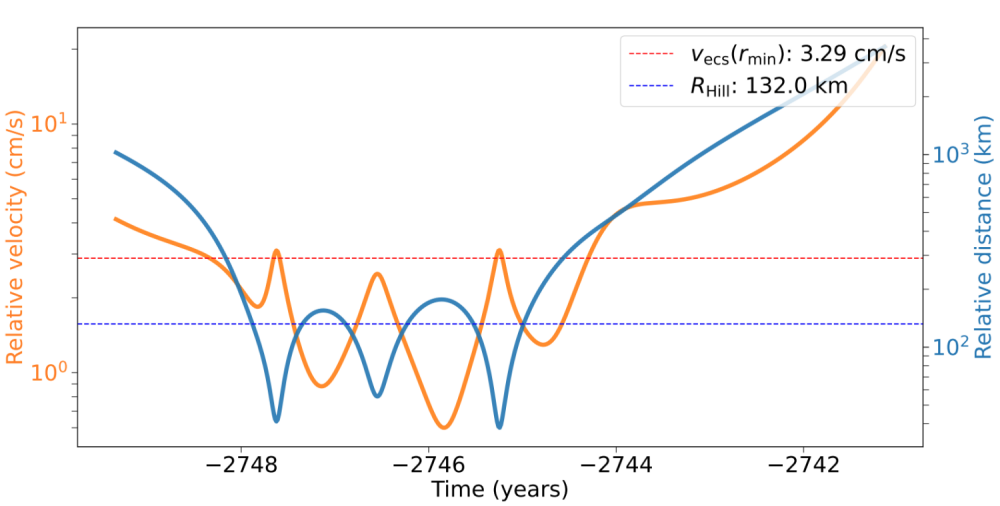
Fig. 1. Example of a close encounter between the clones of the pair 469759 (2005 QM29) - (2016 QZ123), where the mutual gravitational attraction influences the dynamics of the pair. The encounter led to gravitational capture, and clones revolved around the center of mass for 2-3 orbital periods.


Fig. 2 Time distribution of close encounters for the cluster, where the colors of the links correspond to those of the histogram, while the width of connections illustrates the number of encounters between the components. The numbers on the lines represent the median of the encounter time distribution between the components.


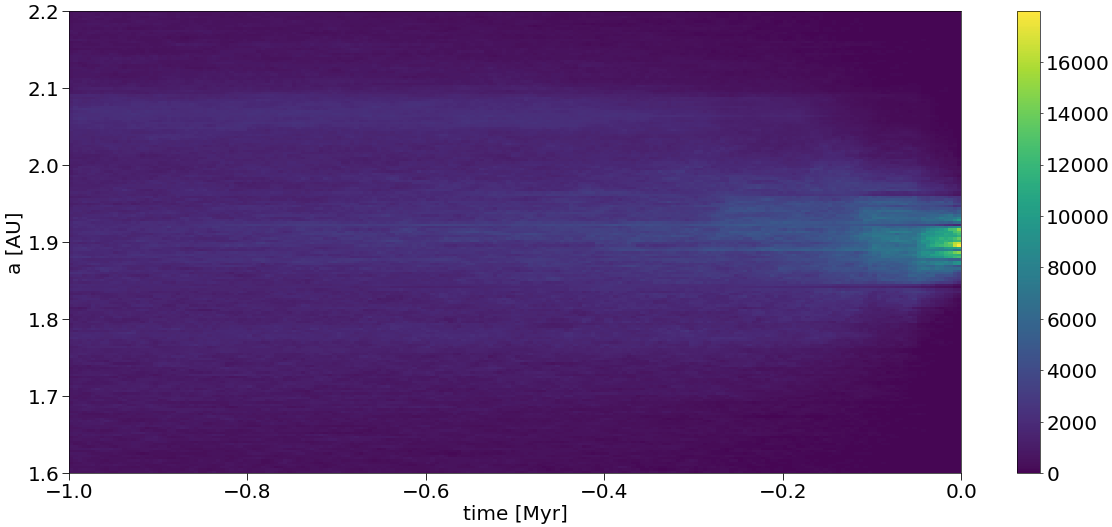
The work also presents the results on identifying the source regions of individual meteoroids. It describes the methods and outcomes of utilizing instrumental observations of fireballs to reconstruct their atmospheric trajectories and their pre-atmospheric heliocentric orbits.  The orbits were numerically integrated backward in time to search for potential source regions, close planetary encounters, and possible dynamical associations with selected asteroids. Candidate asteroids were selected based on proximity in orbital element space and similarity in Tisserand parameters. This approach was applied to the Adalen meteorite event (07 November 2020) and the Kyiv fireball (19 April 2023).  A backward numerical integration of the meteoroid’s orbit over 1 million years was computed to search for potential parent bodies. The statistical estimates and the numerical results (Fig. 3) indicate that the Adalen meteoroid likely entered near-Earth space from the inner Main Belt either via the ν₆ secular resonance with Saturn (89%) or the 3:1 mean-motion resonance with Jupiter (10%). The meteoroid associated with the Kyiv fireball possibly originated from ν₆ secular resonance with Saturn (50%), 3:1 mean-motion resonance with Jupiter (19%), or the Hungary asteroid group (38%).


Fig. 3 Distribution of the semi-major axis of Adalen meteoroid clones in numerical integration up to 1 million years backward in time.


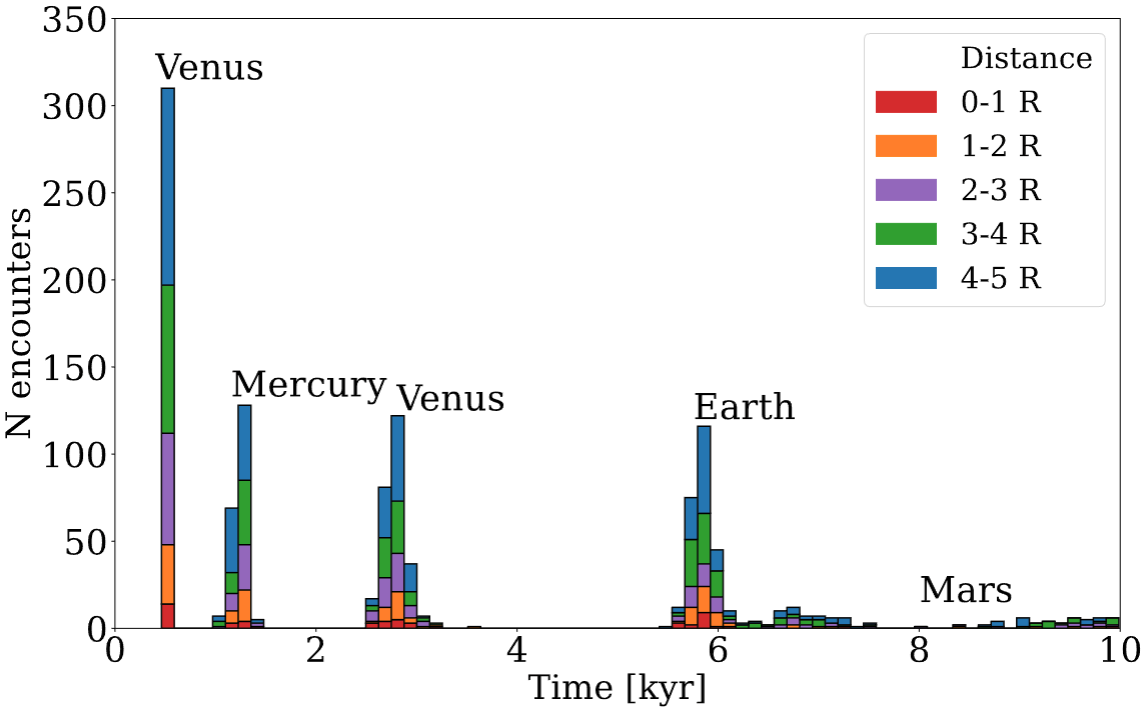
In the context of planetary defense, the dynamical evolution of the potentially hazardous asteroid (153201) 2000 WO107 was investigated. Utilizing photometric and radar observations from its 2020 opposition, the asteroid's shape, density, and rotational parameters were determined for the first time. The data confirmed a contact-binary structure, and the asteroid appears to contain a significant metallic component.  Using data obtained, a refined Yarkovsky effect model was used to perform dynamical simulations of the asteroid and compute the probabilities of close planetary encounters. The analysis shows that the asteroid's dynamical evolution is governed by its highly elongated orbit and interactions with terrestrial planets, and that it poses no threat to Earth over the next 10,000 years (Fig. 4).


Fig. 4 Registered encounters of 200,000 clones of the 2000 WO107 asteroid with terrestrial planets in the simulation to 10 kyr into the future.

Acknowledgments

The authors are grateful to the Ukrainian soldiers who defend our lives and freedom from russian aggression. YK thanks the French PAUSE program, which provides support to scientists at risk.

How to cite: Kyrylenko, I., Kruhlyi, Y., and Golubov, O.: Numerical simulations of the asteroid dynamics: pairs, clusters, contact binaries, and the origin of meteorites , Europlanet Science Congress 2026, The Hague, The Netherlands, 7–11 Sep 2026, EPSC2026-975, https://doi.org/10.5194/epsc2026-975, 2026.

09:00–09:12
|
EPSC2026-412
|
ECP
|
On-site presentation
Luana Liberato, Paolo Tanga, David Mary, Kate Minker, Raphael Lallemand, Ziyu Liu, Benoit Carry, Josselin Desmars, and Daniel Hestroffer

Binary asteroids are fundamental probes of the physical and collisional evolution of the Solar System. Their mutual orbits provide one of the few direct ways to estimate asteroid masses, bulk densities, and internal structures. However, the population of known binary systems is small. It remains strongly biased toward small bodies in the near-Earth and inner main-belt populations, while binaries in the intermediate-size regime and in the outer main belt remain poorly characterised. 

In Liberato et al. (2024), we introduced a new method to identify binary asteroid candidates. We searched for astrometric wobble signatures in Gaia Data Release 3, producing the first-ever list of astrometric binary asteroid candidates, several of which have already been independently confirmed. In Liberato et al. (2026), we further refined the method by accounting for specific statistical properties of the Gaia astrometric data and by implementing a selection procedure designed to control the false-detection rate. We then explored the Gaia Focused Product Release (FPR), which contains more than 150,000 objects observed over 66 months. Among them, 47,896 objects had sufficient data for us to investigate the possibility of an undetected companion. Extensive validation tests demonstrated the robustness of the detections: simulations based on noise-only scenarios produced, on average, a number of candidates approximately 80% lower than that obtained from the Gaia FPR data. In addition, astrometric wobble signatures were successfully recovered for nine previously known binary systems, confirming our method's capacity in detecting genuine binary-induced signals. Our analysis identified 343 astrometric binary candidates.

Now, we expand the analysis on the results from Liberato et al. (2026). The FPR candidate population spans a broad range of dynamical classes, with the majority located in the main asteroid belt, but also includes objects associated with the Cybele and Hilda groups, as well as several Jupiter Trojans. The distribution of candidates differs significantly from that of currently known binaries, revealing a larger fraction of objects in the middle and outer main belt. This suggests that our method, associated with the Gaia astrometry precision, is sensitive to binary systems that are difficult to detect with conventional photometric or direct-imaging techniques, reducing the strong observational biases affecting the currently known population.

A substantial fraction of the candidates are associated with asteroid families, indicating that collisional environments may play a major role in binary formation and survival. We identify 95 candidates, as well as one previously known binary, associated with asteroid families. Their distribution in proper element space suggests that binaries may be considerably more common in outer-belt families than currently known. The presence of candidate binaries among family parent bodies, including (369) Aeria, (780) Armenia, and (1303) Luthera, is particularly significant because these systems could provide direct constraints on the masses, densities, and reaccumulation histories of poorly characterised collisional families.

The physical properties of the candidates indicate a diverse population. Approximately 60% of the objects have estimated diameters below ~15 km, consistent with binary formation through rotational fission driven by the YORP effect (Walsh et al. 2008). In contrast, several candidates exceed diameters of ~50 km, a size range where YORP-driven spin-up becomes inefficient and collisional formation mechanisms are expected to dominate. Some intermediate-sized objects, known as Escaping Ejecta Binaries (EEBs; Durda et al. 2004), may form through sub-catastrophic collisions. These EEBs are severely underrepresented in the known binary asteroid population compared with theoretical expectations (Pravec & Harris 2007). Our results show that 27% of our candidates are within the EEB size range, and several are synchronous. This suggests that we may be revealing a significant fraction of a previously hidden population of binary asteroids across the main belt.

The taxonomic distribution of the candidates also differs slightly from that of known binaries. While the fraction of S-type asteroids remain the highest in our sample, the fraction of C-type candidates is significantly enhanced relative to the currently known binary population. This trend is consistent with the larger number of outer main-belt objects recovered by Gaia astrometry. It may suggest that the apparent dominance of S-type binaries in previous surveys (Minker \& Carry 2023) is largely driven by observational bias that favours objects in the inner main belt.

Finally, the availability of multiple Gaia observation windows for several candidates allows independent estimates of orbital parameters and provides an internal consistency check on the astrometric solutions. A significant fraction of the multiple detections show compatible or aliased solutions, reinforcing the physical plausibility of the binary interpretation. Confirmation through stellar occultation observations, or photometric light curves, could substantially increase the number of known binaries in the middle and outer main belt, improve estimates of binary occurrence rates in asteroid families, and provide new constraints on the formation, evolution, and internal structure of small bodies.

These results show the strong potential of Gaia astrometry to reveal a previously hidden population of binary asteroids across the Solar System and to improve the binaries' physical characterization. Some Gaia Data Release 4 results will also be presented to support these findings and prepare the community to the upcoming full release in December 2026.

References:

1. D. D. Durda et al. (2004). Icarus 167.2, pp. 382–396.

2. L. Liberato et al. (2024). Astronomy & Astrophysics, 688, A50.

3. L. Liberato et al. (2026). Astronomy & Astrophysics, Under Review

4. K. Minker and B. Carry (2023). Astronomy & Astrophysics 672 (2023): A48.

5. P. Pravec and A. W. Harris (2007). Icarus 190, pp. 250–259

6. K. J. Walsh et al. (2008). Nature 454.7201, pp. 188–191.

How to cite: Liberato, L., Tanga, P., Mary, D., Minker, K., Lallemand, R., Liu, Z., Carry, B., Desmars, J., and Hestroffer, D.: Physical Diversity of New Binary Asteroid Candidates from Gaia FPR, Europlanet Science Congress 2026, The Hague, The Netherlands, 7–11 Sep 2026, EPSC2026-412, https://doi.org/10.5194/epsc2026-412, 2026.

09:12–09:24
|
EPSC2026-1126
|
On-site presentation
Yurii Kruhlyi, Daniel Hestroffer, and Ziyu Liu and the Gaiamoons photometry

Introduction: The Gaia space mission of ESA has collected extremely precise data on the astrometry of asteroids. These data can be used to measure the periodic oscillation of the photocenter of binary asteroids and thus to discover their binarity [1]. Using this method for the Gaia DR3 catalogue, Liberato et al. [2] has so far discovered hundreds of candidates in binaries (the so-called Gaiamoons), and most of them are expected to be confirmed in the following years. 

Observations: We have implemented the observation program of Gaia binary asteroids to reveal their binary nature and determine their physical parameters using precise photometry. For this purpose, we cooperate with different observatories in France, Slovakia, Bulgaria, Georgia, Uzbekistan, Kazakhstan, Taiwan, and Chile. The observatories are distributed across different locations, allowing observations to continue even when weather conditions are poor at some sites. In addition, their coverage across multiple longitudes makes it possible to obtain long, continuous lightcurves, which are essential for the reliable interpretation of the photometric data. The observations are carried out with 0.6 - 2 m telescopes. If possible, the predicted timing of mutual events in the Gaiamoons binary system is used to plan photometric observations. Thus, we expect to obtain photometric lightcurves with the occultation/eclipse events, which could confirm binarity and improve the parameters of mutual orbits. 

Results and prospects: We present the results of our photometric observations of the Gaiamoons binary candidates, which fall into two categories: known binary asteroids — (87) Sylvia, (90) Antiope, (121) Hermione, (317) Roxane, (542) Susanna, and (4337) Arecibo — and asteroids suspected of being binary systems — (605) Juvisia, (712) Boliviana,  (1127) Mimi, (1967) Menzel, and (4209) Briggs. In addition, we include in the analysis the photometric data for Gaiamoons binary asteroids obtained from various sky survey data, including TESS and others. In particular, using photometric data from the TESS survey, we confirmed the predicted occultation/eclipse events in the well-known binary asteroid (22) Kalliope [3]. 

The obtained observations are supposed to be used to conduct numerical modeling of the binary systems using the astrometric and photometric data. Our numerical code generalizes our previously devised algorithm for shape modeling of contact-binary asteroids [4]. It represents a model of a binary system as two ellipsoid-shaped objects orbiting each other. By comparing simulated brightness and position of the photocenter of the binary system with real observations, we estimate the most likely shapes, sizes, masses, and densities of the asteroid components, together with uncertainties of these values.

Acknowledgments: The Kharkiv team is thankful to Ukrainian soldiers who defend our lives and freedom against russian aggression. YK thanks the French PAUSE program for its support of scientists at risk. 

References

[1] Pravec, P., & Scheirich, P. 2012, Planet. Space Sci., 73, 56 

[2] Liberato L., Tanga P., Mary D., et al., A&A, 2024, 688, A50.

[3] Emelyanov, N. V., Kovalev, M. Y., & Varfolomeev, M. I. 2023, MNRAS, 522,165 

[4] Krugly Y., Golubov O., Kyrylenko I., et al., A&A, 2025, 702, A170

How to cite: Kruhlyi, Y., Hestroffer, D., and Liu, Z. and the Gaiamoons photometry: Gaia Binary Asteroids: Lightcurve Photometry and Modelling, Europlanet Science Congress 2026, The Hague, The Netherlands, 7–11 Sep 2026, EPSC2026-1126, https://doi.org/10.5194/epsc2026-1126, 2026.

09:24–09:36
|
EPSC2026-242
|
Virtual presentation
Eri Tatsumi, Jin Beniyama, Miguel R. Alarcon, Julia de León, Julia Martikainen, Petr Pravec, Tomohiko Sekiguchi, Seiya Takenaka, Bryce T. Bolin, Thomas G. Mueller, Marcel Popescu, Norio Narita, Akihiko Fukui, Hasegawa Hasegawa, Javier Licandro, Masateru Ishiguro, Daisuke Kuroda, Seitaro Urakawa, and Hiroyuki Kurokawa and the NGSR WG

D-type asteroids are among the most primitive, organic-rich objects in the Solar System and are widely thought to have originated in the outer regions of Solar System, being them key witnesses to early Solar System chemistry and volatile delivery. (162998) 2001 SK162 is a Near-Earth Asteroid (NEA) belonging to the Apollo group and designated as a Potentially Hazardous Asteroid (PHA). Discovered by the LINEAR program in 2001, the object follows an eccentric orbit (e ~ 0.47) with a small orbital inclination of 1.7° and a perihelion distance of ~1.01 au. Some previous studies showed that this asteroid is possible D/T types [1,2,3,4]. These orbital and spectral characteristics led to its selection as the D-type primary target of the Japanese Next Generation Small-body Sample Return mission (NGSR-D) [5]. Precise knowledge of the target’s fundamental physical properties—in particular its geometric albedo, diameter, rotation state, and shape—is essential for mission planning, including spacecraft navigation, approach trajectory design, and sample acquisition operations. However, these properties remain poorly constrained: previous photometric and thermal-infrared observations [7,6] have yielded significant uncertainties that could directly impact mission design and operations.

To address this, we conducted a coordinated, multi-technique observing campaign of 2001 SK162 between October 2025 and March 2026, using a worldwide network of facilities: lightcurve photometry with the Two-meter Twin Telescope (TTT) at Teide Observatory; visible multi-band photometry with MuSCAT3/4 on the Las Cumbres Observatory (LCO) 2-m telescopes at Haleakala Observatory and with the Pirka 1.6-m telescope at Nayoro Observatory; visible spectroscopy with OSIRIS on the 10.4-m Gran Telescopio Canarias (GTC) at Roque de los Muchachos Observatory (ORM); NIR multi-band photometry with MOSFIRE on Keck I and polarimetry with the Subaru Telescope at Maunakea Observatories and the 2.5-m Nordic Optical Telescope (NOT) at ORM. In parallel, we reanalyzed archival WISE and Spitzer thermal-infrared data to independently constrain the size and albedo.

Lightcurves were obtained with TTT over 37 nights between 2025-10-21 and 2025-12-22. Periodogram analysis yields a rotational period of ~178 h, much longer than the previous estimate [8] and placing 2001 SK162 firmly in the slow-rotator regime. The lightcurve shows a peak-to-peak amplitude of 0.34 mag, indicating a moderately elongated shape. Combining our TTT photometry with archival ZTF data, we fit the H–G phase function and obtain H_V = 18.04 mag and G = 0.10, consistent with the photometric behavior of dark, primitive asteroids.

Visible multi-band photometry with MuSCAT3/4 (LCO 2-m) and Pirka 1.6-m telescope and visible spectroscopy with OSIRIS/GTC consistently reveal a featureless, red visible reflectance spectrum. Within the recent taxonomic framework of Mahlke et al. [9], the spectrum is best classified as D- or Z-type, although the color variation with different rotational phase is little. This confirms the spectral classification on which the NGSR-D target selection was based and reinforces the scientific case for sampling 2001 SK162. Moreover, we also obtained the near infrared reflectance at Y, J, and K bands by MOSFIRE/Keck I.

Because the geometric albedo of 2001 SK162 has been poorly constrained, we performed polarimetric observations with Subaru and NOT to discriminate between high- and low-albedo solutions, and reanalyzed archival WISE and Spitzer thermal-infrared data to provide an independent estimate of the geometric albedo and effective diameter. Joint analysis of these complementary techniques is ongoing and will be presented at the meeting, with the goal of delivering a self-consistent set of physical parameters for the NGSR-D mission. Together, these results provide the first comprehensive physical characterization of (162998) 2001 SK162. The combination of an unusually long rotation period, elongated shape, and primitive D/Z-type spectral classification makes this object a scientifically compelling target for NGSR-D.


[1] Binzel et al. (2004) MAPS 39, 351, [2] Ye (2011) AJ  141, 32, [3] Thomas et al. (2014) Icarus 228, 217, [4] Marsset et al. (2022) AJ 163, 165, [5] Okada, T. et al. (2026) EPSC 2026, [6] Mainzer et al. (2011) AJ 743, 156, [7] Mueller et al. (2011) AJ 141, 109, [8] Pravec, P. et al. (2005) https://space.asu.cas.cz/~ppravec/neo.htm, [9] Mahlke, M., Carry, B., & Mattei, P.A. (2022) A&A 665, A26.

How to cite: Tatsumi, E., Beniyama, J., Alarcon, M. R., de León, J., Martikainen, J., Pravec, P., Sekiguchi, T., Takenaka, S., Bolin, B. T., Mueller, T. G., Popescu, M., Narita, N., Fukui, A., Hasegawa, H., Licandro, J., Ishiguro, M., Kuroda, D., Urakawa, S., and Kurokawa, H. and the NGSR WG: Physical characterization of the D-type Near-Earth Asteroid (162998) 2001 SK162: the primary target of NGSR-D, Europlanet Science Congress 2026, The Hague, The Netherlands, 7–11 Sep 2026, EPSC2026-242, https://doi.org/10.5194/epsc2026-242, 2026.

09:36–09:48
|
EPSC2026-482
|
ECP
|
On-site presentation
Max Mahlke, Benoit Carry, Raphael Marschall, Marcus Hallmann, Thorsten Kleine, and Oliver Stenzel


PRIAMOS (PRImordial Asteroid Mission to understand the Origin of the Solar system) is an asteroid sample return mission that will rendezvous with a D-type Near-Earth Asteroid (NEA), characterise its surface, and return a regolith sample to Earth [1]. Unlike prior sample return missions, PRIAMOS will return rocky material not represented by meteorites and coming from the unexplored archive of the far-outer Solar System. The analyses of the returned sample in ground-based laboratories will pave the way to a holistic understanding of the origin of the Solar System, the dynamical processes that shaped its evolution, and the origin of Earth as a habitable planet.

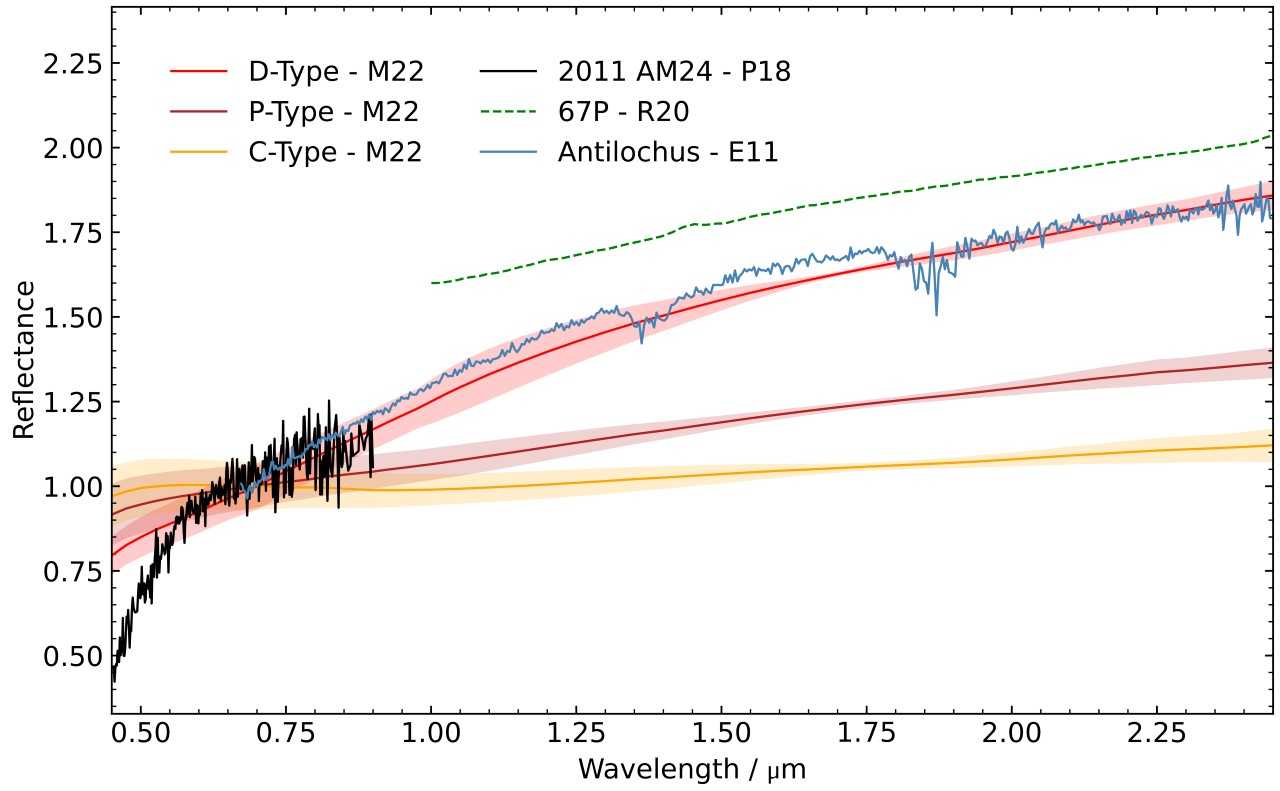
To achieve the scientific objectives of PRIAMOS, we seek a suitable D-type target in near-Earth space. D-type asteroids are primarily classified by two key criteria [2]: (i) their spectral slope in the visible part of the spectrum is featureless with a steep red component and a possible convex shape longward of 1.5 μm (refer to Fig. 1), and (ii) a low albedo (average of 0.06). Because spectra are only available for a small subset of asteroids, the classification is often based on photometry, which has a larger uncertainty given the lower spectral resolution. It is important to note that the certainty of any classification depends critically on the quality of the data used. Therefore, the ultimate classification should be done using spectra, as is the case for our baseline target.

The procedure to identify our baseline target 2011 AM24 was as follows. Out of the almost 40,000 known NEAs we selected all asteroids that have at some point been classified as a D-type, regardless of the classification scheme and underlying observational method. There are 44 NEAs that satisfy this condition. All of these candidates were then evaluated for the reachability and return trajectories. Based on this mission analysis, we have selected 2011 AM24, the target with the most favourable orbital transfers (including a backup launch window with an identical return date to Earth) and physical properties, including a diameter of ~500 m , comparable to the previous targets of sample return missions (~530x300 m for Itokawa, ~550 m for Bennu, ~1 km for Ryugu), and low albedo of 0.045, which is comparable to cometary nuclei.

We will present the known properties of the PRIAMOS baseline target and the associated reachability. Additionally, we will present the possibilities to further characterise the target in the future.

Figure 1: The spectrum of 2011 AM24 (from P18 - [3]) in comparison to the class templates of D-, P-, and C-types (from M22 - [1]) and the spectra of 67P (from R20 - [4]) and Jupiter Trojan (1583) Antilochus (from E11 - [5]).

References
1.    Kleine T., Marschall R., Martin, H. and the PRIAMOS team, EPSC-DPS2025, 2025, 1500
2.    Mahlke M., Carry B., Mattei P.-A., A&A, 2026, 665, A26.
3.  Perna D., Barucci M. A., Fulchignoni M., et al., PSS, 2018, 157, 82-95
4.  Raponi A., Ciarniello M., Capaccioni F., et al., NatAst, 2020, 4, 500-505
5.  Emery J., Burr D. M., Cruikshank D. P., AJ, 2011, 141, 25

How to cite: Mahlke, M., Carry, B., Marschall, R., Hallmann, M., Kleine, T., and Stenzel, O.: Identification of the PRIAMOS sample-return target for ESA’s M8 mission, Europlanet Science Congress 2026, The Hague, The Netherlands, 7–11 Sep 2026, EPSC2026-482, https://doi.org/10.5194/epsc2026-482, 2026.

Orals FRI2: Fri, 11 Sep, 11:00–12:24 | Room Sun (Amare Studio)

Chairperson: Yurii Kruhlyi
11:00–11:12
|
EPSC2026-686
|
On-site presentation
Nicolas Crouzet, Inga Kamp, Bernhard R. Brandl, Gijs Verdoes Kleijn, Nik Martindale, Sandor Kruk, Thomas Müller, and Thomas Henning

Asteroids are remnants of the early Solar System and are possible reservoirs of organic compounds that can be delivered to planets. Besides, collisions with asteroids can alter the evolution of planets and their moons and pose a threat to life on Earth. We will present our project on detecting and characterising asteroids via their thermal emission using the JWST Mid-Infrared Instrument (MIRI) in the context of Solar System science and planetary defence. JWST MIRI opened up a new window to detect small and cool asteroids by observing at mid-infrared wavelengths (5 - 28 micron) with unprecedented sensitivity. After four years in operation, a wealth of archival MIRI imaging data is available for mining. As a first step, we focused on the images acquired via the MIRI Mid-INfrared Disk Survey (MINDS) which is part of the MIRI European Consortium Guaranteed Time Observation program. We detected 18 asteroids in this data set. Most of them were unknown, and these are fainter and smaller than the known ones. We will present our method to search for asteroids, show the results obtained so far, and describe our plan to extend it to the whole MIRI archive. One component will be to develop a citizen science project to identify asteroids. This search is complementary to those conducted at visible and near-infrared wavelengths with facilities such as VST/OmegaCAM, HST, Euclid, and LSST: their combination helps build the spectral energy distribution of asteroids which constrain their temperatures, sizes, and surface properties. Overall, this study will help understand the physical properties of asteroids, their role in the formation of the Solar System and of planetary systems in general, and will contribute to assessing the risk of future collisions with Earth.

How to cite: Crouzet, N., Kamp, I., Brandl, B. R., Verdoes Kleijn, G., Martindale, N., Kruk, S., Müller, T., and Henning, T.: Detection of new asteroids with JWST MIRI: Solar System science and planetary defence, Europlanet Science Congress 2026, The Hague, The Netherlands, 7–11 Sep 2026, EPSC2026-686, https://doi.org/10.5194/epsc2026-686, 2026.

11:12–11:24
|
EPSC2026-797
|
ECP
|
On-site presentation
Max Mahlke, Yoonsoo P. Bach, Carey M. Lisse, Masateru Ishiguro, Seungwon Choi, Jooyeon Geem, Sunho Jin, Hangbin Jo, and Bumhoo Lim

Launched in March 2025, NASA’s SPHEREx mission is currently conducting the first all-sky near-infrared spectral survey at wavelengths between 0.75μm and 5μm.  Over its two-year nominal mission, SPHEREx acquires a spectrum for every 6.2” x 6.2” pixel on the sky, a transformative dataset for its primary science drivers in cosmology, galaxy formation, and interstellar ices [1]. However, this survey also provides an unprecedented opportunity for Solar System science, as exemplified by the recent SPHEREx discovery of a CO2 atmosphere around the interstellar comet 3I/ATLAS [2]. This presentation details the ongoing efforts of the SPHEREx Solar System Object Catalogue (SSOC) External Collaboration (XC) to extract, calibrate, and categorise these spectra, with a focus on the first-year asteroid results.

The scientific significance of the SPHEREx dataset for minor bodies lies in its unique spectral coverage. While previous large-scale taxonomic efforts have focused on silicaceous compositions discernible in ground-based observations between 0.45μm and 2.45μm [3, 4], SPHEREx provides a critical window into the presence of volatiles, organics, and hydrated minerals identified at wavelengths beyond 2.45 μm (e.g. [5]). The sheer volume of high-quality spectra generated by this mission allows for a statistically robust ensemble analysis of the Main Belt and beyond, transitioning from individual case studies toward a holistic characterisation of the Solar System’s compositional landscape [6].

Now, after more than one year of active operations and data processing, the SSOC XC presents a comprehensive status update. We showcase the first intermediate spectra derived from the mission pipeline, spanning diverse taxonomic classes including C-, S-, and M-complex asteroids. Extracting high-fidelity spectra for moving targets from a scanning mission presents unique data-reduction challenges; we discuss our solutions for these issues and address the remaining systematics currently present in the spectral products. Finally, we provide a timeline for the public release of the initial Solar System Object Catalogue.  This work represents a major milestone in planetary astronomy, providing a rich, uniform spectral library that will serve as a cornerstone for Solar System studies for decades to come.

How to cite: Mahlke, M., Bach, Y. P., Lisse, C. M., Ishiguro, M., Choi, S., Geem, J., Jin, S., Jo, H., and Lim, B.: Beyond the 2.45 micron Barrier: The SPHEREx Year 1 Census of Asteroid Spectral Diversity, Europlanet Science Congress 2026, The Hague, The Netherlands, 7–11 Sep 2026, EPSC2026-797, https://doi.org/10.5194/epsc2026-797, 2026.

11:24–11:36
|
EPSC2026-509
|
ECP
|
On-site presentation
Sara Marques and Oliver Jennrich
Near-Earth asteroids (NEAs) follow heliocentric trajectories similar to Earth's, yet despite their proximity this population remains poorly characterised, particularly with respect to physical properties such as mass. We present a novel approach to  characterising this population using the Laser Interferometer Space Antenna (LISA), the European Space Agency's upcoming gravitational-wave observatory.
 
LISA's measurement principle relies on high-precision interferometry to detect picometer-level variations induced by passing gravitational waves in the inter-spacecraft distances. This extreme sensitivity also renders LISA susceptible to more conventional gravitational perturbations, including the pull exerted by asteroids passing close to one of its spacecraft. While such signatures could be regarded as a noise source that degrades the gravitational-wave signal, they equivalently offer an opportunity to detect and characterize the perturbing bodies themselves.
 
We present the first systematic assessment of the signals produced by asteroid encounters with LISA and the resulting parameter resolution. Our results demonstrate that LISA can detect and characterize NEAs, provided the object passes sufficiently close to a spacecraft. The mass accuracies achievable from a single encounter are unmatched by any current observational technique, except dedicated probes that orbit the asteroid for an extended period. Furthermore, the method is largely insensitive to the observational biases that affect ground-based surveys, thereby improving access to the intrinsic properties of the population. The localization accuracies obtained within our framework further translate into a preliminary orbit determination and a constrained sky region, enabling targeted follow-up observations by other facilities.

How to cite: Marques, S. and Jennrich, O.: A novel method for characterising near-Earth asteroids with LISA, Europlanet Science Congress 2026, The Hague, The Netherlands, 7–11 Sep 2026, EPSC2026-509, https://doi.org/10.5194/epsc2026-509, 2026.

11:36–11:48
|
EPSC2026-425
|
On-site presentation
Josef Ďurech and Josef Hanuš

Asteroid photometry collected from large sky surveys provides valuable information about the spin and shape of these celestial bodies. This information can be uniquely extracted using light-curve inversion methods, provided there are enough accurate photometric measurements for each asteroid. In our study, we utilized photometric data from several surveys, including Catalina, Mt. Lemmon, Pan-STARRS 1 and 2, ZTF, Gaia DR3, ATLAS, and ASAS-SN. By applying light-curve inversion, we derived sidereal rotation periods, spin-axis directions, phase curves, colors, and convex shape models for approximately 40,000 asteroids. The majority of this sample consists of main-belt asteroids, revealing a complex relationship between the distribution of their spins and shapes and various physical and dynamical properties.

How to cite: Ďurech, J. and Hanuš, J.: Mapping the distribution of asteroid spin and shape properties by inversion of their photometry from surveys, Europlanet Science Congress 2026, The Hague, The Netherlands, 7–11 Sep 2026, EPSC2026-425, https://doi.org/10.5194/epsc2026-425, 2026.

11:48–12:00
|
EPSC2026-575
|
On-site presentation
Ivan Slyusarev, Olexandr Khromiuk, and Katerina Solovian

Space weathering is one of the key processes controlling the spectral evolution of airless bodies in the Solar System. Laboratory experiments, lunar sample studies, and spacecraft missions demonstrated that solar-wind and cosmic rays’ irradiation and micrometeoroid bombardment progressively alter the optical properties of the regolith, leading to variations in spectral slope, overall darkening, and attenuation of diagnostic absorption bands. [1,4,6,7,16]. These effects are especially significant for asteroid research, as they influence both the interpretation of taxonomic classes and the correspondence between asteroid spectra and meteorite samples. Asteroid families provide a natural laboratory for investigating the long-term evolution of space weathering because the members of one family share a common origin, similar composition, and comparable age [13,14].

Methodology

In this work we investigate manifestations of space weathering among asteroid families of different taxonomic types using large photometric surveys. The analysis is based on 24 asteroid families, including S-type families (Agnia, Barcelona, Eunomia, Gefion, Iannini, Karin, Koronis, Maria, Massalia, Merxia, and Rafita) and C-type families (Adeona, Astrid, Dora, Erigone, Euphrosyne, Hoffmeister, Hygiea, Misa, Naema, Nemesis, Themis, Ursula, and Veritas) and V-type Vesta family. Photometric data were taken from the SDSS MOC4 catalog together with the new reprocessed SDSS data [16], calculated from Gaia DR3 spectra [5], and SkyMapper catalogs [17]. The use of several independent surveys allowed us to compare the consistency of color trends and reduce systematic effects.

To estimate family ages we applied the V-shape method in the space of proper semimajor axis versus absolute magnitude (a–H) [2,13]. The V-shape boundaries were fitted for each family individually, taking into account the Yarkovsky-driven spreading of fragments [2]. Family ages were calculated using semiempirical relations based on the V-shape width, geometric albedo from WISE [12], and mean density values for different taxonomic classes from Carry [3]. The obtained ages range from several Myr for young families such as Iannini and Karin to more than 1 Gyr for evolved families such as Koronis and Maria.

The main indicator of space weathering in this study is the photometric parameter a*, originally introduced for SDSS asteroid taxonomy [8]. This parameter is sensitive to the spectral slope and therefore can be used as a proxy for spectral reddening. For each family we cross-matched all available members with the four photometric catalogs and calculated mean color indices and a* values. Additional filtering based on geometric albedo and color distribution was applied to remove interlopers and improve taxonomic homogeneity. The SDSS and SkyMapper surveys also provide an opportunity to analyze the behavior of color indices in the near-ultraviolet region. In particular, the u − g and u − v color indices from these two surveys were used after excluding measurements with large errors. In addition, correlations between the color indices and the sizes of asteroids were investigated for the selected families.


Results

Our analysis reveals a clear correlation between the a* parameter and the logarithm of family age for S-type asteroid families. The observed trend shows rapid reddening during the first several hundred Myr, followed by a slower phase of spectral evolution. Such behavior is consistent with earlier SDSS-based studies of asteroid space weathering [10, 13] and with laboratory simulations of irradiated silicate materials [9, 15]. The trend is reproduced independently in all four photometric catalogs, indicating that the observed effect is robust.

In contrast, C-type asteroid families demonstrate a different evolutionary behavior: average a* parameter decreases with increasing age. The correlation is weaker than for S-type objects, but the same tendency appears in all analyzed datasets. Unlike silicate-rich S-type asteroids, carbonaceous surfaces may experience slower or compositionally different weathering processes [11].

Another evolutionary effect observed in asteroid families is the change of the lightcurve amplitudes with age. Most asteroid families display amplitude distributions peaking at 0.25–0.35 mag, with preferred rotation periods concentrated near 5, 10, and 15 h. A weak negative correlation was found between mean lightcurve amplitude and family age. Several young families exhibit significantly larger amplitudes than families of comparable age.

Conclusions
The obtained results confirm that broad-band photometric surveys can be successfully used to study long-term spectral evolution of asteroid surfaces. The combination of V-shape dating and photometric indicators provides an efficient approach for investigating space weathering in large asteroid populations. The different behavior observed for S- and C-type families demonstrates that the mechanisms and timescales of space weathering are taxonomically dependent and should be considered separately in models of asteroid surface evolution.

References

1. Binzel, R. P., Morbidelli, A., Merouane, S., et al. (2010). Nature, 463, 331–334.

2. Bolin, B. T., Delbo, M., Morbidelli, A., & Walsh, K. J. (2017). Icarus, 282, 290–312.

3. Carry, B. (2012). Planetary and Space Science, 73, 98–118.

4. Chapman, C. R. (2004). Annual Review of Earth and Planetary Sciences, 32, 539–567.

5. Galluccio, L., Delbo, M., De Angeli, F., et al. (2023). Astronomy & Astrophysics, 674, A35.

6. Hapke, B. (2001). Journal of Geophysical Research: Planets, 106, 10039–10073.

7. Hapke, B. (2002). In Asteroids III, 183–193.

8. Ivezić, Ž., et al. (2001). Astronomical Journal, 122, 2749.

9. Jaramillo-Correa, C., Pearson, N. C., Domingue, D., et al. (2024). The Planetary Science Journal, 5, 100.

10. Jedicke, R., et al. (2004). Nature, 429, 275–277.

11. Lantz, C., Clark, B. E., Barucci, M. A., & Lauretta, D. S. (2013). Astronomy & Astrophysics, 554, A138.

12. Masiero, J. R., et al. (2011). Astronomical Journal, 741, 68.

13. Nesvorný, D., et al. (2005). Icarus, 173, 132–152.

14. Nesvorný, D., Brož, M., & Carruba, V. (2015). In Asteroids IV, 297–321.

15. Noble, S. K., Pieters, C. M., & Keller, L. P. (2007). Icarus, 192, 629–642.

16. Sergeyev, S., & Carry, B. (2021). Astronomy & Astrophysics, 652, A59.

17. Sergeyev, S., et al. (2022). Astronomy & Astrophysics, 658, A109.

How to cite: Slyusarev, I., Khromiuk, O., and Solovian, K.: Space Weathering Signatures in Asteroid Families of Different Taxonomic Types, Europlanet Science Congress 2026, The Hague, The Netherlands, 7–11 Sep 2026, EPSC2026-575, https://doi.org/10.5194/epsc2026-575, 2026.

12:00–12:12
|
EPSC2026-255
|
On-site presentation
Louis Malbranque, Cateline Lantz, Rosario Brunetto, Kohei Kitazato, Zahia Djouadi, Philippe Benoit-Lamaitrie, Alice Aléon-Toppani, Jérôme Bourçois, Orlène Kinsumuna, Obadias Mivumbi, Rei Kanemaru, Masanao Abe, and Takahiro Iwata

Introduction

The presence of hydroxyl groups on the lunar soil has been reported by four spacecrafts since 2009 [1-4]. Numerous experimental studies have demonstrated that OH bonds can form as a result of proton bombardment on various silicate samples (e.g. [5]). Here we present a new study on proton implantation on S-type asteroid analogs to support the Hayabusa2 mission extent (also called Hayabusa2#) which will fly by asteroid (98943) Torifune in July 2026 [6]. The goal is to investigate whether the formation of OH bonds is a general process that can take place at the surface of most airless bodies, including S-type asteroids, or not. This could have major implications for Solar System history, particularly regarding the origin of water on Earth.


Methods

The samples used are a San Carlos olivine and three L-LL type ordinary chondrite meteorites (NWA 7985, Sahara 98222, Bensour), which appear to be good analogs for the surface of (98943) Torifune. The samples were crushed into powders (<45 µm) and pressed into pellets, then heated for 24 hours at 400°C under vacuum to remove most of adsorbed water.

The pellets were placed in the INGMAR vacuum chamber (IAS and IJCLab) [7], which allows monitoring the samples by the Near-InfraRed (0.8 - 5 µm) reflectance spectroscopy during ion implantation, as a simulation of solar wind proton implantation. The irradiation was conducted on the SIDONIE ion separator, part of the MOSAIC platform at IJCLab, under high vacuum (10-9 Torr). NIR spectra were acquired for each sample using a Fourier Transform spectrometer (Tensor37 Bruker, N2 purged) at five fluences: 3*1016, 6*1016, 1*1017, 2*1017, and 3*1017 H+/cm2. For comparison, we also recorded the spectrum of the unirradiated samples. The energy used was 20 keV per proton, except for the stage with the highest fluence, where it was 15 keV.


Results and discussion

All samples exhibit a broad absorption band around the 3 µm region, which is characteristic of H2O stretching vibrations. This suggests that the heating process did not completely remove these components and/or that the few minutes required to transfer the samples into the vacuum chamber may have been sufficient to reintroduce a fraction of atmospheric H2O in them. However, an increase in the band depth at ~2.8 µm is identified in all samples when the spectra of irradiated samples are ratioed to the spectrum of unirradiated samples. This feature is specific to the stretching vibrations of the OH group, which implies that OH bonds were formed during proton implantation and increased in number with increasing fluence. The maximum band depth is reached for Bensour LL-chondrite with a 3.5% increase relative to the unirradiated spectrum; however, the best spectra are obtained for the olivine sample, which exhibits the most significant relative band depths at all fluences below 3*1017 H+/cm2.

Some studies have reported a saturation limit where OH bonds can no longer form in the implantation layer [8]. At this point, the destruction of OH bonds is as efficient as their formation, and the band depth stabilizes, which is not observed in this study. This suggests that more OH bonds could form in samples exposed to higher fluence levels.

However, it is possible that the heavy ions in the solar wind break the OH bonds faster than they form, even though H+ accounts for ~95% of the ions in the solar wind.

The maximum fluence used in our study would correspond to an exposure time of approximately 1.5-3*107 years at 1 AU from the Sun, considering only protons at 15-20 keV. However, protons in the energy range 1-15 keV are orders of magnitude more abundant. Even considering a lower OH production yield and/or a less efficient detection (NIR photons penetrate much deeper than the penetration depth of solar wind ions), we expect these lower energy ions to contribute to the OH band depth, thus lowering significantly the corresponding timescale in space. For comparison, Nakauchi et al. estimated an exposure time of 102 years for a fluence of 3*1017 H+/cm2 [9].


Conclusion

According to our preliminary results, OH bonds can be formed on airless bodies, such as (98943) Torifune, by solar-wind proton implantation. Through secondary processes, hydroxyls could also rearrange into H2O molecules on the surface of these bodies [9]. If the depletion of OH bonds by heavy solar ions is weaker than its formation yield, Hayabusa2# could detect signatures of OH and/or H2O with the NIRS3 spectrometer during the flyby of (98943) Torifune in July 2026.


References

[1] Clark, R. N (2009). Science 326, 562–564

[2] Sunshine, J. M. et al. (2009). Science 326, 565–568

[3] Pieters, C. M. et al. (2009). Science 326, 568–572

[4] Simon, A. A. et al. (2019). Geophysical Research Letters 46, 6322–6326

[5] Ichimura, A. S. et al. (2012). Earth and Planetary Science Letters 345-348, 90-94

[6] Hirabayashi, M. et al. (2021). Advances in Space Research 68, 1533-1555

[7] Lantz, C. et al. (2017). Icarus 285, 43-57

[8] Schaible, M. J. & Baragiola, R. A. (2014). Journal of Geophysical Research: Planets 119, 2017-2028

[9] Nakauchi Y. et al. (2021). Icarus 355, 114-140

How to cite: Malbranque, L., Lantz, C., Brunetto, R., Kitazato, K., Djouadi, Z., Benoit-Lamaitrie, P., Aléon-Toppani, A., Bourçois, J., Kinsumuna, O., Mivumbi, O., Kanemaru, R., Abe, M., and Iwata, T.: Proton irradiation of olivine and meteorites pellets: an evidence of surface hydroxylation by space weathering on airless bodies, Europlanet Science Congress 2026, The Hague, The Netherlands, 7–11 Sep 2026, EPSC2026-255, https://doi.org/10.5194/epsc2026-255, 2026.

12:12–12:24
|
EPSC2026-532
|
ECP
|
On-site presentation
Maélie Coutelier, Andreas Nathues, Ranjan Sarkar, Martin Hoffmann, Jan Hendrik Pasckert, Nico Schmedemann, and Kurt Mengel

We present a comprehensive mineralogical and geological analysis of Ikapati crater and its surrounding terrain on Ceres using a cross-correlated dataset from the Dawn Framing Camera (FC) and the Visible and Infrared Spectrometer (VIR) onboard the DAWN spacecraft1. Beside standard analysis tools, we use modern AI techniques for our analyses.

Our spectral and geomorphological analysis reveals that Ikapati impacted the rim of a larger ancient crater. The smooth material associated with this older crater structure exhibit systematically reduced phyllosilicate signatures2. Spectra from these smooth materials - including Ikapati's floor - show shallower band depths at both 2.73 µm (OH) and 3.06 µm (NH₄⁺) compared to the surrounding background terrain (Fig.1). This depletion is regionally extensive across the ancient crater's floor, suggesting a significant early thermal alteration due to this impact.

However, an early thermal alteration does not agree with previous surface dating of the Ikapati area, as the smooth material was dated younger than the ejecta blanket of Ikapati3,4. If that hypothesis is confirmed, this could be possibly explained by the fact that 1: Ikapati also altered thermally the area, and 2: the ejecta blanket of Ikapati is really thin, therefore does not erase older impact craters. Thus its age could eventually be overestimated and actually comparable to that of the smooth material bearing terrains. In addition, further processes can also create biases in crater counting, like including features not recognized as pits or secondary impacts, differences of the measured crater diameter due to target property effects5, mass wasting, and flows.

Small, bright impact craters pepper substantial areas of the smooth material, especially on the floor of Ikapati and west of Ikapati’s crater rim. These bright deposits showed absorption features at 3.4 µm and 4.0 µm, diagnostic for the presence of sodium carbonate (natron) and calcium-magnesium carbonate (dolomite/calcite). This indicates that locally, beneath the smooth mateial, there seems to be a bright carbonate layer that could have formed by ascended brines that did not reach the surface.

Figure 1: Left: FC false color moaic (R:0.965 µm , G: 0.749 µm , B: 0.738 µm ). Right: NH4 band depth overlayed on the FC clear filter mosaic.

A distinctive degradation (notch) of the western crater rim, which is surrounded by dark material (DM), suggests that the notch and the associated DM could have originated from a low-velocity impact that conserved some of the projectile material. This impact potentially led to material flows on both sides of the rim, forming melt ponds which then solidified.

Furthermore, cross-correlated analysis also has been employed to identify yellow Bright Material (yBM) units within the Ikapati region. Its spectrum exhibits a distinctive signature: while the 2.73 µm OH band depth remains shallow (0.15-0.25), the 3.06 µm NH₄⁺ absorption is prominent. The decoupling of OH and NH₄⁺ signatures indicates that yBM could be a distinct alteration product where ammonium has been preserved despite OH depletion through thermal processing. Alternatively, ascending ammonium-rich brines may have led later on to a successive increase in ammonium6.

The regional depletion of smooth material units suggests widespread alteration or dehydration of the older crater system, while the excavation of carbonates indicates a local salt-rich subsurface layer. If not pretended by late ammonization, this potential preservation of NH₄⁺ in yBM despite OH depletion has implications for the stability of ammoniated phases and the chemical evolution of Ceres' near-surface environment. This multi-unit mineralogical diversity supports models of brine-driven cryovolcanic activity, impact-driven resurfacing, and complex aqueous alteration histories on Ceres.

Aknowledgments

The authors would like to thank the DLR-Agency and the MPS for their financial support for this project.

References

1.    Russell, C. T. & Raymond, C. A. The Dawn Mission to Vesta and Ceres. Space Sci Rev 163, 3–23 (2011).
2.    Raponi, A. et al. Mineralogical mapping of Coniraya quadrangle of the dwarf planet Ceres. Icarus 318, 99–110 (2019).
3.    Pasckert, J. H. et al. Geologic mapping of the Ac-2 Coniraya quadrangle of Ceres from NASA’s Dawn mission: Implications for a heterogeneously composed crust. Icarus 316, 28–45 (2018).
4.    Schmedemann, N. et al. Timing of optical maturation of recently exposed material on Ceres. Geophysical Research Letters 43, 11,987-11,993 (2016).
5.    van der Bogert, C. H. et al. Origin of discrepancies between crater size-frequency distributions of coeval lunar geologic units via target property contrasts. Icarus 298, 49–63 (2017).
6.    Nathues, A. et al. Consus Crater on Ceres: Ammonium-Enriched Brines in Exchange With Phyllosilicates? Journal of Geophysical Research: Planets 129, e2023JE008150 (2024).


How to cite: Coutelier, M., Nathues, A., Sarkar, R., Hoffmann, M., Pasckert, J. H., Schmedemann, N., and Mengel, K.: In deep analysis of Ikapati Crater on Ceres, Europlanet Science Congress 2026, The Hague, The Netherlands, 7–11 Sep 2026, EPSC2026-532, https://doi.org/10.5194/epsc2026-532, 2026.

Posters: Thu, 10 Sep, 18:00–19:30 | Foyer 3

Display time: Thu, 10 Sep, 08:30–19:30
F3.76
|
EPSC2026-189
|
On-site presentation
Andreas Nathues, Maelie Coutelier, Martin Hoffmann, Jan Hendrik Pasckert, Ranjan Sarkar, and Nico Schmedemann

Ceres, the largest object in the main asteroid belt (940 km in diameter), is a survivor of the earliest period of Solar System formation. It orbits the Sun at a mean distance of approximately 2.8 AU. Information about its interior provides essential insights into the formation and evolution of volatile-rich planetary embryos that originated within the protoplanetary disc. From 2015 to 2018, NASA’s Dawn spacecraft collected data in orbit around Ceres [1, 2], returning a wealth of imaging information obtained by the Framing Camera (FC) [3] and the Visible and Infrared Spectrometer (VIR) [4].    

Although the equatorial to mid-latitude regions of Ceres have been extensively mapped and analysed, the polar latitudes (> ±60°) have received comparatively little investigation, primarily due to the suboptimal quality of the returned imaging data, which is a consequence of the challenging illumination conditions. Notably, the south pole was poorly illuminated during the prime mission, a period in which most of the global high-res imaging data were collected.

However, following some improvements in the mosaicking of polar FC imagery in clear (Fig. 1) and colour filters, the analysis of certain sufficiently illuminated surface areas became possible. Contrary to our initial expectations, the south pole region has been found to show a number of distinctive colour lithologies that are also present at lower latitudes. It is noteworthy that the colour of the polar background material often deviates from the global average of Ceres, exhibiting an increased spectral redness. The spectral appearance of the polar lithologies is influenced by this redder background material due to the occurrence of mixing. Also, a dependence on the longitudes of their distribution indicates specific contexts of origin.

Fig. 1: Clear filter mosaic of Ceres' south pole from LAMO orbit (resolution about 35 m/pix.).

[1] Russell, C.T., Raymond, C.A. The Dawn Mission to Vesta and Ceres. Space Sci Rev 163, 3–23 (2011). https://doi.org/10.1007/s11214-011-9836-2

[2] Russell, C.T. et al. Dawn arrives at Ceres: Exploration of a small, volatile-rich world. Science 353, 6303, 1008–1010 (2016). https://doi.org/10.1126/science.aaf4219

[3] Sierks, H. et al. The Dawn Framing Camera in: The Dawn Mission to Minor Planets 4 Vesta and 1 Ceres. Springer, 263–327 (2011). https://link.springer.com/content/pdf/10.1007%2F978-1-4614-4903-4_2.pdf (book)

[4] De Sanctis, M. C. et al. The VIR Spectrometer. Space Sci Rev 163, 329–369 (2011). https://doi.org/10.1007/s11214-010-9668-5

How to cite: Nathues, A., Coutelier, M., Hoffmann, M., Pasckert, J. H., Sarkar, R., and Schmedemann, N.: Colour lithologies of Ceres' south pole, Europlanet Science Congress 2026, The Hague, The Netherlands, 7–11 Sep 2026, EPSC2026-189, https://doi.org/10.5194/epsc2026-189, 2026.

F3.77
|
EPSC2026-315
|
On-site presentation
Ruoyu Zhai and Yunzhao Wu

The Didymos binary asteroid system is a key target for planetary-defense science. Its satellite Dimorphos was impacted by NASA Double Asteroid Redirection Test (DART) mission, and the system will be further investigated by ESA Hera mission. Although Didymos is generally recognized as an S-type asteroid with ordinary-chondrite-like spectral characteristics (de León et al. 2010), its specific meteorite analog and the physical cause of the spectral changes observed after the DART impact remain debated.

Here we investigate the mineralogical composition, meteorite analog, and surface evolution of the Didymos system using visible and near-infrared reflectance spectra. We analyzed seven spectra of the Didymos system obtained around the DART impact, from the night before impact to several nights after impact (Polishook et al. 2023). To ensure internal consistency in the spectral interpretation, we compiled an expanded dataset of ordinary chondrite spectra with corresponding mineralogical measurements and established new calibration equations linking band parameters to olivine abundance, fayalite content, and ferrosilite content. These calibrations were then applied to the Didymos spectra after band-parameter analysis.

The derived mineralogical parameters indicate that Didymos is most consistent with L ordinary chondrites, with a preference for highly metamorphosed type 6 material. An LL-chondrite interpretation is less likely, although it cannot be completely excluded. This suggests that the Didymos system may have originated from the highly thermally metamorphosed inner region of an L-chondrite parent body.

We further used ratio spectra to distinguish between the effects of space weathering and grain size on ordinary-chondrite-like surfaces. Laboratory meteorite spectra show that, for H and L chondrites, grain-size variations commonly produce diagnostic deviations near the 1 and 2μm absorption bands when ratio spectra are compared with a space-weathering function. In contrast, the ratio spectra of the Didymos system are well described by a space-weathering trend and do not show the characteristic absorption-band-related features expected for dominant grain-size effects. Therefore, the spectral changes observed after the DART impact are most likely controlled by differences in space-weathering state, rather than by grain size or compositional heterogeneity.

Finally, we estimate a surface exposure age of approximately 0.39 Myr for Didymos from the degree of spectral weathering. This age is consistent with the reported surface crater retention age of Dimorphos, supporting the interpretation that Didymos and Dimorphos are compositionally homogeneous and that the binary system formed through rotational fission. These results provide new spectral evidence for the origin and evolution of the Didymos system and demonstrate that meteorite analog identification is essential for interpreting asteroid spectral changes caused by impact events.

References

de León, J., Licandro, J., Serra-Ricart, M., Pinilla-Alonso, N., & Campins, H. (2010). Observations, compositional, and physical characterization of near-Earth and Mars-crosser asteroids from a spectroscopic survey. Astronomy & Astrophysics, 517, A23.

Polishook, D., DeMeo, F. E., Burt, B. J., Thomas, C. A., Rivkin, A. S., Sanchez, J. A., & Reddy, V. (2023). Near-IR spectral observations of the Didymos system: daily evolution before and after the DART impact indicates that Dimorphos originated from Didymos. The Planetary Science Journal, 4(12), 229.

How to cite: Zhai, R. and Wu, Y.: Meteorite analogs of the Didymos binary asteroid system and implications for its origin, Europlanet Science Congress 2026, The Hague, The Netherlands, 7–11 Sep 2026, EPSC2026-315, https://doi.org/10.5194/epsc2026-315, 2026.

F3.78
|
EPSC2026-622
|
ECP
|
On-site presentation
Danylo Yerokhin and Ivan Slyusarev

Primitive asteroids are of particular interest for studies of the origin and early evolution of the Solar System, since their composition is believed to preserve, to a large extent, the primordial material of the protoplanetary disk that has undergone only limited thermal and chemical processing. Such objects are usually assigned to carbonaceous taxonomic classes C, B, G, F and related subclasses, which are characterized by low geometric albedo (pV < 0.1) and relatively neutral or slightly red-sloped reflectance spectra in the visible range [1].

Interest in primitive taxonomic asteroid types increased significantly following the successful sample-return missions from primitive near-Earth asteroids. The Hayabusa2 mission to the C-type asteroid Ryugu and the OSIRIS-REx mission to the B-type asteroid Bennu provided direct evidence of the mineralogical and chemical composition of primitive bodies and revealed complex processes of aqueous alteration and space weathering on their surfaces. These missions demonstrated that primitive asteroids preserve material from the early Solar System and may contain organic compounds and hydrated minerals [2-4]. The returned samples also improved the interpretation of remote photometric and spectroscopic observations of low-albedo asteroids.

According to the analysis of physical properties of asteroid families by Masiero et al. [5], combined with the dynamical family catalog compiled by Nesvorný et al. [6], the main asteroid belt contains 122 dynamically identified asteroid families. Approximately 50 out of these 122 families are dominated by low-albedo (pV < 0.1) asteroids. Among the largest and most scientifically important low-albedo asteroid families are Themis, Hygiea and Pallas. These families are located primarily in the outer and middle main asteroid belt.

Data from infrared satellite surveys (IRAS, AKARI, WISE) and subsequent spectroscopic studies have shown that several primitive dynamical families contain asteroids with geometric albedos noticeably higher than the typical value (pV ≈ 0.1) [7-12].

Photometric observations of asteroids at different phase angles allow the investigation of their phase-brightness relations, which provide an important tool for determining absolute magnitudes and refining photometric estimates of geometric albedo [13-15].

Our study aims to improve the phase curves of such asteroids with unusually high albedo in the largest primitive families by integrating high-cadence TESS photometry with sparse photometry from ZTF survey. Failure to properly account for the rotational modulation of brightness increases the dispersion of the phase-curve data points and introduces systematic biases in the derived phase-function parameters. Neglecting this correction can significantly affect the resulting values of the absolute magnitude H, the HG/HG12 parameters, the linear phase coefficient β, and the amplitude of the opposition effect.

Systematic bias in the absolute magnitude H values propagates directly into errors in the derived visual geometric albedo [16].

To address this issue, we introduce a method that constructs rotational lightcurve using data from the Transiting Exoplanet Survey Satellite (TESS). We validate the rotation period by eliminating alias solutions, confirming the expected double-peaked light-curve morphology, and performing an independent robustness assessment using Phase Dispersion Minimization (PDM), alongside model selection based on the Bayesian Information Criterion (BIC). A strict geometric requirement of this approach is the alignment of the TESS-derived template with the precise opposition corresponding to the ZTF. We therefore partition the multi-filter survey data into distinct oppositional epochs. In addition, we require not only a broad temporal overlap between TESS and the ground-based surveys, but also that ZTF measurements occur strictly within the active TESS sector observing window. Ultimately, only single-opposition data are used.
Once a temporally consistent “TESS template - ZTF opposition” pair is established, we apply the rotational correction to the ZTF survey data. For all filters within a given opposition, we fit a universal phase shift tied to the object’s rotational epoch, whereas the amplitude scaling of the correction is determined separately for each specific photometric band. Finally, after outlier rejection, the data are binned with respect to α to produce robust, representative phase-curve points across the targeted phase-angle intervals.

To independently validate this framework, we acquired dedicated ground-based photometry. Spectrophotometric observations for the Themis family members (2560) Siegma and (7024) Impey were carried out with the 0.5-m D500WS telescope (Newtonian optical system). Images were obtained using a Moravian C4-16000 CCD camera in the SDSS photometric system with broadband filters g, r, i, z.

By combining the newly determined absolute magnitudes with diameters from WISE, we re-evaluated their geometric albedos. We also conducted a secondary consistency check utilizing the empirical correlation between the phase slope β and pV [13,15]. The updated pV estimates for (2560) Siegma settled into the 0.05-0.09 interval, which is completely standard for dark, primitive bodies. Similarly, the β-derived and photometric assessments for (7024) Impey point to a low albedo in the 0.04-0.06 range.

We used TESS light curves together with sparse ZTF photometry to study 78 members of the Themis, Hygiea, and Pallas families with anomalously high geometric albedos. Rotationally corrected phase curves and revised albedo estimates were successfully obtained for 22 targets.

The obtained results will be presented and discussed in detail at the conference.


References 

[1]    Mahlke, M., Carry, B., Mattei, P.-A., 2022. A&A. 665, A26.
[2]    Yokoyama, T., et al., 2023. Science 379, eabn7850.
[3]    Nakamura, T., et al., 2023. Science 379, eabn8671.
[4]    Lauretta, D. S., et al., 2024. M&PS, 59, 2453-2486.
[5]    Masiero, J. R., et al., 2015. Asteroids IV, 323-340.
[6]    Nesvorný, D., Brož, M., Carruba, V., 2015. Asteroids IV, 297-321.
[7]    Masiero, J. R., et al., 2011. ApJ. 741, 68.
[8]    Usui, F., et al., 2011. PASJ. 63, 1117-1138.
[9]    Kasuga, T., et al., 2013. AJ. 146, 1.
[10]    De Prá, M. N., et al., 2020. A&A. 643, A102.
[11]    Tatsumi, E., et al., 2022. A&A. 664, A107.
[12]    Brown, M. E., Wong, I., Belyakov, M., 2025. PSJ, 6, 22.
[13]    Belskaya, I. N., Shevchenko, V. G., 2000. Icarus 147, 94-105.
[14]    Muinonen, K., et al., 2002. Asteroids III, 123-138.
[15]    Lupishko, D. F., Krugly, Yu. N., Shevchenko, V. G., 2007. Kinem. Fiz. Nebesn. Tel. 23(6), 323-336.

How to cite: Yerokhin, D. and Slyusarev, I.: Asteroids with Unusually High Albedo in Primitive Asteroid Families: Joint Analysis of TESS and Sparse ZTF Photometry, Europlanet Science Congress 2026, The Hague, The Netherlands, 7–11 Sep 2026, EPSC2026-622, https://doi.org/10.5194/epsc2026-622, 2026.