
 ,,
,,- Aerospace Engineering, Planetary exploration, Delft University of Technology, Delft, Netherlands (a.marzolini@tudelft.nl)
Ganymede is the primary target of ESA's JUpiter ICy moons Explorer (Juice), which will measure, among other quantities, the moon's gravity field, tidal response, and induced magnetic field with unprecedented precision [1]. These observations will substantially refine models of Ganymede's internal structure, with direct implications for the habitability of its subsurface ocean. However, individual geophysical observables suffer from inherent parameter degeneracies that no single measurement can resolve [2] [3]. We present a Bayesian framework that combines multiple geophysical datasets to constrain Ganymede's interior structure. First, we use currently available observations to retrieve an interior model consistent with existing measurements. Second, we incorporate the expected observations from Juice to investigate their contribution to improving these constraints.
We model Ganymede’s interior as a five-layer spherically symmetric body, consisting of a metallic core, a silicate mantle, a high-pressure ice layer, a liquid salty ocean and an ice shell, consistent with the moon’s total mass and radius. Ocean density and electrical conductivity are computed from phase diagrams as a function of MgSO4 concentration (wt%). To constrain the interior parameters, we consider multiple geophysical observables with complementary sensitivities: the moment of inertia (MoI), the magnetic induction amplitude, and the tidal Love numbers at diurnal frequency. We explore the posterior distributions of interior parameters using a Markov Chain Monte Carlo approach.
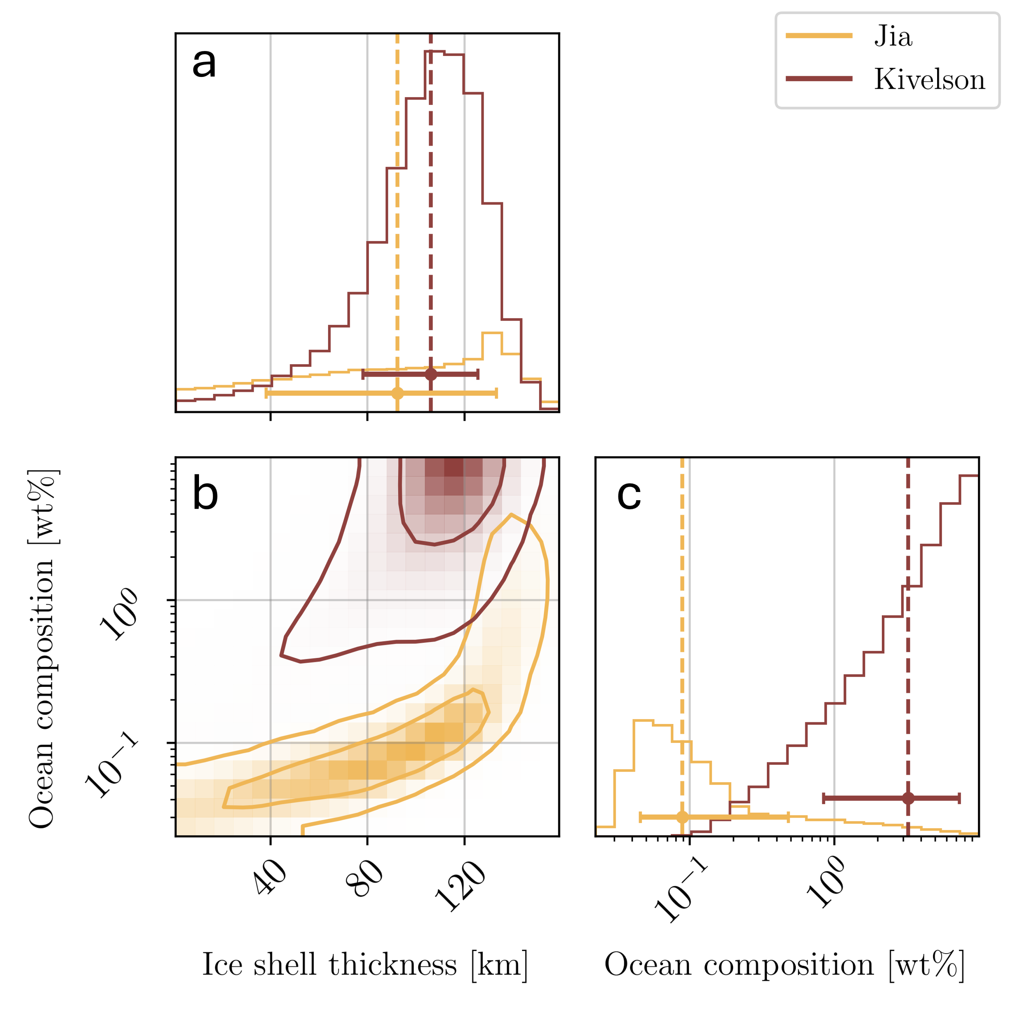
Figure 1: Posterior probability distributions of the hydrosphere parameters retrieved from two inversions with different estimates of the magnetic induction amplitude from [4] (Jia) and [5] (Kivelson). The vertical dashed lines indicate the 50th percentile, while the horizontal bars show the 1σ credible regions, defined from the 16th and 84th percentiles. The contour lines in (b) mark the 1σ and 2σ credible regions.
We first constrain the interior using currently available observations from the Galileo and Juno missions, namely the MoI and magnetic induction amplitude. For the latter, we consider both the estimate of 0.84±0.018 reported by [5] and the more recent estimate of 0.72±0.03 from [4]. The higher magnetic induction amplitude is consistent with high salinity oceans, while the more recent estimate favors low salinity oceans. In both cases, shell thickness and ocean salinity are strongly correlated, with the posterior distribution showing two families of high probability (Figure 1b): low-salinity oceans spanning a wide range of ice shell thicknesses, and thicker ice shells compatible with a broader range of ocean compositions. These results demonstrate that the inferred interior structure is sensitive to the adopted magnetic induction estimate.
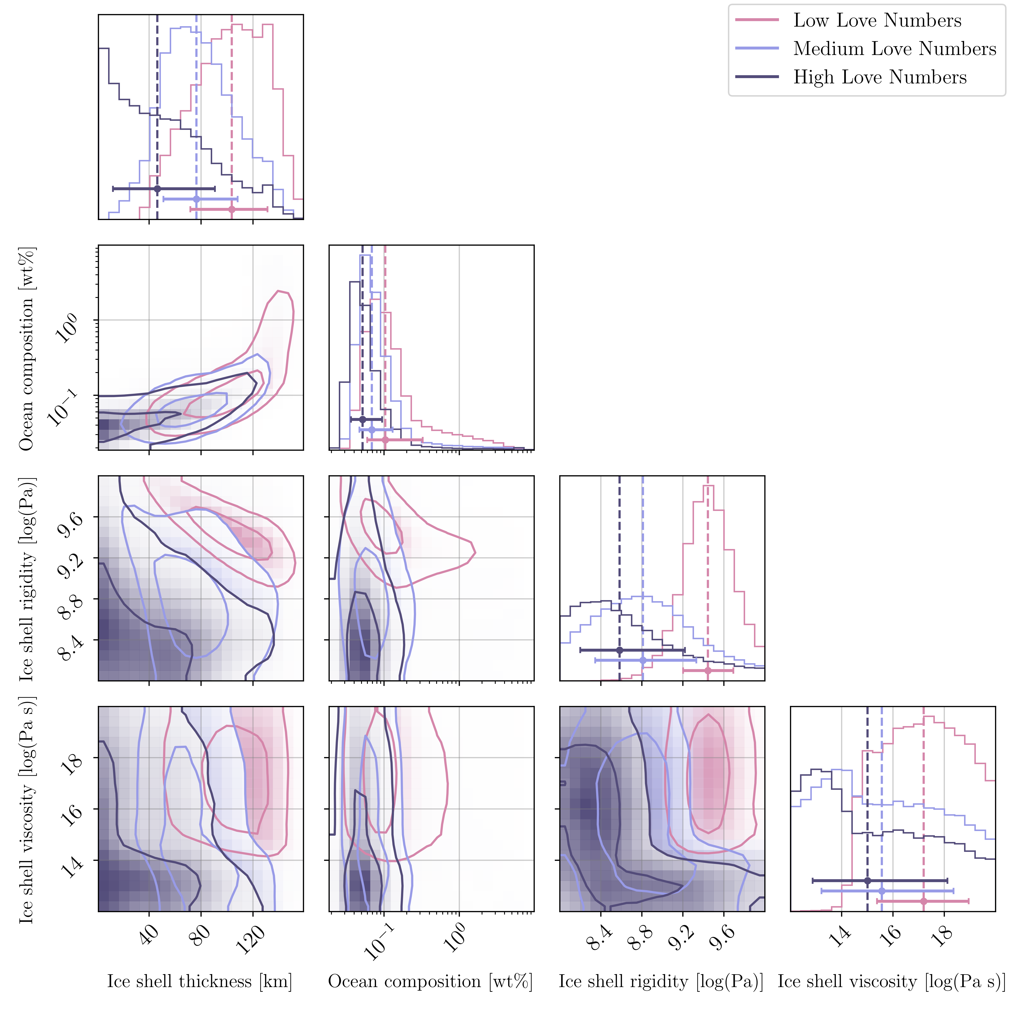
Figure 2: Posterior probability distributions of the hydrosphere parameters and mechanical properties for three inversions with different synthetic values of the real tidal Love number. Details are as in Figure 1.
We then assess the improvement of adding synthetic tidal Love number measurements to simulate future Juice observations. The Love number values span the range of tidal responses predicted by interior models that are consistent with the moon’s MoI and observed magnetic induction amplitude. The inclusion of k2 and h2 reduces the uncertainty in both ice shell thickness and ocean composition (Figure 2). The tidal response values strongly influence the preferred region of parameter space: lower real Love number values shift the posterior distributions toward thicker ice shells and more saline oceans. Measuring Ganymede’s tidal response will therefore help discriminate between models compatible with current observations. However, including tidal observations introduces new trade-offs between ice shell thickness and rigidity, which cannot be resolved by the real parts of Love numbers alone. Adding the imaginary part of k2, which is sensitive to the dissipative properties of the ice shell, was found to further constrain mechanical parameters and partially resolve these degeneracies.
These results demonstrate that a joint inversion is essential to fully exploit existing observations and the future Juice dataset. The Bayesian framework presented here is directly applicable to the analysis of future Juice measurements and can be extended to incorporate additional observables such as multi-frequency magnetic induction responses, libration amplitudes, and tidal tomography. More broadly, the methodology is transferable to other icy moons, such as Europa, targeted by Europa Clipper, providing a unified approach to interior characterization.
Bibliography
[1] T. Van Hoolst, et al. 2024. Space Sci. Rev., 10.1007/s11214-024-01085-y
[2] S. Kamata, et al. 2016. J. Geophys. Res. Planets, 10.1002/2016JE005071
[3] F. Petricca, et al. 2023. Geophys. Res. Lett., 10.1029/2023GL104016
[4] X. Jia, et al. 2024. J. Geophys. Res. Planets, 10.1029/2024JE008309
[5] M. G. Kivelson, et al. 2002. Icarus, 10.1006/icar.2002.6834
How to cite: Marzolini, A., Rovira-Navarro, M., van der Wal, W., and Filice, V.: Probing Ganymede's Interior Through Combined Geophysical Observations, Europlanet Science Congress 2026, The Hague, The Netherlands, 7–11 Sep 2026, EPSC2026-487, https://doi.org/10.5194/epsc2026-487, 2026.


