
 1,2,1,2,2,2,
- 1University of Padova, Geoscience Department, Italy (susanna.tonoian@phd.unipd.it)
- 2INAF-OAPD Astronomical Observatory of Padova, Italy
- 3Johns Hopkins University Applied Physics Laboratory, Laurel, MD 20723, USA
Introduction
Among the icy satellites of Uranus, Ariel is considered a candidate ocean world [1]. The available imagery of the surface by Voyager 2 covers less than 40% of its surface [2], from which mosaics and digital elevation models (DEM) were produced [3]. Spectral information of Ariel’s surface indicates a composition mainly of H2O, CO2, and CO ices [4], and an interpretation of James Webb Space Telescope (JWST) observations [5, 6] suggests the presence of nitrogen-bearing species. In addition, a geological map of the imaged region has been produced and digitized [7, 8] and later combined with relative and absolute age estimates for the youngest and oldest geological units [9]. These studies indicate that Ariel underwent extensive resurfacing not later than 3.0 Ga. Altogether, this makes Ariel a compelling target for investigating the origin and morphology of its extensional features. In this work, we estimated the geometrical parameters of the main chasmata to evaluate the extension of the visible area.
Data and Methods
We used DEMs, photomosaic, and the structural map based on Voyager 2 data [2,10] (Fig.1B). After conducting the structural analysis of the surface, we developed a pipeline to evaluate the geometrical parameters of the chasmata. The length distribution of features was studied to identify the spacing pattern [11]. The geometries of the biggest chasmata have been assessed to establish relationships between length and vertical displacement [12]. The vertical displacement was calculated from measurements of throw. Extension area (A) was calculated using the formula: A = L/tan(α) [13], where L is the length of a chasma and α is a dip angle (Fig.1A).
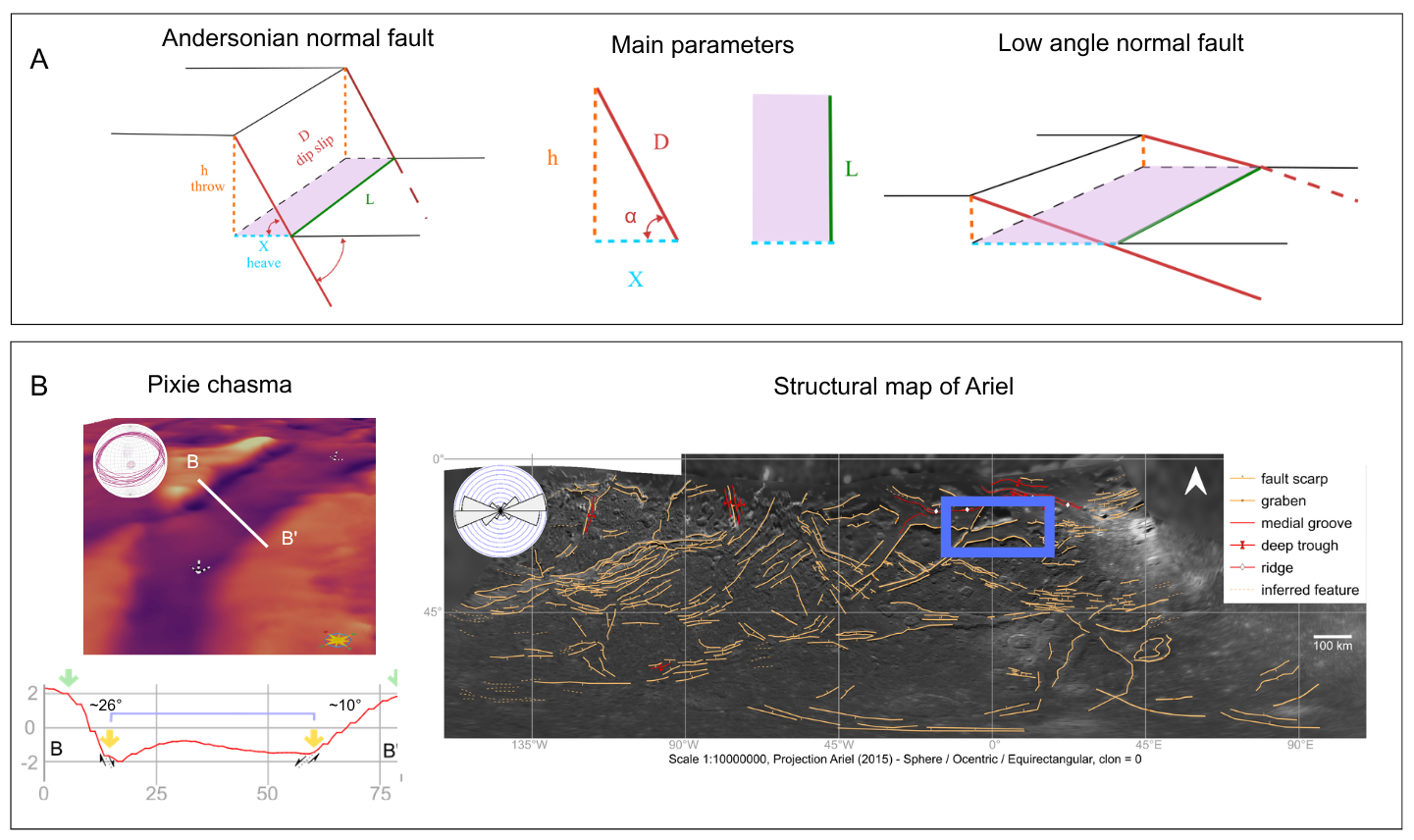
Figure 1. A. Schematic model of a normal fault with a dip angle of 60 degrees, illustrating the key geometrical parameters used for extension area estimation: h (throw), X (heave), L (length), D (vertical displacement), and dip angle (α). On the right side of panel A, an example of a normal fault with a low dip angle and its extension area is shown. B. Three-dimensional view of Pixie Chasma with a stereoplot of dip measurements obtained in VRGS[14], alongside a geological profile displaying average dip angles on each side. Yellow and green arrows indicate the marginal trough and chasma rim, respectively. The structural map of Ariel features a Rose diagram [15] indicating the orientations of structures. The blue rectangle marks the location of Pixie Chasma.
Discussion and future work
Dip angle estimations of the main chasmata reach 50 degrees at maximum and around 25 degrees on average, lower than the typical angle of 60 degrees for an Andersonian fault assumed before [16, 17]. Even though the interpretations of dip angle values should be taken cautiously because of the DEM medium quality, the low values of dip can significantly increase the amount of extension. Overall, these estimates suggest a sensibly higher radius change of the whole body connected to chasmata formation and development unless compensated by other processes. From a morphological point of view, the dip measurement could also be affected by slope deposits, which could have been overlooked due to poor resolution. New missions collecting high-resolution imagery will significantly improve the analysis.
Acknowledgements: This activity has been developed under the ASI/UniBo-CIRI agreement n. 2024-5-HH.0.
References:
[1] Castillo‐Rogez J. et al. (2023) J. Geophys. Res. Planets e2022JE007432. [2] Schenk P.M. and Moore J.M. (2020) Philos. Trans. R. Soc. A 20200102. [3] Beddingfield C.B. et al. (2025) Planet. Sci. J. 32. ad9d3f. [4] Cartwright R.J. et al. (2015) Icarus 257, 428-456. 2015.05.020. [5] Cartwright R.J. et al. (2020) Astrophys. J. Lett. L22. aba27f. [6] Cartwright R.J. et al. (2024) Astrophys. J. Lett. L29. [7] Croft S.K. and Soderblom L.A. (1991) Uranus 561-628. [8] Beddingfield C.B. and Cartwright R.J. (2021) Icarus 114583. [9] Kirchoff M.R. et al. (2022) Planet. Sci. J. 42. ac42d7. [10] Tonoian S. et al. (2025) EPSC-DPS2025-1554. 1554. [11] Soliva R. and Schultz R.A. (2008) Tectonics 27. 2007TC002148. [12] Schultz R.A. and Fossen H. (2002) J. Struct. Geol. 24, 1389-1411. S0191-8141(01)00146-8. [13] Golombek M.P. (1982) J. Geophys. Res. Solid Earth A77-A83. JB087iS01p00A77. [14] VRGeoscience Limited (2003) VRGS. Retrieved from: www.vrgeoscience.com. [15] Alberti M. et al. (2016) Rendiconti Online Soc. Geol. Ital. 39, 55-59. [16] Bergstralh J.T. et al. (1991) Uranus. [17] Watters T.R. and Schultz R.A. (2010) Planetary tectonics. Cambridge University Press.
How to cite: Tonoian, S., Lucchetti, A., Massironi, M., Penasa, L., Beddingfield, C., Pajola, M., Rossi, C., and Pozzobon, R.: Geometry of chasmata on Ariel’s surface and its implications, Europlanet Science Congress 2026, The Hague, The Netherlands, 7–11 Sep 2026, EPSC2026-490, https://doi.org/10.5194/epsc2026-490, 2026.


