
 ,,,,,,
- Institute for Space Astrophysics and Planetology, Roma, Italy (marjorie.galinier@inaf.it)
The Visual and Infrared Mapping Spectrometer (VIMS) onboard Cassini collected thousands of spatially resolved spectra of the surface of the five inner mid-sized moons of Saturn (Mimas, Enceladus, Tethys, Dione and Rhea) between 2004 and 2017 [1]. These moons are embedded in Saturn’s E-ring, generated by Enceladus’ plumes and containing water ice grains, either in pure form or contaminated by organics or salts [2]. The mid-sized moons are characterized by an icy surface affected by endogenous activity and exogenous processes, such as cratering events, UV irradiation, accumulation of E-ring particles, and weathering from the interaction with energetic particles [3]. Their surfaces are darkened by agents that could be the same over the whole Saturn system, yet there is no consensus to date on their exact nature [4]. To explain the observed reddening and darkening of Saturn’s inner moons, it has been suggested that their surfaces may be impacted by processed organic-rich E-ring grains, thought to get redder and darker upon irradiation at the moon’s surface, and during their travel from Enceladus to the moons [3]. In this study, we aim to test this hypothesis by performing radiative transfer modeling of Dione’s surface.
Exploiting the VIMS dataset and relying on previous works [1,5], we produced photometrically corrected maps of Dione, for the first time at full VIMS spectral coverage. We used a photometric correction method based on the Akimov theory [1] to independently convert all the VIMS-VIS and VIMS-IR spatially resolved spectra to the same illumination condition (incidence angle and phase angle of 30°, emission angle of 0°). Implementing new filtering steps, we cleaned the dataset from pixels with irregular photometric responses (saturated or partially-filled pixels), to improve the quality of the spectral maps. Then, using the produced filtered dataset of photometrically corrected spectra, we produced spectral maps of Dione by projecting each pixel and their corresponding spectrum on a cylindrical map of the moon’s surface, according to the pixel’s average position in latitude and longitude. We calculated the median spectrum of each tile of the map at each wavelength, using a sampling of 2 pixels per degree. Finally, we produced the full VIS-IR spectrum of each pixel at the surface of Dione, by bridging the VIS and IR spectra. Fig.1 shows the final spectral map obtained for Dione at a wavelength around 1047 nm.
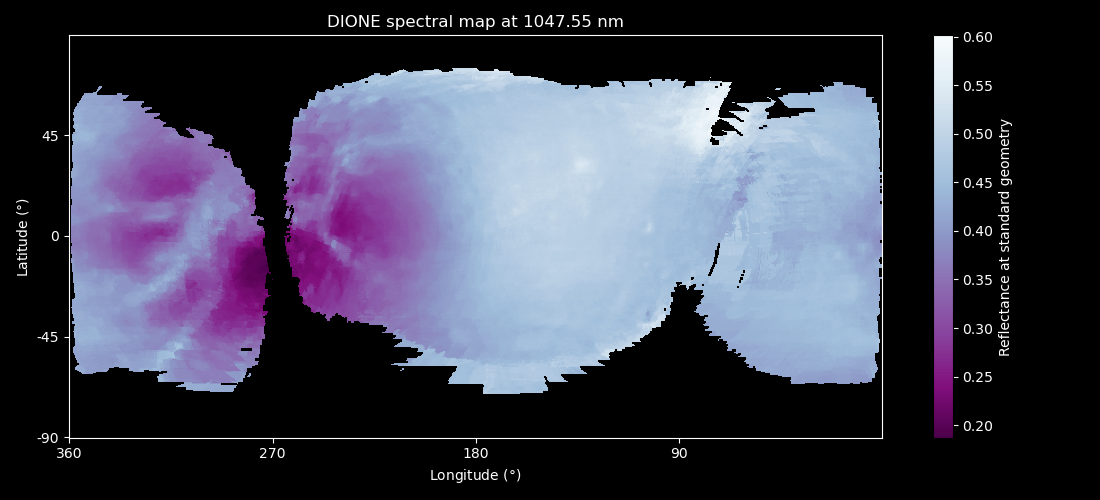
Fig.1: Spectral map of Dione at 1047.55 nm. The high albedo contrast between the leading and trailing hemispheres is well appreciated, as well as the presence of several craters, and bright faults across the moon’s trailing hemisphere (nicknamed ‘wispy terrains’).
To further characterize the moon’s surface and to derive estimates of the composition and physical properties of its different regions, we performed spectral unmixing by applying a well-tested simplified Hapke Isotropic Multiple Scattering Approximation (IMSA) model [5,6]. Such modeling is performed for the first time in a systematic way across the whole surface of Dione, so that the produced compositional maps can be used to better understand the surface distribution of the contaminants with respect to the processes altering Dione's surface. Hapke theory allows for the computation of the reflectance of a given mixture of components as a function of their optical constants. Dione is known to be covered in water ice of different grain sizes, affected by darkening agents. In our model, we assume tholins as the agents responsible for Dione’s surface reddening, as they are considered a good proxy of the organic residues produced by irradiation of icy surfaces [5]. Furthermore, we consider amorphous carbon as a neutral absorber responsible for the lowering of the surface albedo and the reduction of the depth and contrast of water ice absorption bands [5]. We thus considered four different populations of components: (i) large water ice grains (≥µm) mixed with tholins in an intra-particle mixture; (ii) sub-µm water ice grains; (iii) sub-µm amorphous carbon grains; and (iv) large water ice grains mixed with sub-µm amorphous carbon grains in an intra-particle mixture. The best fit of each pixel of the moon's map has been achieved using a Levenberg-Marquardt (LM) least squares algorithm. In order to sample the parameter space, we varied the grain sizes, abundance and fraction of contaminants in the water ice grains.
A resulting optical abundance map of Dione is shown in RGB colors in Fig.2. We can observe that tholins and carbon are both more abundant in the trailing hemisphere of the moon, while its leading hemisphere is coated in purer water ice. The competition between different exogenous processes such as E-ring particles deposition and cold plasma particles bombardment are currently under study, in order to assess the consistency of our results with the hypothesis tested in this work [3].
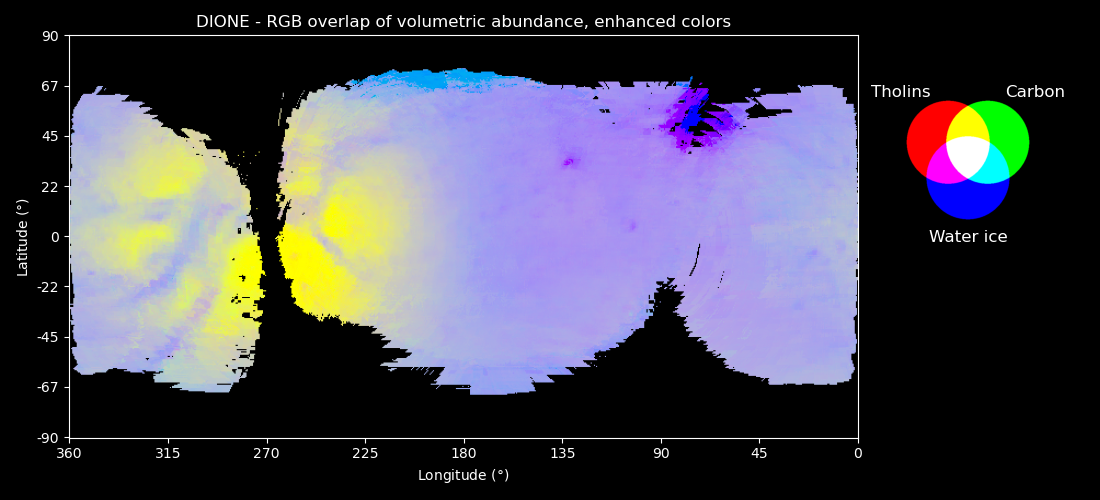
Fig.2: Dione RGB overlap of the volumetric abundance of water ice (blue), of tholins (red) and of amorphous carbon (green). The colours corresponding to the abundance of tholins and amorphous carbon have been boosted for a better visual representation.
[1] Filacchione, G., et al., Icarus 2022, 375.
[2] Postberg, F., et al., 2018. in Enceladus and the Icy Moons of Saturn, ed. P. M. Schenk, R. N. Clark, C. J. A. Howett, A. J. Verbiscer, & J. H. Waite, p.129
[3] Hendrix, A.R., et al., 2018. Icarus 300, 103-114
[4] Clark, R.N., et al., Icarus 2008, 193, 372–386.
[5] Ciarniello, M., et al., Icarus 2011, 214, 541–555.
[6] Hapke, B., 2002. Icarus 157, 882, 523–534.
Acknowledgements: This work is supported by the INAF data analysis grant “Mid-sized Saturnian icy Satellites Investigation by Spectral modeling” (MISSIS) and by the project "Preliminary study of payloads for missions to Saturn's moon Enceladus" ASI--INAF agreement n. 2024-19-HH.0.
How to cite: Galinier, M., Ciarniello, M., Filacchione, G., Raponi, A., Galluzzi, V., D'Aversa, E., and Gorga, B.: Study of the darkening agents of Saturn's mid-sized icy moon Dione, Europlanet Science Congress 2026, The Hague, The Netherlands, 7–11 Sep 2026, EPSC2026-494, https://doi.org/10.5194/epsc2026-494, 2026.


