
 5,6,5,
- 1Solar System Science and Exploration Division, Southwest Research Institute, Boulder, CO, USA
- 2Dept. of Astronomy, Whitman College, Walla Walla, WA, USA
- 3Climate and Space Sciences and Engineering, University of Michigan, 2455 Hayward Street, 48109-2143, Ann Arbor, MI, USA
- 4Department of Astrophysics, University of Zurich, Winterthurerstr. 190, CH-8057 Zurich
- 5Space Science Institute, Boulder, CO, USA
- 6Laboratoire Lagrange, CNRS, Observatoire de la Côte d’Azur, UniCA, Nice, France
- 7Jet Propulsion Laboratory, California Institute of Technology, Pasadena, CA, USA
- 8Space Sciences Laboratory, University of California, Berkeley CA, USA
Saturn's heavy-element enrichments appear intermediate between those of Jupiter and the ice giants [1–5]. If Jupiter and Saturn formed through similar core accretion processes, differences in their elemental and isotopic compositions would trace distinct regions and epochs of the protosolar nebula (PSN) sampled during their growth [6]. Measuring Saturn’s heavy-element and isotopic inventory is essential to constrain its formation environment, accretion history, atmospheric-to-bulk composition link, and long-term thermal evolution.
Remote sensing provides only limited diagnostics. Saturn’s carbon abundance is comparatively well constrained because methane (CH4) does not condense in that atmosphere and it exhibits strong infrared signatures observed by Voyager/IRIS and Cassini (VIMS, CIRS), enabling retrievals of the tropospheric CH4 mole fraction and thus C/H [7]. Condensable species detectable via remote sensing such as NH3 and H2O vary spatially, potentially having deep inhomogeneities like those in Jupiter's atmosphere [8]. In-situ characterization of those species' vertical and horizontal variations is key to constraining their bulk abundances [9]. On the other hand, noble-gas abundances and most isotopic ratios, which are inaccessible to remote sensing [10], do not have appreciable spatial variations, allowing them to be reliably measured in situ at a single location. Noble gases (He, Ar, Kr, Xe) and their isotopic ratios, as well as ratios such as D/H and 14N/15N, would provide strong constraints on the primordial gas and solids accreted by Saturn. Measuring the helium abundance in Saturn’s atmosphere is important for understanding Saturn’s thermal evolution and interior structure [11]. Together, these measurements would establish the strongest direct link between Saturn’s present atmospheric composition and the conditions prevailing in the PSN during its formation and evolution.
Probe measurements may be affected by deep inhomogeneities like those in Jupiter’s atmosphere [9], but in-situ characterization of vertical and horizontal spatial variation is key to constraining bulk atmospheric abundances [10]. Other non-condensable species and key tracers can be directly sampled by probes: measurements of noble gases (He, Ar, Kr, Xe) and isotopic ratios such as D/H, 14N/15N, and noble-gas isotopes would provide strong constraints on the primordial gas and solids accreted by Saturn. Measuring the helium abundance in Saturn’s atmosphere is important for understanding Saturn’s thermal evolution and interior structure [11].
The minimum payload required to address the key measurements consists of a mass spectrometer (MS) and a Tunable Laser Spectrometer (TLS). The MS must combine high mass resolution to separate isobaric species (e.g., N2-CO), sufficient sensitivity for trace noble gases, broad mass coverage up to Xe isotopes, and high isotopic precision. The TLS would provide complementary high-precision isotopic measurements of key volatile species. Together, the measurements would deliver the critical dataset needed to break longstanding degeneracies in giant-planet formation models [8]. By linking elemental and isotopic abundances to Saturn’s birth environment in the PSN, these in situ measurements provide a key diagnostic of giant planet formation.
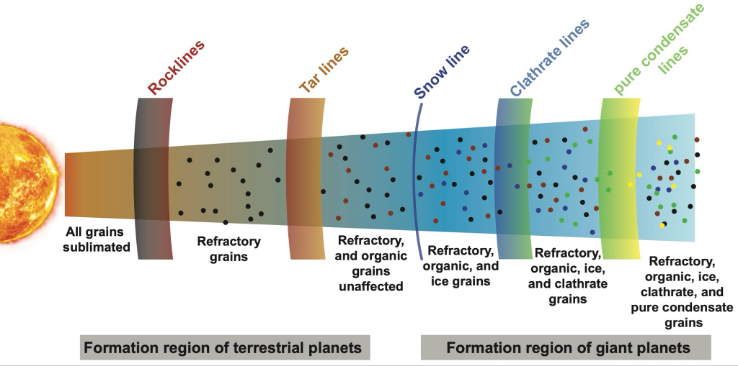
Figure 1. Thermochemical transitions in the PSN. Radial temperature–pressure gradients define rock, tar, snow, clathrate, and ice lines that control the composition of solids and the distribution of carbon among refractory, organic, and volatile reservoirs. Saturn’s position relative to these transitions determines the material incorporated during its growth and influences its present composition.
Tracing Saturn’s Metallicity Back to the Protosolar Nebula
Saturn’s supersolar metallicity, best reflected by its enhanced C/H ratio [12], likely records the chemical evolution of the protosolar nebula (PSN) at its formation location and epoch. In evolving disks, volatile redistribution near ice lines can enrich both vapor and solid phases through condensates, clathrates, and refractory organic-rich material. Saturn’s enrichment may thus result from a combination of supersolar vapors and solids, shaped by disk transport, formation timing, and the balance between gas and solid accretion (Fig. 1).
Each pathway predicts distinct chemical and isotopic fingerprints only testable by in situ measurements. Vapor-dominated accretion would enhance volatile elemental ratios while preserving near-nebular noble-gas abundances and isotopic compositions. Accretion of condensates or clathrates would produce correlated enrichments in heavy noble gases (Ar, Kr, Xe), directly probing clathration efficiency and formation temperature. Refractory organic delivery could alter elemental ratios and shift isotopic tracers such as 14N/15N and D/H away from nebular values. High-precision probe measurements would therefore discriminate between gas-phase enrichment, icy/clathrate delivery, refractory-dominated accretion, or mixtures thereof.
Saturn Probe and Satellite Constraints on Giant Planet Formation
Elemental and isotopic measurements across the Saturnian satellite system provide key context for interpreting Saturn’s formation history. Enceladus’s plume reveals H2O, CO2, organics, and H2, while its D/H ratio is consistent with cometary values inferred for most Saturnian icy satellites (D/H ~ 2–3 × 10⁻⁴) [13–15]. Titan provides additional constraints: its atmosphere is strongly depleted in primordial heavy noble gases relative to solar abundances [16], and its 14N/15N ratio (~167) is far lower than Jupiter’s (~435) measured by the Galileo probe [17]. These signatures suggest that nitrogen in the Saturnian system was incorporated in a chemically processed, possibly ice-rich or organic-bearing form rather than as nebular N2. The forthcoming Dragonfly mission will further refine these constraints through in situ analyses of Titan’s atmosphere and surface chemistry. Combined with future Saturn probe measurements, these data would provide a system-level framework to distinguish enrichment inherited from the PSN from processes operating during planet and satellite formation.
References
[1] Guillot, T. (2005), AREPS, 33, 493.
[2] Helled, R. (2011), ApJL, 735, L16.
[3] Vazan, A. et al. (2016), ApJ, 829, 118.
[4] Militzer, B. et al. (2019), ApJ, 879, 78.
[5] Mankovich, C.R. & Fuller, J. (2021), Nat. Astron., 5, 1103.
[6] Atreya, S.K. et al. (2022), arXiv:2205.06914.
[7] Fletcher, L.N. et al. (2009), Icarus, 199, 351.
[8] Miguel, Y. et al. (2022), A&A, 662, A18.
[9] Wong, M.H. et al. (2024), SSRv, 220, 15.
[10] Mousis, O. et al. (2016), P&SS, 130, 80.
[11] Howard, S. et al. (2024), A&A, 689, A15.
[12] Mousis, O. et al. (2009), ApJ, 696, 1348.
[13] Waite, J.H. et al. (2009), Nature, 460, 487.
[14] Clark, R.N. et al. (2019), Icarus, 321, 791.
[15] Brown, M.E. et al. (2025), PSJ, 6.
[16] Niemann, H.B. et al. (2005), Nature, 438, 779.
[17] Owen, T. et al. (2001), ApJ, 553, L77-L79.
How to cite: Mousis, O., Canup, R., Rhoden, A., Atkinson, D., Atreya, S., Helled, R., Hofstadter, M., Guillot, T., Mankovich, C., Moses, J., and Wong, M.: Future Entry Probe Measurements as Constraints on Saturn’s Formation Environment, Europlanet Science Congress 2026, The Hague, The Netherlands, 7–11 Sep 2026, EPSC2026-500, https://doi.org/10.5194/epsc2026-500, 2026.


