
 1,2,
1,2,- 1Beihang University, School of Astronautics, Department of Spacecraft Technology, Beijing, China (liujiancen@buaa.edu.cn)
- 2Key Laboratory of Spacecraft Design Optimization and Dynamic Simulation Technologies, Ministry of Education, Beijing, China
- 3Institute of Mechanics, Chinese Academy of Sciences, Beijing, China
The origin of comet 2P/Encke remains difficult to explain using purely gravitational dynamics, mainly because its present aphelion is decoupled from Jupiter. In this work, we investigate the backward orbital evolution of 2P/Encke under sublimation-driven recoil forces using a Monte Carlo approach. A dust-mantle thermophysical model is adopted to simulate the variation of the non-gravitational acceleration (NGA) with heliocentric distance. The numerical experiments show that both the magnitude of the NGA and its lag angle as functions of heliocentric distance are relatively insensitive to changes in the orbital elements and spin-axis orientation. We therefore fit the magnitude of the acceleration using a double power-law function and represent the lag angle using a piecewise linear function. The resulting empirical NGA model is then embedded into long-term orbital integrations.
We integrate the backward evolution of 2P/Encke over the past 1000 kyr under different parameter settings, taking into account both nucleus erosion and the variation of the acceleration direction. In purely gravitational integrations including the giant planets, most test particles collide with the Sun under the influence of the Saturnian ν6 secular resonance, while the remaining particles stay in the inner Solar System. The terrestrial planets can provide a dynamical pathway connecting 2P/Encke with Jupiter-family comets, but the transfer efficiency is limited to about 4 percent.
When a sufficiently large NGA, of the order of 1×10⁻⁹ AU/d2, is sustained, the aphelion distance and semimajor axis of some particles increase in backward time, allowing them to recover Jupiter-coupled orbits. Although this acceleration scale is higher than the observed value of about 2×10⁻¹⁰ AU/d2, the difference may arise partly from the different representations of the recoil force in our fitted thermophysical model and in the standard Marsden model. In this case, about 10 to 20 percent of the particles can be traced back to Jupiter-family comet orbits, with a mean transfer time of about 80 kyr and a mean active lifetime of about 20 kyr.
A smaller NGA does not improve the efficiency of tracing particles back to Jupiter-family-comet-like orbits, even though it allows a longer active interval before the nucleus reaches the same reconstructed size in backward integrations. Instead, it causes a large fraction of the particles to collide with the Sun rapidly. This behavior occurs because the current orbit of 2P/Encke lies in a dynamical transition region: decreasing the semimajor axis tends to drive particles into Jovian mean-motion resonances, whereas increasing the semimajor axis strengthens the influence of the ν6 secular resonance.
These results suggest that, after 2P/Encke entered the inner Solar System through gravitational scattering by Jupiter, its activity may have been dominated by supervolatile-driven outgassing. Such activity could have generated sufficiently strong NGA over tens of thousands of years, progressively lowering the aphelion distance, decoupling the comet from Jupiter, and ultimately producing its present orbit.
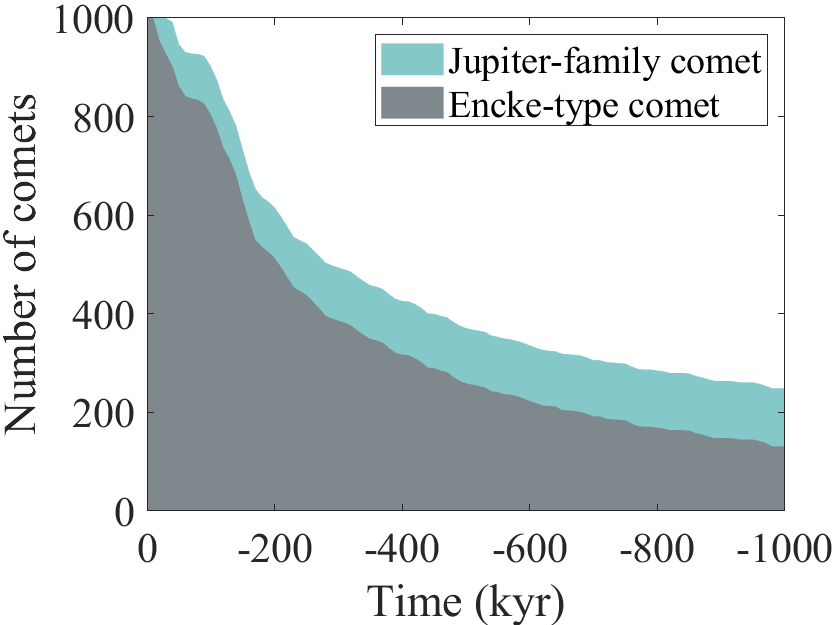
Figure 1. Backward orbital evolution of Monte Carlo clones of 2P/Encke over 1000 kyr with an imposed NGA of 1×10⁻⁹ AU/d2. The maximum nucleus diameter is limited to 30 km. A subset of particles recover Jupiter-family-comet-like orbits in backward time, supporting a non-gravitational pathway for the origin of 2P/Encke.
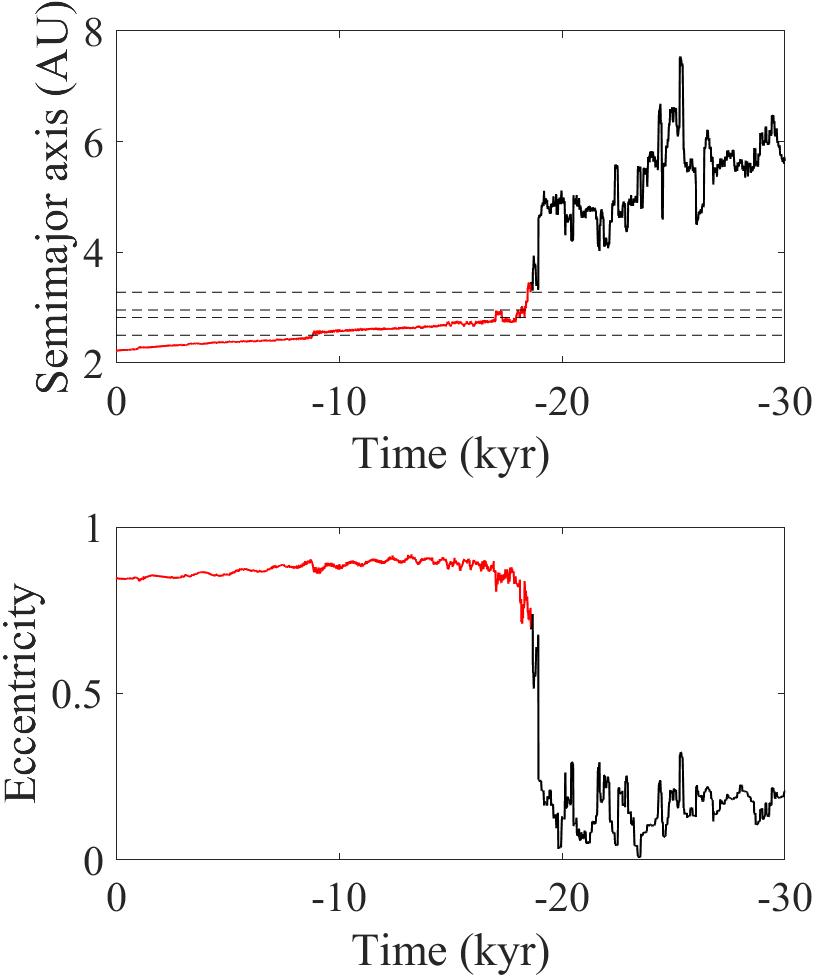
Figure 2. Backward orbital evolution of a representative particle. The red curve indicates the interval affected by NGA. In the upper panel, the black dashed lines indicate, from bottom to top, the nominal locations of Jupiter’s 3:1, 5:2, 7:3, and 2:1 mean-motion resonances.
How to cite: Liu, J., Tang, Y., Wang, X., and Yue, Y.: Tracing the origin of 2P/Encke through non-gravitational orbital evolution, Europlanet Science Congress 2026, The Hague, The Netherlands, 7–11 Sep 2026, EPSC2026-504, https://doi.org/10.5194/epsc2026-504, 2026.


