

- University of Freiburg, Institute of Earth and Environmental Sciences, Department of Geology, Freiburg im Breisgau, Germany (filippo.carboni@geologie.uni-freiburg.de)
Introduction
Alba Mons (AM) has been extensively studied in order to determine its geological evolution in relationships with the TVP and the geological processes driving its formation [1]. Several dating attempts focussed on the relative dating of faults based on their cross-cutting relationships with different geological terrains, whose absolute age was inferred through cumulative crater counting [2].
However, an absolute fault dating (i.e. buffered crater counting of faults) and a clear stratigraphic constraints for the onset and termination of specific faults is still lacking. Such constraints allows to better determine not only the timing but also the kinematics and extensional rates associated with specific faults affecting AM. In this work, I select 1 emblematic area in the eastern side of AM (Fig.1), where structural and stratigraphic relationships between different geological features are evident and whose absolute ages can be inferred through cumulative and buffered crater counting techniques. Following the absolute dating I carry out a fault analysis to determine kinematic parameters and depth of faulting.
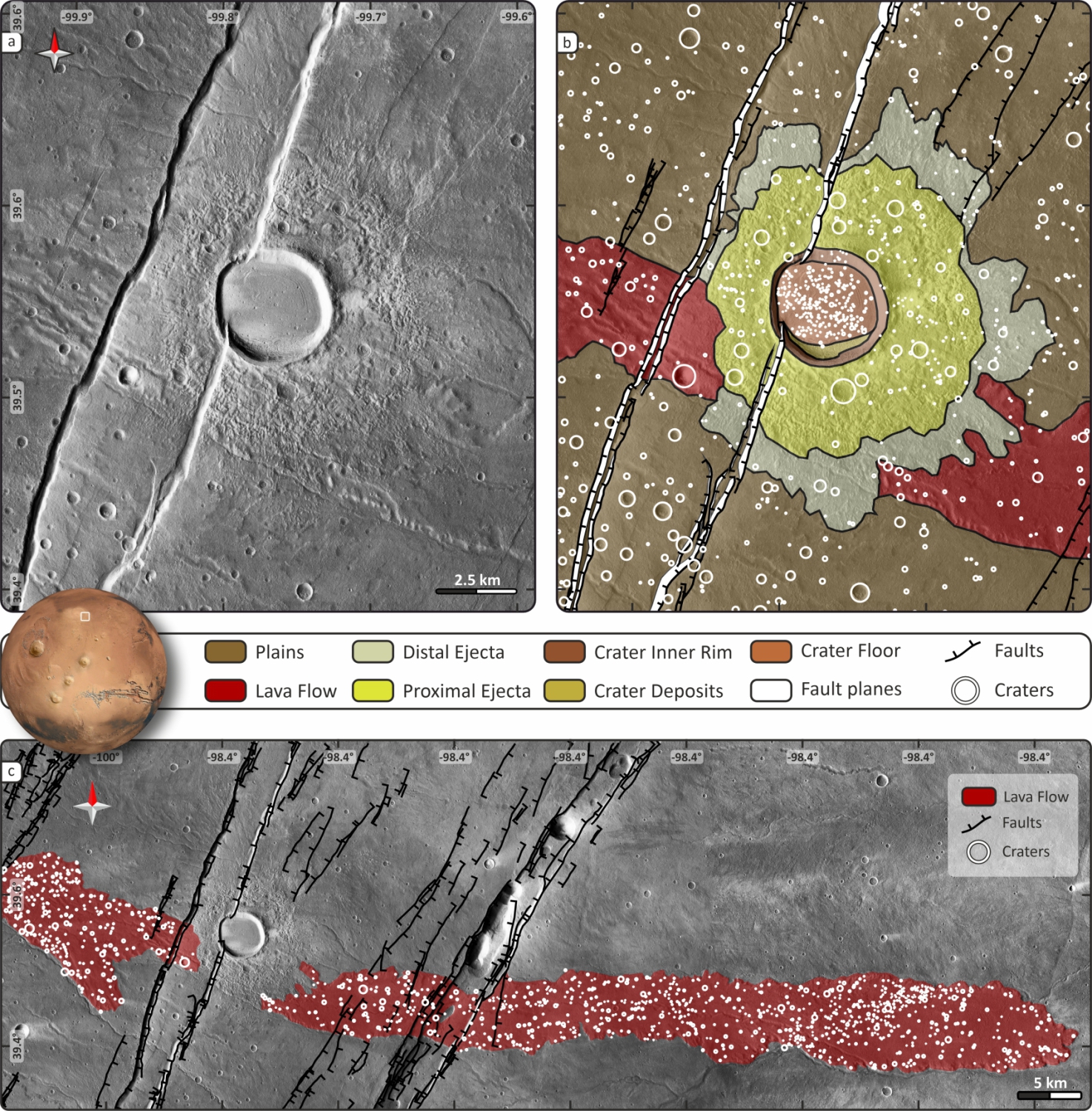
Fig.1. Map view of the crater object of this study (a), its geological map (b) and the total extent of the dated lava flow (c).
Data and Methods
Structural mapping was performed at 1:40.000 scale over 2 Global Context Camara (CTX) tiles from the V01 CTX mosaic [3], merged and centred at N40° W100° to remove any projection distortion. One pair of High-resolution CTX (~6 m/px) [4] was processed to obtain Digital Elevation Models (DEMs). Both the DEMs and derived orthoimages were imported into MoveTM software to build a 3D model aimed at characterizing the faults kinematic characteristics taking into account visible resurfacing.
The OpenCraterTool for QGIS [5], was used to map all visible craters through a conventional Crater Counting (CCC) method and Buffered Crater Counting (BCC) simple approach. To determine the proper buffer areas for the BCC analysis, the CSFD Tool software [6] was used. The cumulative size frequency distribution of the counted impact craters, per each mapped area and fault system, including their statistical and randomness analysis, was performed using the CraterStats software [7]. This work relies on the combination of production and chronology functions derived from [8] and [9].
Results and discussion
The results show a very good agreement, within dating errors, between the relative dating based on cross-cutting relationship (Fig. 2) and the absolute dating of faults based on the buffered crater counting (Fig. 3).
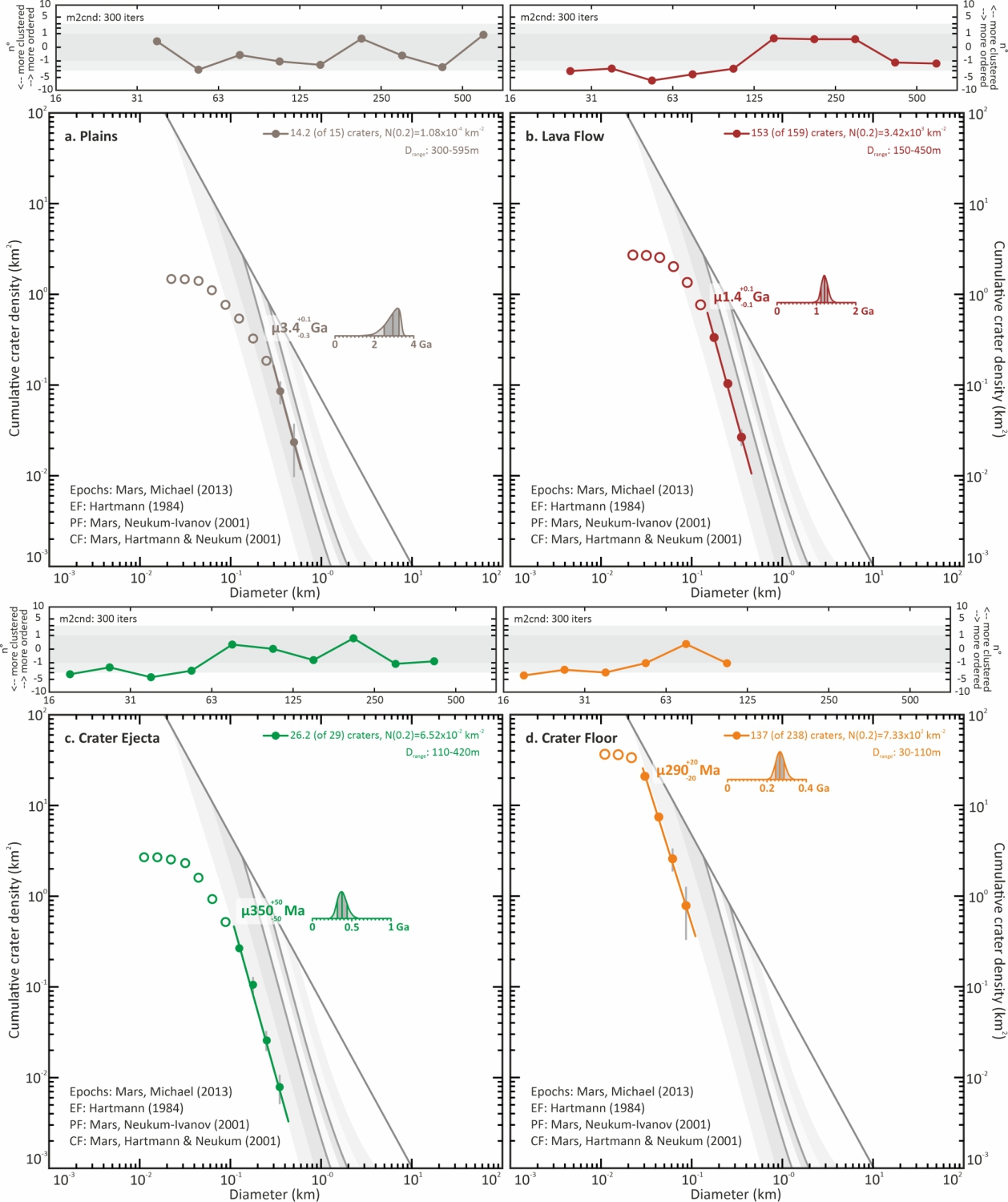
Fig.2. Absolute dating of stratigraphic succession mapped in the study area, including surrounding plains, lava flow, crater ejecta deposits and crater floor deposits.
In particular, the plains surrounding the crater have an age of 3.4 Ga (+0.3, -0.1), the lava flow is dated 1.4 Ga (± 0.1), the crater ejecta are dated 350 Ma (± 50) and the crater floor is dated 290 Ma (± 20). Considering that the faults clearly cuts the crater but not the crater floor, which clearly appears to seal the fault due to crater floor resurfacing (i.e., infilling), the fault time of activity should be constrained between the ejecta age (i.e., impact time) and the crater infilling. The absolute dating of the graben system, analysed for a total length of ~170 km, gives an age of 320 Ma (± 40), which is in perfect agreement.
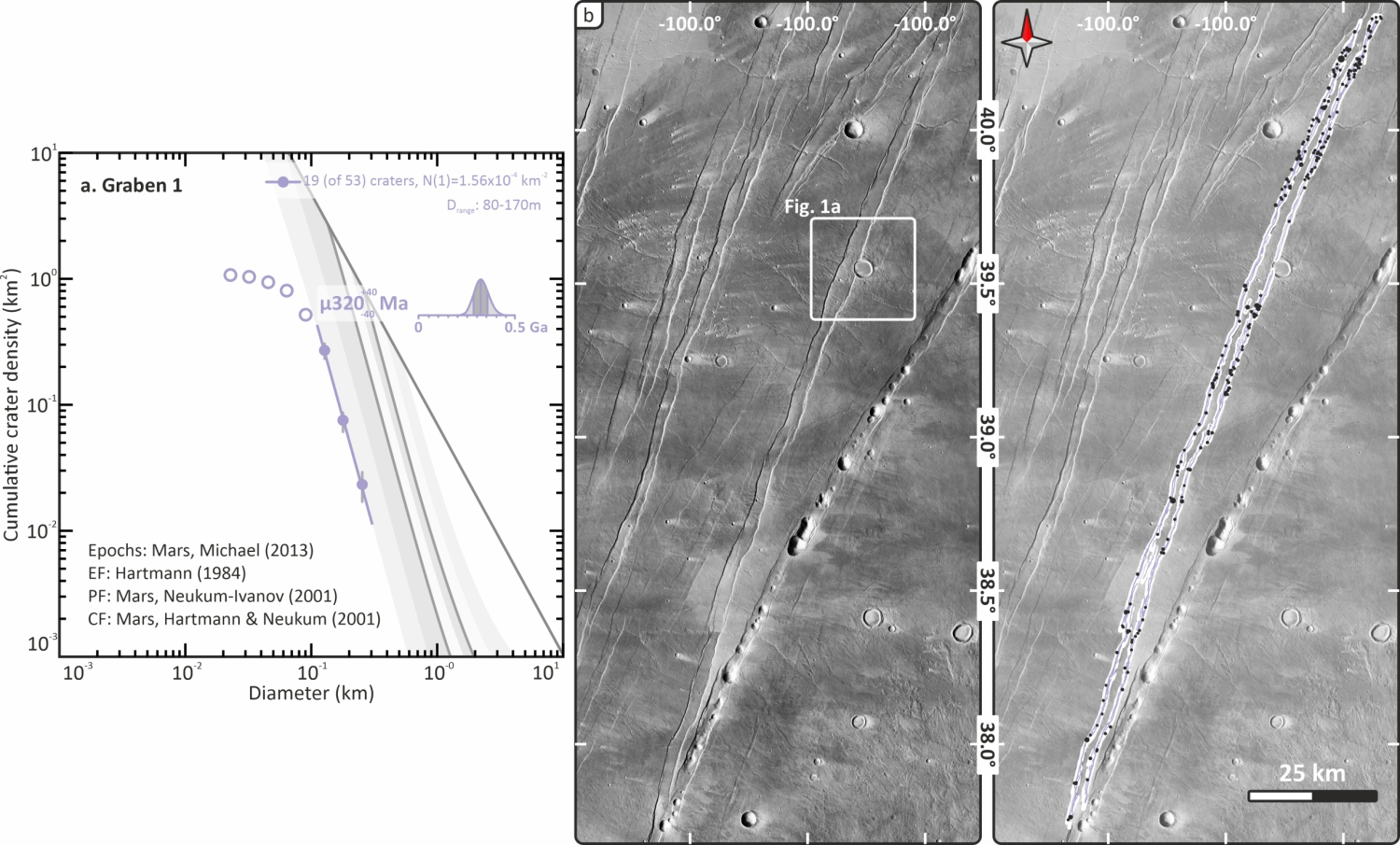
Fig.3. Absolute dating of the graben system cutting the crater.
However, the obtained age of faulting can either represent a single or the last of multiple stages of deformation. In the latter case, the fault pre-dates the crater, which is subsequently deformed during the latest activation; if so, the fault displacement should be higher away from the crater and lower in correspondence of the dislocated crater rims. Although the rims are visibly eroded at the fault hanging-wall, the along fault displacement analysis can be still considered representative. The kinematic analysis (Fig. 4) reveals that the displacement accrued by the faults looks to be constant, suggesting a single stage of relatively fast activation of the fault.
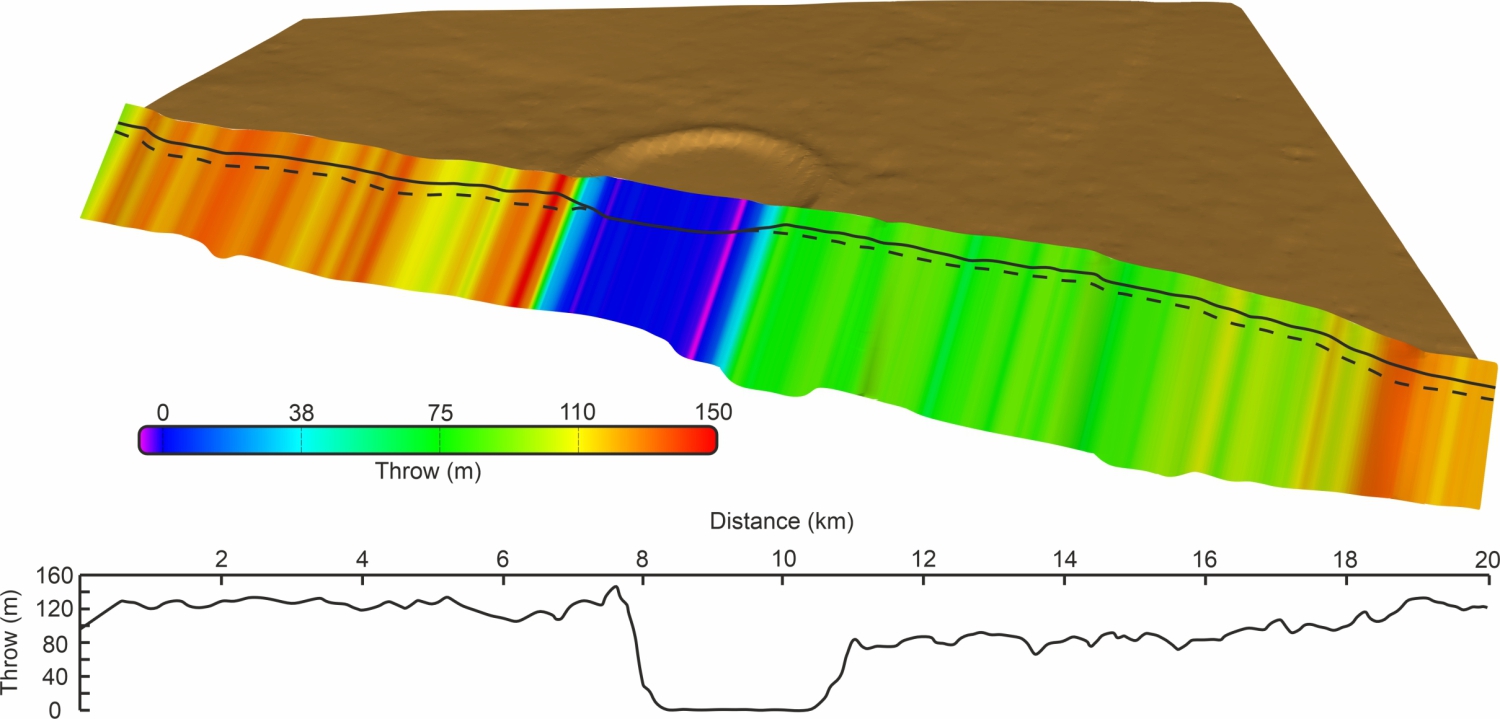
Fig.4. kinematic analysis of the fault showing the along-strike throw variation
References
[1] Ivanov & Head, 2006, https://doi.org/10.1029/2005JE002469. [2] Krishnan & Kumar, P. S., 2023, https://doi.org/10.1029/2022JE007511. [3] Dickson et al., 2024, https://doi.org/10.1029/2024EA003555. [4] Malin et al., 2007, https://doi.org/10.1029/ 2006JE002808. [5] Heyer, et al., 2023, https://doi.org/10.1016/j.pss.2023.105687. [6] Riedel et al., 2018, http://dx.doi.org/10.1002/2018EA000383, 2018. [7] Michael and Neukum, 2010, https://doi.org/10.1016/j.epsl.2009.12.041. [8] Ivanov, 2001, https://doi.org/10.1023/A:1011941121102. [9] Hartmann and Neukum, 2001, https://doi.org/10.1023/A:1011945222010.
How to cite: Carboni, F.: Extension at Alba Patera: Kinematics and Absolute Dating, Europlanet Science Congress 2026, The Hague, The Netherlands, 7–11 Sep 2026, EPSC2026-506, https://doi.org/10.5194/epsc2026-506, 2026.


