
 1,2,3,3,5,1,
- 1University of Winnipeg, Centre For Terrestrial and Planetary Exploration (C-TAPE), Winnipeg, MB, Canada
- 2Department of Earth Sciences, University of Western Ontario, London, ON, Canada
- 3School of Physical Sciences, The Open University, Milton Keynes, UK
- 4Department of Earth and Environmental Sciences, The University of Manchester, Manchester, UK
- 5Department of Geosciences, Swedish Museum of Natural History, Stockholm, Sweden
Introduction: Lunar basaltic breccias Dominion Range (DOM) 18262 and 18666 were recovered during the 2018 ANSMET campaign [1–2]. The DOM pairing group (including 18262 and 18666) shares textural similarities with Meteorite Hills (MET) 01210 [3], part of the YAMM paired lunar meteorite group (Yamato 793169, Asuka-881757, Miller Range 05035) [4]. These meteorites represent ~3.8–3.9 Ga basaltic material [4–11] lacking KREEP (K, REE, and P) signatures, indicating origins outside the Procellarum KREEP Terrane [12]. The YAMM parent flow is interpreted as a “cryptomare,” reflecting deeper provenance and older crystallization ages than Apollo low-Ti basalts (3.2–3.5 Ga) [6]. Here we present petrographic, geochemical, and geochronological analyses of DOM 18262 and 18666 to evaluate their relationship to the YAMM group and potential paired meteorites.
Methods: Textural analyses of polished thin sections were conducted using optical microscopy and SEM (FEI Quanta 200 3D) at The Open University (OU), with 0.60 nA beam current and 20 kV accelerating voltage.
Quantitative mineral chemistry of lithic clasts and phases was measured using a CAMECA SX100 electron microprobe (OU) with a 5 µm defocused beam, 20 nA current, and 15 kV voltage.
207Pb/206Pb ages of apatite and merrillite were obtained using a CAMECA IMS 1280 ion microprobe (at NordSIMS, Swedish Museum of Natural History) in multicollection mode (~2.5 nA, 30 kV), following established protocols [13].
Results: Petrography: DOM 18262 is an impact breccia containing lithic and mineral clasts (100–400 µm) within a clastic matrix. Lithologies include quartz monzodiorites, coarse low- and high-Ti basalts, symplectites, reduction-textured clasts, and abundant clast-rich impact melt rocks. It is classified as a Type C impact melt-bearing breccia [14] with moderate shock (M-S3/4) [15].
DOM 18666 consists of a dark clastic matrix with ~50–500 µm lithic and mineral clasts dominated by low- and high-Ti basalts. Pyroxene compositions (Fe# = 29.1–99.3; Ti# = 47.3–100.0; Fs26–98En1–68Wo1–42) are comparable to MET 01210 (Fe# = 24.4–94.2; Ti# = 49.2–98.2; Fs30–86En1–49Wo1–42; Figs. 1–2) [16]. DOM 18666 shows moderate shock (melt veins, mosaicism; M-S4) [15] and is also a Type C impact melt-bearing breccia [14].
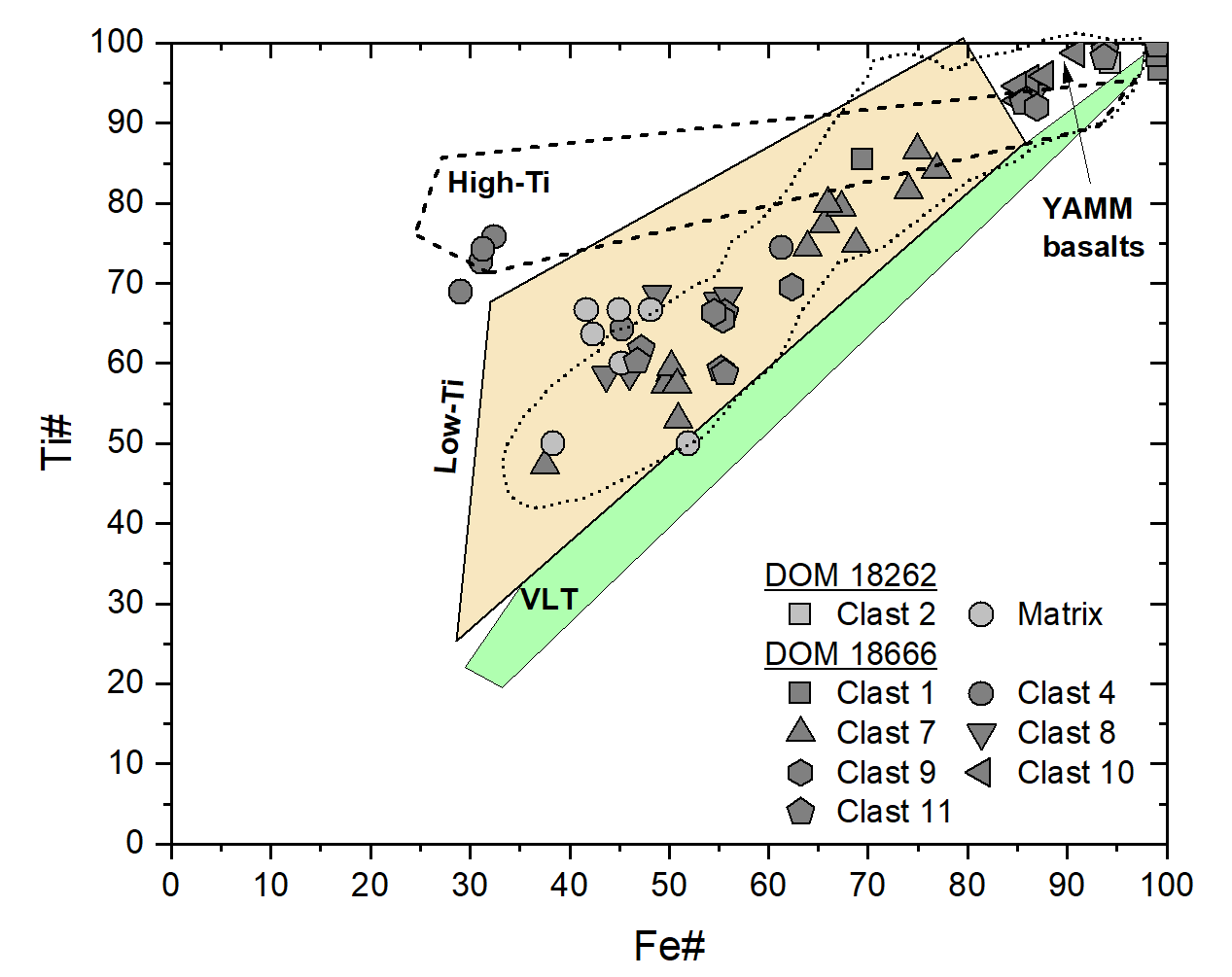
Fig. 1: Fe# vs Ti# of pyroxene in basaltic clasts in DOM 18262, DOM 18666, and YAMM basalts [4, 16]. Compositional fields from [17–18].
Geochronology: Apatite in basaltic clasts from both samples yields 207Pb/206Pb ages of 3.86–3.96 Ga, interpreted as crystallization ages. These are consistent with YAMM meteorites (3.8–3.9 Ga) [4, 19] and the proposed paired meteorite Ramlat Fasad (RF) 532 (~3.86 Ga) [20]. No correlation is observed between clast type and age.
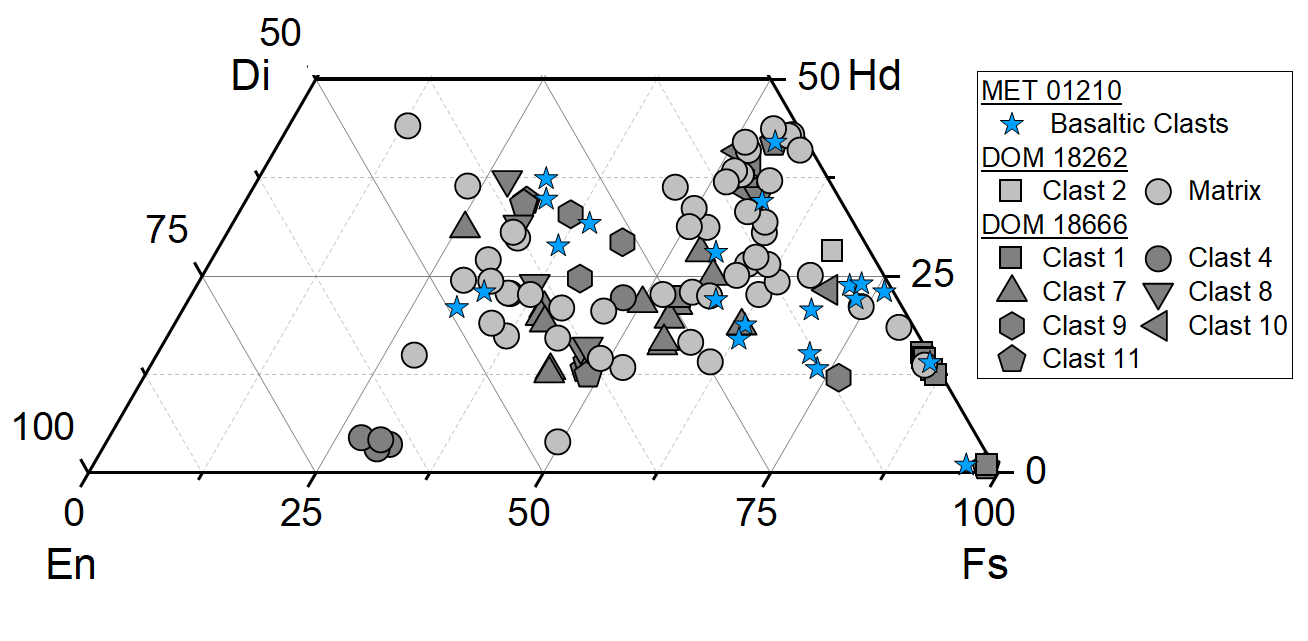
Fig. 2: Pyroxene quadrilateral for basaltic clasts in DOM 18262 and 18666, compared to basaltic clasts in MET 01210 [16].
Discussion: DOM 18262 and 18666 texturally and petrographically closely resemble MET 01210, other DOM group meteorites (e.g., DOM 18543) [21], and proposed YAMM-related samples such as NWA 16256 [20, 22] and RF 532 [20]. Shared features include predominance of low-Ti basaltic clasts, symplectites, glassy spherules, and coarse-grained basalt fragments [4].
Pyroxenes display exsolution lamellae (~2 µm thick), although less prominent than in existing YAMM samples. Exsolution lamellae suggest crystallization in a thick lava flow or burial of YAMM mare material [4, 23–25]. Shock features are consistent across these samples, with DOM meteorites (M-S3/4 to M-S4) comparable to MIL 05035, RF 532, and NWA 16256 [15, 20, 22].
Phosphate ages (3.86–3.96 Ga) align with YAMM crystallization ages (3.8–3.9 Ga) [4, 19] and RF 532 (~3.86 Ga) [20], and are older than Apollo 12/15 low-Ti basalts (3.2–3.5 Ga) and Luna 24 VLT basalts (~3.2 Ga) [6]. The YAMM basalts are interpreted as a cryptomare flow, possibly from the Schiller–Schickard region, emplaced prior to Orientale (>3.8 Ga) [4–5]. The dominance of low-Ti lithologies supports observations that cryptomare deposits are typically low-Ti [10, 26].
Cl and H isotopic compositions of apatite in DOM samples are similar to MIL 05035, supporting a shared origin [27]. Further constraints from ejection ages, impact chronology (e.g., Ar–Ar), and trace element geochemistry would strengthen these interpretations.
Conclusions: DOM 18262 and 18666 exhibit petrographic, lithological, and mineralogical characteristics consistent with MET 01210 and other YAMM group samples. Shock features and pyroxene compositions are comparable across these meteorites. Phosphate Pb–Pb ages (3.86–3.96 Ga) overlap with those of the YAMM group (3.8–3.9 Ga) [4, 19] and proposed paired samples [20].
References: [1] Righter, K. (2019) Antarctic Met. Newsletter 42(2). [2] Gattacceca, J. et al. (2020) MaPS 55, 1146–1150. [3] Zeigler, R. A. et al. (2021) 84th Ann. Met. Soc., 2609. [4] Arai, T. et al. (2010) GCA 74, 2231–2248. [5] Hawke, B. R. et al. (2006) LPSC XXXVII, abstract #1516. [6] Nyquist, L. E. and Shih, C. Y. (1992) GCA 56, 2213–2234. [7] Misawa, K. et al. (1993). GCA 57, 4687–4702. [8] Nyquist, L. E. et al. (2007) LPSC XXXVIII, abstract #1338. [9] Torigoye-Kita, N. et al. (1995) GCA 59, 2621–2632. [10] Terada, K. et al. (2007) Nature 450, 849–852. [11] Srivastava, Y. et al. (2022) Nat. Comm. 13, 7594. [12] Calzada-Diaz, A. et al. (2015) MaPS 50, 214–228. [13] Snape, J. F. et al. (2016) EPSL 451, 140–158. [14] Osinski, G. R. et al. (2025) 56Th LPSC, abstract #1765. [15] Stӧffler, D. et al. (2018) MaPS 53, 5–49. [16] Day, J. M. et al. (2006) GCA 74(24), 5957–5989. [17] Nielsen, R. L. and Drake, M. J. (1978) Proc. Mare Crisium: The View from Luna, 419–428. [18] Arai, T. et al. (1996) MaPS 31, 877–892. [19] Merle, R. E. et al. (2024) J. Petrol. 65(6). [20] Oliveira, B. H. et al. (2026) AGC 1(2), 772. [21] Schweitzer, A. et al. (2026) GSL Spec. Pub. 562(1) [22] Gattacceca, J. et al. (2025) MaPS 60(7), 1587–1591. [23] Jolliff, B. L. et al. (1993) Ant. Met. Res. 6, 3. [24] Warren, P. H. and Kallemeyn, G. W. (1993) Ant. Met. Res. 6, 35. [25] Joy, K. H. et al. (2008) GCA, 72, 3822–3844. [26] Hawke, B. R. et al. (2005) LPSC XXVI, abstract #1642. [27] Hayden, T. S. et al. (2022) LPSC LIII, abstract #1886.
How to cite: Hayden, T. S., Barrett, T. J., Anand, M., Whitehouse, M. J., Jeon, H., Cloutis, E. A., and Franchi, I. A.: Petrography, mineral chemistry, and geochronology of basaltic clasts in Dominion Range 18262 and DOM 18666: Possible launch pairings and ancient mare origins. , Europlanet Science Congress 2026, The Hague, The Netherlands, 7–11 Sep 2026, EPSC2026-514, https://doi.org/10.5194/epsc2026-514, 2026.


