
 1,2,3,4
- 1Université de Reims Champagne-Ardenne, LEATP, Reims, France
- 2Laboratoire de Météorologie Dynamique (LMD/IPSL), Sorbonne Université, CNRS, Paris, France
- 3LIRA, Observatoire de Paris, Université PSL, CNRS, Sorbonne Université, Université Paris Cité, 5 place Jules Janssen, 92195 Meudon, France
- 4Laboratoire Atmosphères Observations Spatiales (LATMOS/IPSL), Université Paris-Saclay, Université de Versailles Saint-Quentin-enYvelines (UVSQ), Sorbonne Université, CNRS, Guyancourt, France
1 Introduction
In Titan’s atmosphere and on its surface, methane plays a crucial role in the global climate. Since the methane cycle resembles Earth’s water cycle, with many similar processes as evaporation, condensation, rains and On Titan, condensed methane forms clouds and bodies of liquid at the surface (lakes, seas). One important aspect of Earth’s water cycle is infiltration into the ground, storage, and large scale transport in underground aquifers. On Titan, similar process should be at work too ([1], [2]). We already know that methane precipitation occurs on Titan’s surface and infiltration [3], and that the surface is moist [4]. We then assume that methane can infiltrates Titan’s soil, creating a subsurface cycle that participates to the surface/atmosphere exchanges and to planetary scale horizontal flux. In addition, it could also change locally the soil’s properties and its temperature. The underground aspects of the methane cycle are not well understood, and models struggle to reproduce some keys observation as, for instance, the cloud cycle. However implementing a representation of the subsurface methane cycle and its effect on the atmosphere and on the surface will help to constrain some unknow parameters of the underground of Titan.
2 Objective and method
The Titan Planetary Climate Model, first developed at the Institut Pierre-Simon Laplace ([5],[6]), is a useful and powerful tool for exploring Titan’s climate, especially the methane cycle. The Titan PCM employs an advanced microphysical scheme. [7] to simulate the complex cloud physics within Titan’s troposphere. This scheme enables a realistic representation of the methane cycle through condensation, evaporation, and precipitation processes in the lower layers of the atmosphere. However, exchanges between atmospheric and surface methane are still treated in a simplified manner (Figure 1). The goal of this work is to develop and use a comprehensive model that better captures the interactions between the surface, the subsurface, and the atmosphere.
For the inclusion of a subsurface model in Titan’s PCM, we use a quasi-3D model that computes the vertical flux of liquid in a one dimensional column and the horizontal transport in a two dimensional diffusion scheme using hydrodynamics equations. This follow the same general principle than behind the model described in [1] although our infiltration model for vertical flux differs and will be explained. In addition, Titan is known to host different types of terrain. These variations play a fundamental role in the soil’s ability to retain liquid within its pores. Characterizing and parameterizing these terrains in a realistc way is therefore a key challenge in implementing our subsurface model. The soil’s porosity and drainage capacity must be set to values representative of sandy loam, a soil type expected from the accumulation and compaction of tholins at Titan’s surface.
3 Results
In our presentation, we will discuss the main properties and performances of the surface model that we have developed and the way it is implemented in the Titan PCM. Then in a second place, we will show the main outcomes of the reference model, without subsurface processes, and the new model that includes the full subsurface model. One of the most important parameter of the model is the permeability of the soil. because it controls the retention
time of the liquid methane. Other parameters may also alter the final results such as the porosity or the methane table depth. We will then discuss the effect of these different key parameters on the modeled methane cycle.
For this discussion, we will essentially focus on the differences in the spatial distribution of gaseous methane and methane cloud, precipitations and methane flux at planetary scale in the atmosphere and in the subsurface. Several scenarios will be considered and our model will be compared to others availables simulations ([7],[1]).
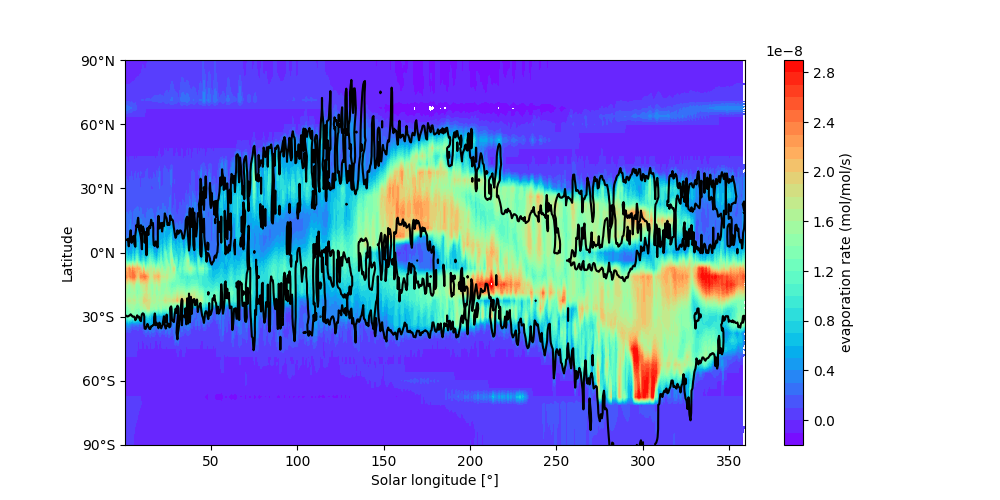
Figure 1: Seasonal evolution of the simple case of the methane flux scheme simulated by the Titan PCM before the
subsurface model. The map displays the evaporation rate, while the black contours indicate the spatial distribution
of methane precipitation over one Titan year.
References
[1] Sean P. Faulk, Juan M. Lora, Jonathan L. Mitchell, and P. C. D. Milly. Titan’s climate patterns and surface methane distribution due to the coupling of land hydrology and atmosphere. Nature Astronomy, 4:390–398, January 2020.
[2] Tetsuya Tokano. Stable existence of tropical endorheic lakes on titan. Geophysical Research Letters, 47(5):e2019GL086166, 2020. e2019GL086166 10.1029/2019GL086166.
[3] E. P. Turtle, J. E. Perry, J. M. Barbara, A. D. Del Genio, S. Rodriguez, S. Le Mouélic, C. Sotin, J. M. Lora, S. Faulk, P. Corlies, J. Kelland, S. M. MacKenzie, R. A. West, A. S. McEwen, J. I. Lunine, J. Pitesky, T. L. Ray, and M. Roy. Titan’s Meteorology Over the Cassini Mission: Evidence for Extensive Subsurface Methane Reservoirs. , 45(11):5320–5328, June 2018.
[4] H. B. Niemann, S. K. Atreya, S. J. Bauer, G. R. Carignan, J. E. Demick, R. L. Frost, D. Gautier, J. A. Haberman, D. N. Harpold, D. M. Hunten, G. Israel, J. I. Lunine, W. T. Kasprzak, T. C. Owen, M. Paulkovich, F. Raulin, E. Raaen, and S. H. Way. The abundances of constituents of Titan’s atmosphere from the GCMS instrument on the Huygens probe. , 438(7069):779–784, December 2005.
[5] Sébastien Lebonnois, Jérémie Burgalat, Pascal Rannou, and Benjamin Charnay. Titan global climate model: A new 3-dimensional version of the IPSL Titan GCM. , 218(1):707–722, March 2012.
[6] Bruno de Batz de Trenquelléon, Lucie Rosset, Jan Vatant d’Ollone, Sébastien Lebonnois, Pascal Rannou, Jérémie Burgalat, and Sandrine Vinatier. The new titan planetary climate model. i. seasonal variations of the thermal structure and circulation in the stratosphere. The Planetary Science Journal, 6(4):78, mar 2025.
[7] Bruno de Batz de Trenquelléon, Pascal Rannou, Jérémie Burgalat, Sébastien Lebonnois, and Jan Vatant d’Ollone. The new titan planetary climate model. ii. titan’s haze and cloud cycles. The Planetary Science Journal, 6(4):79, mar 2025.
How to cite: Petetin, C., Rannou, P., Lebonnois, S., De Batz de Trenquelléon, B., and Rosset, L.: Effect of subsurface on the methane cycle in Titan's atmosphere with a Planetary Climate Model, Europlanet Science Congress 2026, The Hague, The Netherlands, 7–11 Sep 2026, EPSC2026-517, https://doi.org/10.5194/epsc2026-517, 2026.


