
 1,1,1,1,1,1,2
- 1The Open University, School of Physical Sciences, Milton Keynes, United Kingdom of Great Britain – England, Scotland, Wales (paul.streeter@open.ac.uk)
- 2RAL Space, Harwell, UK
Introduction: Ozone is an important trace gas in the martian climate system. It is intimately linked to the odd-hydrogen (HOx) species (H, OH, HO2), low-abundance but highly reactive chemicals essential for maintaining the stability of Mars’ overwhelmingly CO2 atmosphere [1]. These HOx species are difficult to observe directly, but their presence can be inferred via their destruction of (and therefore anti-correlation with) ozone.
Ozone has a short photochemical lifetime on the dayside of a few hours. In the polar night, however, it is able to persist for significantly longer, allowing it to serve as a tracer for large-scale atmospheric dynamics, such as those associated with the polar vortices. Indeed, observed ozone has been shown to be closely correlated with modelled potential vorticity (PV, a diagnostic thermal-dynamical variable) in the polar winter [2].
Ozone observations can serve as valuable constraints for our understanding of both chemical and dynamical processes in the martian atmosphere. However, numerical models have long had issues in representing martian ozone, tending to underestimate total ozone abundance [e.g. 3]. Several tacks have been taken in trying to resolve this discrepancy, including incorporating heterogeneous chemical reactions (gas-solid; e.g. uptake of HOx species onto water ice clouds) and modifying existing reaction rates [e.g. 3,4]. While some improvement has resulted, model-observation disagreements remain.
In this work, we explore the impacts of data assimilation (see below) on the modelled ozone representation, and compare to retrieved ozone observations, in order to better characterise the model biases and the causal mechanisms behind them.
Approach: We employ a statistical technique called data assimilation. Data assimilation is a means for combining a numerical model of a system with discrete observations of that system; for example, a global climate model (GCM) of Mars with satellite observations of the martian atmosphere. By doing this, one can get the best of both worlds: the full spatio-temporal coverage and deterministic causal chain of the model, and the accuracy of actual observational data.
We use the Open University’s Mars GCM, also known as the Mars Planetary Climate Model – UK (PCM-UK) [5,6,7]. This shares model physics with the Mars PCM, but possesses a different dynamical core and data assimilation capability using the analysis correction scheme adapted from the UK Met Office [8].
We assimilate temperature profiles from the Mars Climate Sounder (MCS) and Atmospheric Chemistry Suite (ACS), together with water column and profile retrievals from ACS and the Nadir and Occultation for MArs Discovery (NOMAD) instrument. We do not assimilate ozone, but compare the model ozone to column retrievals from NOMAD-UVIS [9].
Results & Discussion: We present results comparing the baseline model simulation (“Control”), assimilated model simulation (“Assimilation”), and NOMAD-UVIS ozone retrievals (“Observations”) for the first half of Mars Year (MY) 36.
Preliminary results indicate that the Assimilation improves the fit with the Observations in some areas but worsens it in others, likely due to a wetter atmosphere in the Assimilation. At higher latitudes nearer the poles, both Control and Assimilation significantly underpredict total ozone column.
Over the southern winter pole, where Observations are unfortunately lacking, we find that the Assimilation and Control show radically different ozone distributions within the polar vortex. This appears to be due to the improved representation of the characteristic annular vortex structure in the Assimilation, where the PV maximum is located at least 10 degrees off-pole (see Fig. 1).
We discuss these and other results in the context of existing work. By comparing the ozone distribution in the two model simulations and the retrieved ozone, we can identify where model biases are due to missing chemistry/physics, and where they may be attributable to incorrect representation of other key atmospheric variables (such as temperatures and the water cycle).
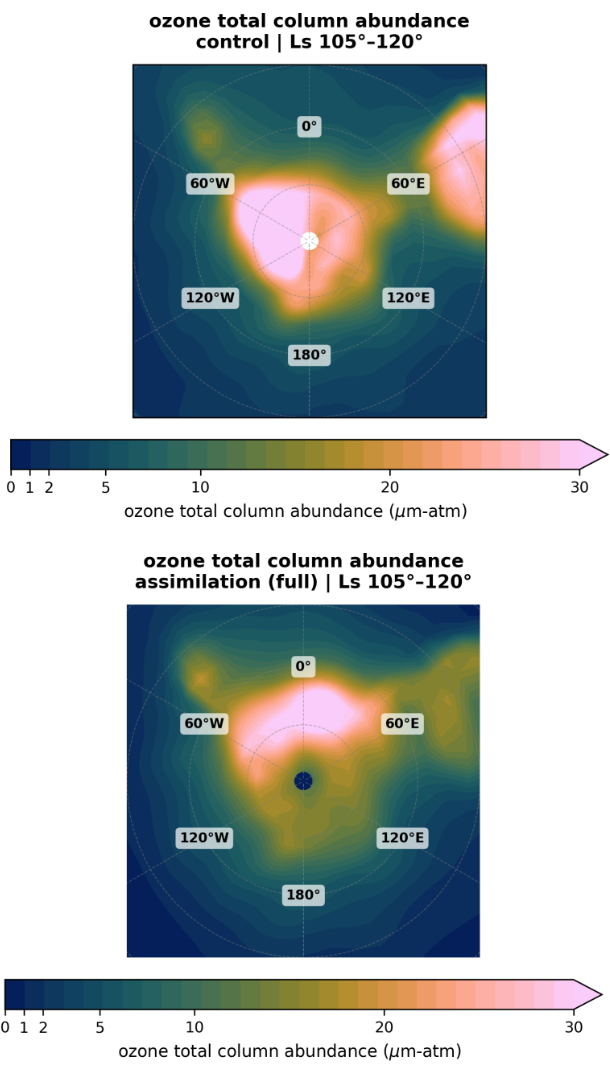
Figure 1. Comparison of modelled ozone total abundance over the south pole between the Control (top) and Assimilation (bottom) for same period in MY 36.
References: [1] McElroy & Donahue (1972). Science. 177 (4053). [2] Holmes et al. (2017). Icarus. 282. [3] Lefèvre et al. (2021). JGR Planets. 126 (4). [4] Brown et al. (2022). JGR Planets. 127 (11). [5] Forget et al. (1999). JGR Planets. 104 (E10). [6] Lewis et al. (2007). Icarus. 192 (2). [7] Holmes et al. (2020). Planet. & Space Sci. [8] Lorenc et al. (1991). QJRMS. [9] Mason et al. (2024). JGR Planets.
How to cite: Streeter, P., Rajendran, K., Holmes, J., Lewis, S., Mason, J., and Patel, M.: Chemico-dynamical impacts of data assimilation on martian atmospheric ozone, Europlanet Science Congress 2026, The Hague, The Netherlands, 7–11 Sep 2026, EPSC2026-519, https://doi.org/10.5194/epsc2026-519, 2026.


