

- Yale University, Earth and Planetary Sciences, New Haven, United States of America (caleb.keaveney@yale.edu)
Uranus is a peculiar planet with an understudied but compelling climate. Its rotation rate and radius place it, along with Neptune, in an interesting dynamical parameter space between the terrestrial planets and the gas giants. Its high obliquity leads to extreme seasonal forcing, its internal heat flux is weak relative to the other giant planets [1], and the abundance and molecular weight of methane contributes to convective inhibition and influences the global circulation [2]. Observational evidence supports to presence of a single eastward jet in each hemisphere along with weak westward flow around the equator [3]. Temperature retrievals suggest a warm equator and poles with cold mid-latitudes [4,5], and there is an apparent methane enrichment at the equator, with methane depleted towards the poles [5,6]. These features allude to an interesting global circulation that nevertheless remains mysterious. Furthermore, observations themselves are limited in spatial and temporal coverage and have large uncertainties, all of which motivates high fidelity atmospheric modeling ahead of a future satellite mission.
Here we present simulation results from a novel general circulation model (GCM) for Uranus. The GCM is built on the GFDL Finite-Volume Cubed-Sphere (FV3) dynamical core, which has hydrostatic and non-hydrostatic capabilities solving Euler’s equations on the sphere. We incorporate a modular and hierarchical suite of model physics packages that includes two-stream, multiple-scattering, non-gray correlated-k “full” radiative transfer including molecular absorption by CH4, C2H2, and C2H6, collision-induced absorption by H2-H2, H2-He, H2-CH4, He-CH4, and CH4-CH4, and a prescribed aerosol model from Irwin et al. [7]; two-stream gray radiation; Newtonian relaxation to radiative equilibrium with pressure-dependent relaxation timescales; large-scale condensation of methane with virtual effects included in the governing equations; Rayleigh bottom-boundary drag to represent interactions with the interior in solid-body rotation; intrinsic heat flux at 0.078 W/m2 introduced uniformly at the model bottom [1]; and an enthalpy- and moisture-conserving dry convective adjustment which homogenizes potential temperature and specific humidity where the virtual potential temperature profile is unstable.
The simulations we present here use idealized Newtonian relaxation to equinoctial radiative equilibrium, with the equilibrium profile itself and relaxation timescales determined from the “full” radiative transfer scheme. The relaxation timescales are pressure-dependent, which we determined to be a critical element of the forcing in properly representing the contributions of radiation to the global energy balance, and a change from previous studies. The simulations are spun-up for multiple Uranus years with horizontal resolution of 0.5° and the vertical domain spanning 30 bar at model bottom to 0.1 hPa at model top.
Our results are consistent with and add color to the observations described above (Fig. 1). We observe a single eastward jet in each hemisphere and westward flow around the equator. We also see a local eastward maximum in the polar regions, suggesting the presence of polar cyclones. The positions of the jets and the magnitude of the winds are consistent with observations. The jets are eddy-driven, with baroclinic waves evident in the jet formation regions. The virtual effect of methane is substantial, and we present evidence to suggest that the equatorial flow on Uranus is dynamically linked to the methane distribution. We also observe methane condensation in the upper troposphere and an interesting energy balance in the lower troposphere, where radiation does not produce appreciable heating and instead dynamical transport and convection dominate energy processes.
These simulations represent an advancement in our understanding of Uranus’s climate, particularly in how the planet’s unique forcing drives an interesting atmospheric circulation, how that circulation transports energy, momentum, and moisture, and how different regions of the planet couple and participate in the energy balance. Ongoing and future work with this Uranus GCM will emphasize methane radiative and dynamical feedbacks, seasonal effects in the stratosphere and troposphere, and the dynamics of mid-latitude and polar vortices present in our simulations.
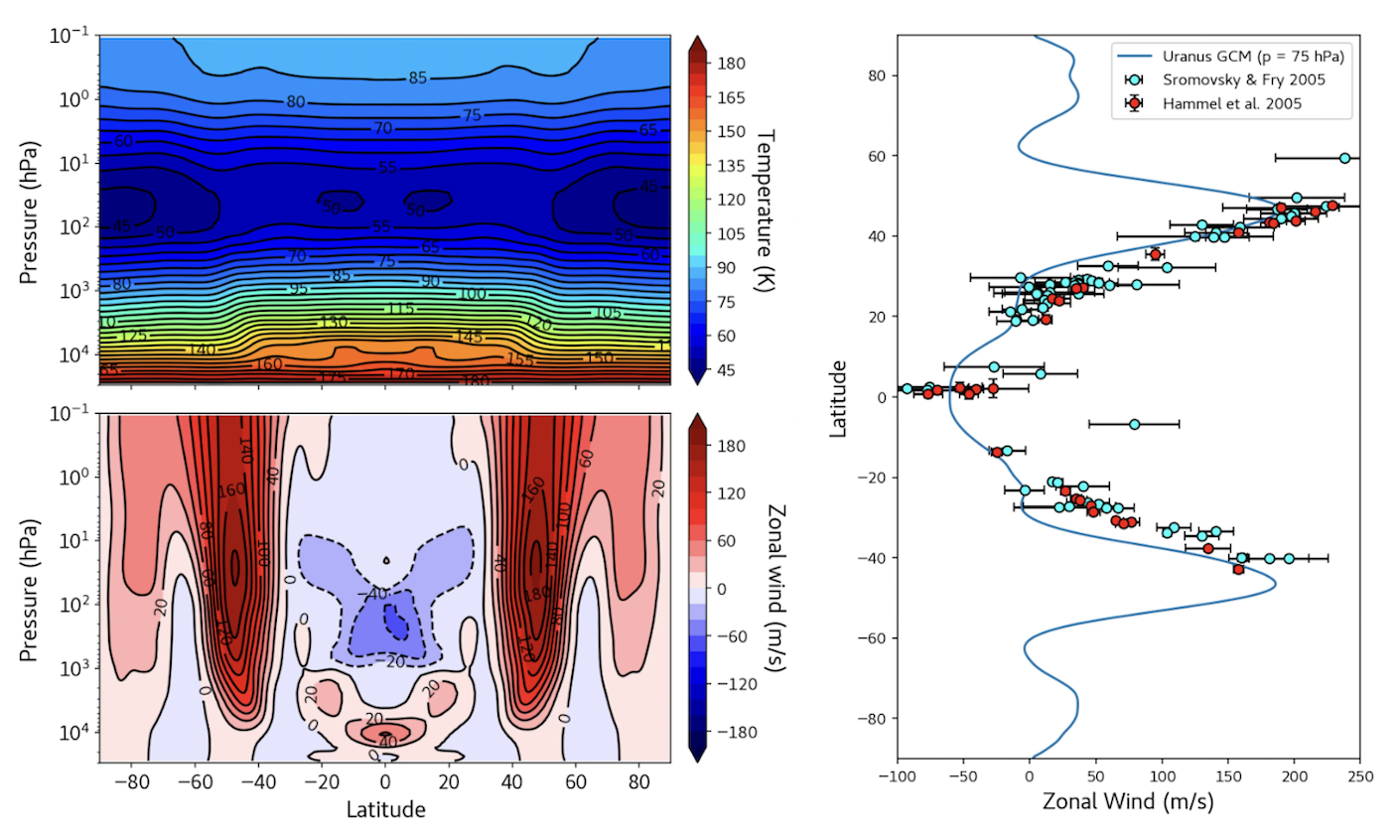
Figure 1: Temperature and wind results from simulations with Uranus GCM. Top left: Zonal-time mean temperature. Bottom left: Zonal-time mean winds, eastward flow in red and westward flow in blue. Right: Time mean zonal winds at 75 hPa in comparison to observation, with Sromovsky & Fry [8] data in blue and Hammel et al. [9] data in red.
References
[1] Wang et al. (2025). Geophysical Research Letters 52(14)
[2] Leconte et al. (2017). Astronomy & Astrophysics 598
[3] Soyeur et al. (2022). The Astronomy Journal 165(1)
[4] Orton et al. (2015). Icarus 260
[5] Roman et al. (2025). EPSC-DPS Joint Meeting 2025, Helsinki, Finland
[6] Sromovsky et al. (2014). Icarus 238
[7] Irwin et al. (2022). Journal of Geophysical Research: Planets 127(6)
[8] Sromovsky & Fry (2005). Icarus 179(2).
[9] Hammel et al. (2005). Icarus 175(2).
How to cite: Keaveney, C. and Lora, J.: Global circulation and the influence of methane in a novel general circulation model for Uranus, Europlanet Science Congress 2026, The Hague, The Netherlands, 7–11 Sep 2026, EPSC2026-524, https://doi.org/10.5194/epsc2026-524, 2026.


