
 3,4,2,1,2,
- 1Univ Toulouse, CNES, CNRS, IRAP, Toulouse, France (jeremie.lasue@utoulouse.fr)
- 2Royal Belgian Institute for Space Aeronomy (BIRA-IASB), Brussels, Belgium
- 3Deutsches Zentrum für Luft- und Raumfahrt, Berlin, Germany
- 4LATMOS/IPSL, UVSQ Univ. Paris-Saclay, Sorbonne Université, CNRS, Guyancourt, France
- 5CNES, Toulouse, France
- *A full list of authors appears at the end of the abstract
Introduction
The Cosmic Vision M5 mission EnVision from ESA will launch by the end of 2031 to study Venus for a nominal duration of 4 years. Its payload includes the VenSpec spectrometry suite, comprising three complementary spectrometers developed by BIRA-IASB, DLR, and LATMOS to study the atmosphere and surface of Venus from the UV to the infrared range. The scientific objectives of the suite are to characterize the diversity of the surface mineralogy as well as to assess the spatial distribution of gaseous species of interest (H2O, HDO, CO, SO2, SO) in order to better understand the interplay between chemistry, dynamics and surface interactions within the atmosphere of Venus [1, 2, 3, 4].
Role of the Working Group
Need for solar spectral irradiance at Venus
Given the radiative properties of the planet, the foremost signal coming from Venus in the wavelength bands used by the spectrometers on the day side is the reflected Solar Spectral Irradiance (SSI). In order to extract the planetary signal, an accurate SSI from the ultraviolet to the infrared needs to be known at the spectral resolution of the instrument channels, and at the date and position of Venus with respect to the Sun. Such an information is difficult to obtain from Earth-based or L1 observatories.
Based on this constraint and on the fact that the spectrometers’ optics will age over time, regular observations of the solar disk will be performed about every three months by the VenSpec suite to calibrate the instrument. These regular observations can also be of interest to complement Earth’s solar irradiance monitoring and global solar irradiance models.
Activities of the Working Group
The activities of the Working Group have been dedicated to the following topics of investigation:
1. to review the Solar Spectral Irradiance (SSI) data available, its consistency over time (some discrepancies are noted between different observatories and will be assessed) and its variability. Over a solar cycle, the SSI variability is lower than 0.1% in the infrared but increases at shorter wavelengths and is about 5% at 200 nm in the UV [5].
2. to work on defining the SSI indices that could be the most useful to generate the Venus-based SSI required by VenSpec especially in the UV where the variability is more important. Typical indices of interest are, for example, the MgII 280 nm doublet [6], the CaII-K bands at 393 nm and the H-1 Lyman-α line at 121.6 nm [5].
3. to review all the observatories that have generated relevant SSI indices over time, and which ones would be active during the planned nominal phase of the mission (2034-38) to be used as validation for the VenSpec generated index suites during Venus conjunction periods (e.g. the US Earth observation mission GOES-U, GOES-R; the Indian solar mission Aditya-L1).
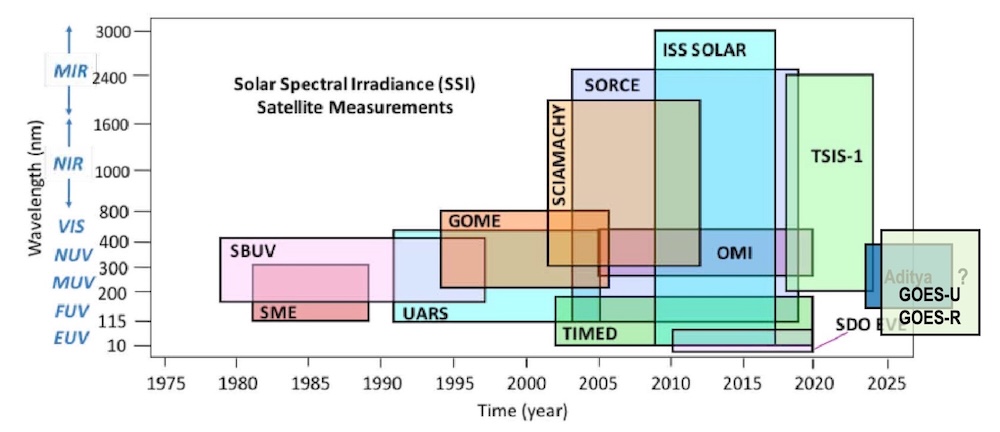
Figure 1: Inventory of SSI monitoring missions through time with potential missions active during the EnVision mission (adapted from [8]).
4. to assess tools that have been developed to predict SSI for positions other than Earth’s in the Solar System like the Flare Irradiance Spectral Model (FISM) developed at LASP [7] and how they could be used during the mission.
5. to work on data taken at Venus by previous missions, such as Venus Express, to assess the validity of the methodology developed to obtain relevant SSI constraints at Venus’ position during the science phase of EnVision.
Conclusion & Perspectives
The Solar observations Working Group of the VenSpec spectrometry suite for the EnVision mission has started to develop a methodology to derive relevant SSI information at Venus for spectral calibration and data analysis. Preliminary assessments and applications of the methodology will be presented at the conference.
References
[1] Helbert, Jörn, et al. Infrared remote sensing and instrumentation XXVII. Vol. 11128. SPIE, 2019.
[2] Marcq, E., et al. Advances in Space Research 68.1 (2021): 275-291.
[3] Lustrement, B., et al. In Infrared Remote Sensing and Instrumentation XXXII, vol. 13144, pp. 164-196. SPIE, 2024.
[4] Robert, S., et al. Journal of applied remote sensing 19.1 (2025): 014525. doi: 10.1117/1.jrs.19.014525
[5] Woods, T. N., and M. T. DeLand. Earth and Space Science 8.8 (2021): e2021EA001740.
[6] Heath, D. F., and B. M. Schlesinger. Journal of Geophysical Research: Atmospheres 91.D8 (1986): 8672-8682.
[7] Chamberlin, P. C., et al. Space Weather 18.12 (2020): e2020SW002588.
[8] Woods, T. N., et al. Solar physics 293.5 (2018): 76.
Jeremie Lasue1, David Bolsée2, Giulia Alemanno3, Arturo Lopez Ariste1, Lucio Baggio4, Sandrine Bertran4, Baptiste Chide1, Lucile Conan4, Anthony Juin5, Baptiste Leduc4, Benjamin Lustrement4, Emmanuel Marcq4, Nuno Pereira2, Patrick Pinet1, Victor Reville1, Séverine Robert2, Nicolas Rouanet4, Alexis Rouillard1, Aurélien Stcherbinine1, Ian Thomas2, Sandrine Vinatier6
How to cite: Lasue, J., Bolsee, D., Alemanno, G., Lopez Ariste, A., Baggio, L., Bertran, S., Chide, B., Conan, L., Juin, A., Leduc, B., Lustrement, B., Marcq, E., Pereira, N., Pinet, P., Reville, V., Robert, S., Rouanet, N., Rouillard, A., Stcherbinine, A., and Thomas, I. and the VenSpec Solar Observations Working Group: Activities of the VenSpec Solar Observations Working Group in preparation for the EnVision mission, Europlanet Science Congress 2026, The Hague, The Netherlands, 7–11 Sep 2026, EPSC2026-534, https://doi.org/10.5194/epsc2026-534, 2026.


