
 1,1,3
1,1,3- 1Univ. Grenoble Alpes, CNRS, IPAG, 38000 Grenoble, France
- 2Univ. Grenoble Alpes, CNRS, OSUG, 38000 Grenoble, , France
- 3Univ. Paris-Saclay, CNRS, IAS, Orsay, France
Introduction
The SSHADE database infrastructure (http://www.sshade.eu), initially developed within the Europlanet-2020 and 2024 RI programs, contains two main types of data. First, it hosts the databases of about 30 experimental research groups from 15 countries working on spectroscopy of solids. This large set of databases currently provides over 9,200 spectra of many different types of solids (ices, minerals/rocks, carbonaceous matters, meteorites, …) over a very wide range of wavelengths (mostly X-ray and VUV to sub-mm). One of the main advantages of SSHADE is to provide a comprehensive set of metadata on the sample and the spectral measurement.
The second spectral product offered by SSHADE is its world-unique ‘band list database’ providing lists of UV-Vis-IR absorption bands and Raman emission bands of molecular solids and minerals of astrophysical, planetary and geoscience interest.
SSHADE has already a large and fast-growing user’s community with over 1,100 registered researchers (350+ new users expected in 2026).
SSHADE band lists
The band list database contains the characteristics (band position, width, intensities, isotopic species involved, mode assignment, …) of electronic, molecular vibration and crystal phonon bands of molecular solids (ices, simple organics) and minerals in various phases (crystalline, amorphous, ...) at different temperatures or pressures. It includes two sub-databases, one for UV-Vis-IR absorption spectroscopy and the second for Raman emission spectroscopy.
We are feeding this database through exhaustive compilations and critical reviews of all spectral data published in various journals and in SSHADE itself, on molecular solids and their simple compounds (binary solid solutions, hydrates, clathrates, ...) as well as on fundamental minerals.
Over the last years we published the absorption band lists of 23 ices and two minerals as well as the Raman band lists of 33 minerals, mostly carbonates, and 10 ices.
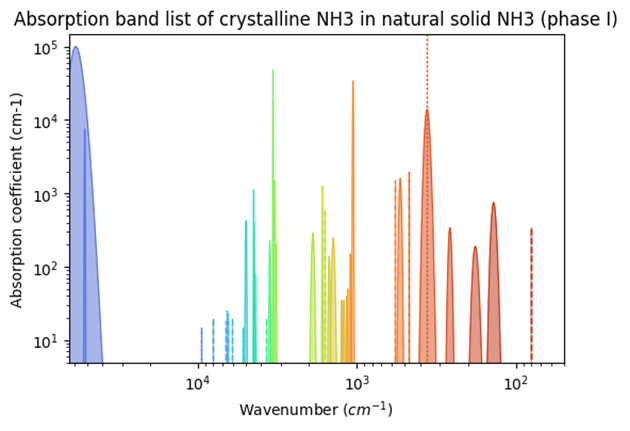
Figure 1: Absorption bandlist of crystalline NH3 (phase I).
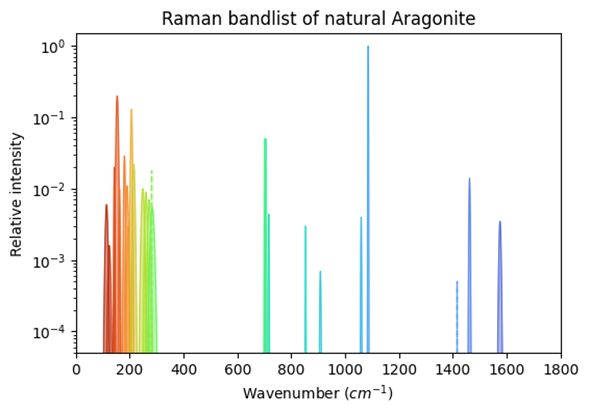
Figure 2: Raman bandlist of Aragonite.
An efficient search tool allows you to search either a band list or a specific band thanks to a set of filters on various parameters, such as band position, width and intensity, expected molecular or atomic composition. The selected band list can be displayed graphically and the data can be exported as a table containing the main parameters of all the bands of the band list, as well as detailed metadata. A data reference and a DOI are associated with each band list.
SSHADE-Band list is now also a service of the VESPA Virtual Planetary Observatory. It is accessible via the EPN-TAP protocol, which allow comparison with observational data and mass processing in the VESPA environment or in other services.
Spectral tools
In order to allow the SSHADE users to compare their own astronomical or laboratory spectra with data provided in our databases, we developed a series of tools to import and store user spectra, plot them together with SSHADE data and apply various conversion operations to the spectra.
- The user’s data import tool
It allows a registered user to import and manage its own spectra (in ascii/csv format) in SSHADE before comparing them with SSHADE spectra or band lists. After comparison, the user can keep it in its protected private space in SSHADE or delete it.
Comparison and data conversion tools: The Comparator Tool
- Compare spectra across datasets: This tool allows to dynamically plot spectra from different experiments, from various solids, instruments or experimental conditions across the databases hosted by SSHADE. It is also possible to compare them with band lists.
- Convert spectra
A number of conversion and calculation options have been recently developed for transmission, absorbance, absorption coefficient and optical constants spectra. This tool, which will soon be available publicly on SSHADE, allows to determine absorption coefficient from absorbance, knowing the thickness of the sample, to convert absorption coefficients to imaginary indices, and inversely. It also allows to calculate absorbance from transmission spectra and derive absorption coefficients. Reversely, it can simulate the transmission spectrum of a sample of known thickness from either absorption coefficients or optical constants.
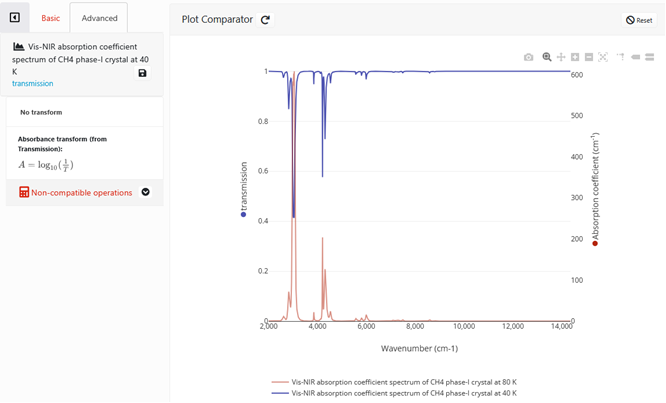
Figure: Comparison and calculation tool of SSHADE and user spectra.
- Export
The converted spectra can be stored in the user personal space and exported using the SSHADE export customization tool.
- Ongoing and future developments
We are working to enrich the ‘Comparator Tool’ with more advanced tools for spectroscopists, including a ‘convolution tool’ that will allow to perform a spectral convolution of the SSHADE laboratory spectra at the specific resolution and sampling of a series of past, current and future space instruments.
Acknowledgements
We acknowledge support from OSUG for its financial and manpower supports, CNES for its financial support through the SBDSC program. The Europlanet 2024 Research Infrastructure project received funding from the European Union's Horizon 2020 research and innovation programme under grant agreement No 871149.
References
- Schmitt, B., et al. (2018) SSHADE: "Solid Spectroscopy Hosting Architecture of Databases and Expertise" and its databases. OSUG Data Center. Service/Database Infrastructure. doi:26302/SSHADE
How to cite: Schmitt, B., Albert, D., Dode, E., Mandon, L., Bonal, L., and Dionnet, Z.: The SSHADE database infrastructure for Solid Spectroscopy: Evolutions 2023-2026 , Europlanet Science Congress 2026, The Hague, The Netherlands, 7–11 Sep 2026, EPSC2026-541, https://doi.org/10.5194/epsc2026-541, 2026.


