
 1,2,1
1,2,1- 1Université Versailles Saint-Quentin, IPSL, LATMOS, Guyancourt, France (emmanuel.marcq@latmos.ipsl.fr)
- 2LIRA, Observatoire de Paris PSL, Meudon, France
Sulphur dioxide (SO2) is arguably the most variable trace at Venus’ cloud top, with observable column density variations spanning about 2-3 orders of magnitude over spatial extents ranging from a few hundred of kilometers to planetary scale, and over time scales ranging from about an Earth day to several decades [2, 3, 1-6]. The most recent extensive datasets on the day side have been acquired by the UV spectrometer SPICAV-UV on board ESA’s Venus Express (2006-2014) operating in nadir mode, and by the UV imager UVI on board JAXA’s Akatsuki (2015-2025), both using SO2 UV absorption featured in the solar light reflected by the cloud top.
Both instruments agree about the latitudinal distribution of SO2, enhanced at lower latitudes compared to higher latitudes due to the interplay between the vertical-meridional general circulation and photochemical destruction. There is however a discrepancy between the two datasets regarding the SO2 distribution with respect to local solar time. Whereas SPICAV-UV [3] found a minimum near the subsolar point at noon, UVI [5] evidenced a morning/evening asymmetry with an afternoon maximum, consistent with the effect of solar tides and with recent 3D photochemical-dynamical coupled numerical models [4].
Recent advances in radiative transfer numerical calculations, especially involving 3D Monte-Carlo solvers such as htrdr-planets [7], now allow for simulating accurately the solar light scattered even for large solar zenith angle values such as near the morning and evening terminators (Fig. 1). This part of the SPICAV-UV dataset could not be processed before using pseudo-spherical radiative transfer solvers like DISORT, and thus the corresponding reflectance spectra were dismissed from previous analyses. Using an updated Venus atmospheric model and a corrective approach involving both DISORT and htrdr-planets (combining DISORT’s computation speed and htrdr-planets’ accuracy), we will present our reanalysis of the whole SPICAV-UV data set, including regions near the terminator. We will then examine if the trends seen in climatological variables such as SO2, O3, cloud top altitude, or the UV absorber with respect to latitude, longitude and local solar time are consistent with previous findings.
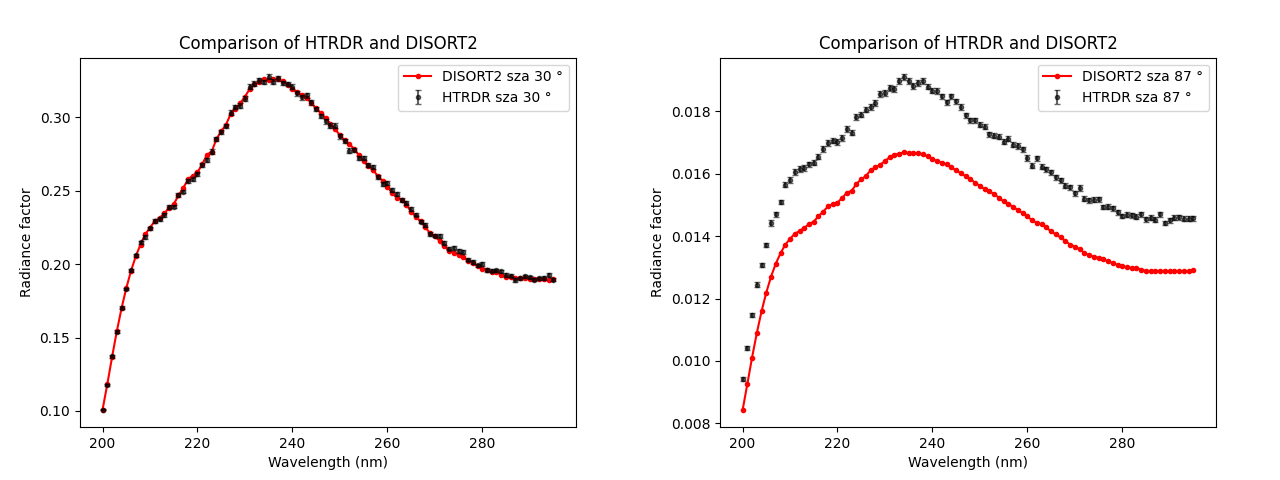 Figure 1: Comparison of synthetic radiance factors for the nominal case using two different solvers, DISORT (pseudo-spherical, red) and htrdr-planets (Monte Carlo 3D, black). Both solvers agree at low solar zenith angle (SZA) values, but DISORT underestimates significantly Venus’ brightness for a grazing Sun near the terminator.
This work has been funded by the French National Research Agency (ANR), project RaD3-net, grant number ANR-21-CE49-0020.
-
Bibliography
-
[1] Encrenaz et al., A & A (2012)
-
[2] Marcq et al., Nature Geosci. (2013)
-
[3] Marcq et al., Icarus (2020)
-
[4] Stolzenbach et al., Icarus (2023)
-
[5] Iwanaka et al., JGR Planets (2025)
-
[6] Encrenaz et al., A & A (2025)
-
[7] He et al., JQSRT (2026)
How to cite: Salugová, E., Marcq, E., He, Z., Vinatier, S., and Bertaux, J.-L.: Cloud top sulphur dioxide measurements from the morning to the evening terminator on Venus, Europlanet Science Congress 2026, The Hague, The Netherlands, 7–11 Sep 2026, EPSC2026-549, https://doi.org/10.5194/epsc2026-549, 2026.


