
 ,
,- University of Valencia, Astronomical Observatory, Valencia, Spain (beatriz.ramirez@ext.uv.es)
Wouldn’t it be nice to learn computational thinking while exploring Mars? In Aula del Cel at the Observatori Astronòmic of the University of Valencia, we have been assisting the educational community for over twenty years with the aim of turning the Universe into our everyday classroom.
The purpose
Our primary goal is always to inspire youth through meaningful learning obtained from experience and evidence. We set the path to this sort of learning by means of our hands-on activities based on real data obtained from scientific research.
For the activity presented in this abstract, we have chosen Mars as a learning scenario due to its widespread presence in popular culture. Cinema, literature and also scientific journalism have been echoing human aspirations to set up a permanently inhabited base on the red planet. But before human exploration starts, robotic exploration, on the ground and in orbit, has been paving the way for several decades now leading to a deep knowledge about our red neighbour that often differs from the image that has settled down in our students’ minds.
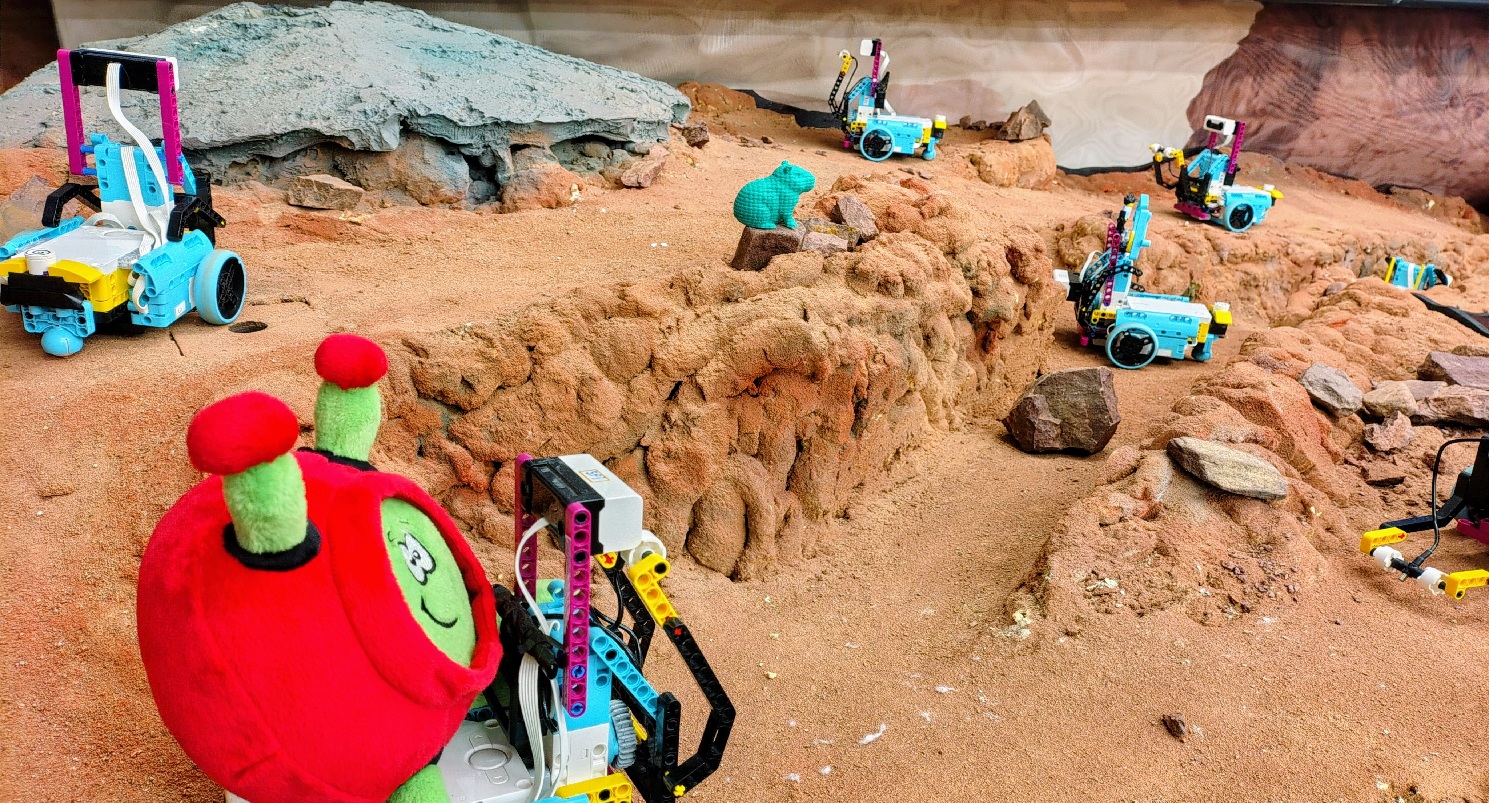
This activity is addressed to lower and upper secondary students, and its overall goal is to develop computational thinking by inviting the students to become software development engineers for a day. The participating teams are required to program a squad of Lego Spike Prime rovers that will have to move autonomously along a Martian model and complete their mission tasks.
The specific targets of the activity are:
- To “rescue” the topic of the red planet from the fantasy realm and bring it to the classroom desk in the form of a list of quantitative properties such as size, distance to the Sun, temperature, gravity, and orbital parameters.
- To offer the students an approach to Mars geography letting them become familiar with its most relevant features such as Olympus mount, Marineris valley, Gale crater or Utopia plain.
- To allow students to assess the difficulties inherent to robotic exploration and solve them by means of engineering skills.
- To develop computational thinking by letting them “think as a rover” and enabling the identification of different sorts of tasks.
- To let the students become familiar with the nature of scientific work, not limited to the scientific method and its stages but understood also as a purely cooperative task involving interpersonal skills and widespread cultural exchange.
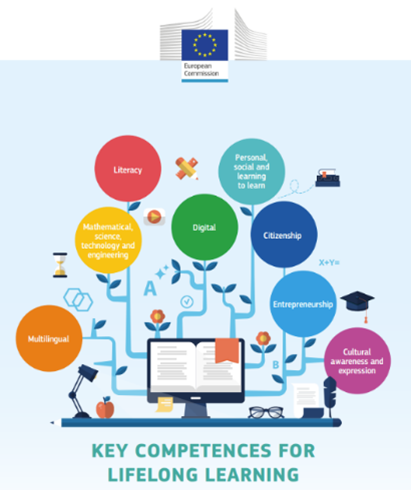
The tasks involved in this activity not only should provide the students with a glimpse of the characteristics of Mars but also, by means of the cooperative work required, they will allow them to develop several educational key competences. We are referring to the “European Commission Key competences for lifelong learning” spanning from the more obvious steam competences until cultural awareness, multilingual or citizenship competences.
The tools and materials
This engaging classroom activity poses several challenges to the students, some of which we list hereafter:
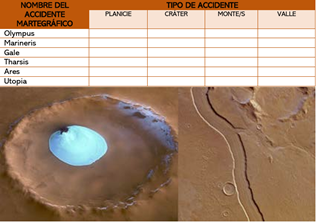
- Exploring a satellite view of Mars in search of geographic features and sorting them out as mounts, valleys, craters or plains.
- Estimating the planet's properties using those of the Earth as reference and checking them out.
- Programming basic orders of machine autonomous movement differentiating from one-time actions to looping actions.
- Programming complex orders based on the use of sensors and decision-making algorithms aimed at avoiding obstacles, detecting cracks or holes on Mars' surface and inserting a thermometer probe placed at the end of a robotic arm into one of these cracks.
- Modifying the physical setup of the rover’s instruments and sensors so that they better suit the proposed goals.
They deal with these challenges with the help of a selection of materials and tools as diverse as the audience. The activity requires that the students make use of cutting-edge online tools, a handcrafted Mars model, commercial software and a full Lego Spike Prime kit per team, as well as a guiding activity sheet.
The making of
The activity invites the participants to become engineers for a day. It is conceived as a training + mission itinerary consisting of three successive milestones:
Milestone 1 – What do we know about Mars thanks to robotic exploration?
First, the students are required to dive into scientific data by means of two tasks.
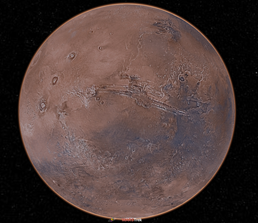
Task 1: make use of the data published in the NASA Mars Trek tool, which is a portal that showcases data collected at various landing sites. They are required to look for several geographic features and, based on what they actually see, classify them as mounts, valleys, craters, or plains.
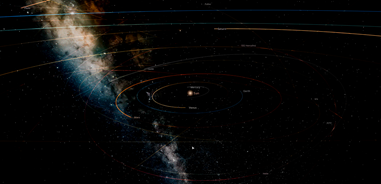
Task 2: make use of the commercial software Sandbox Universe to check out their estimations about Mars properties compared to those of Earth.

Milestone 2 – Meet your rover
Second, the students become familiar with the Lego rover that shall be programmed to fulfill the mission.
Each rover on the desk has an ID card and has been assigned the name of a real Martian rover: Sojourner, Spirit, Opportunity, Curiosity, Perseverance, Zhurong and Rosalind Frankin are our seven rovers. The ID cards contain technical data and facts about the corresponding true rover.
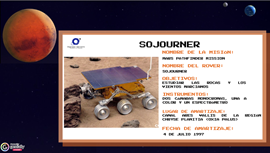
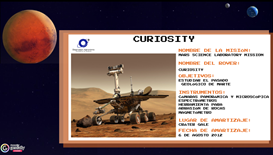
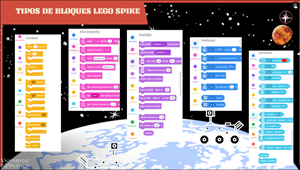
Now the training in programming begins by introducing basic orders and sensors with the help of a supporting presentation. The trainees are asked to develop basic autonomous movement programs which are verified in a test environment: a large and plain table.

Milestone 3 - Program your mission
Third, the students are requested to program the code required for their mission: detect cracks on Mars surface and insert a probe into them or detect obstacles and avoid them.
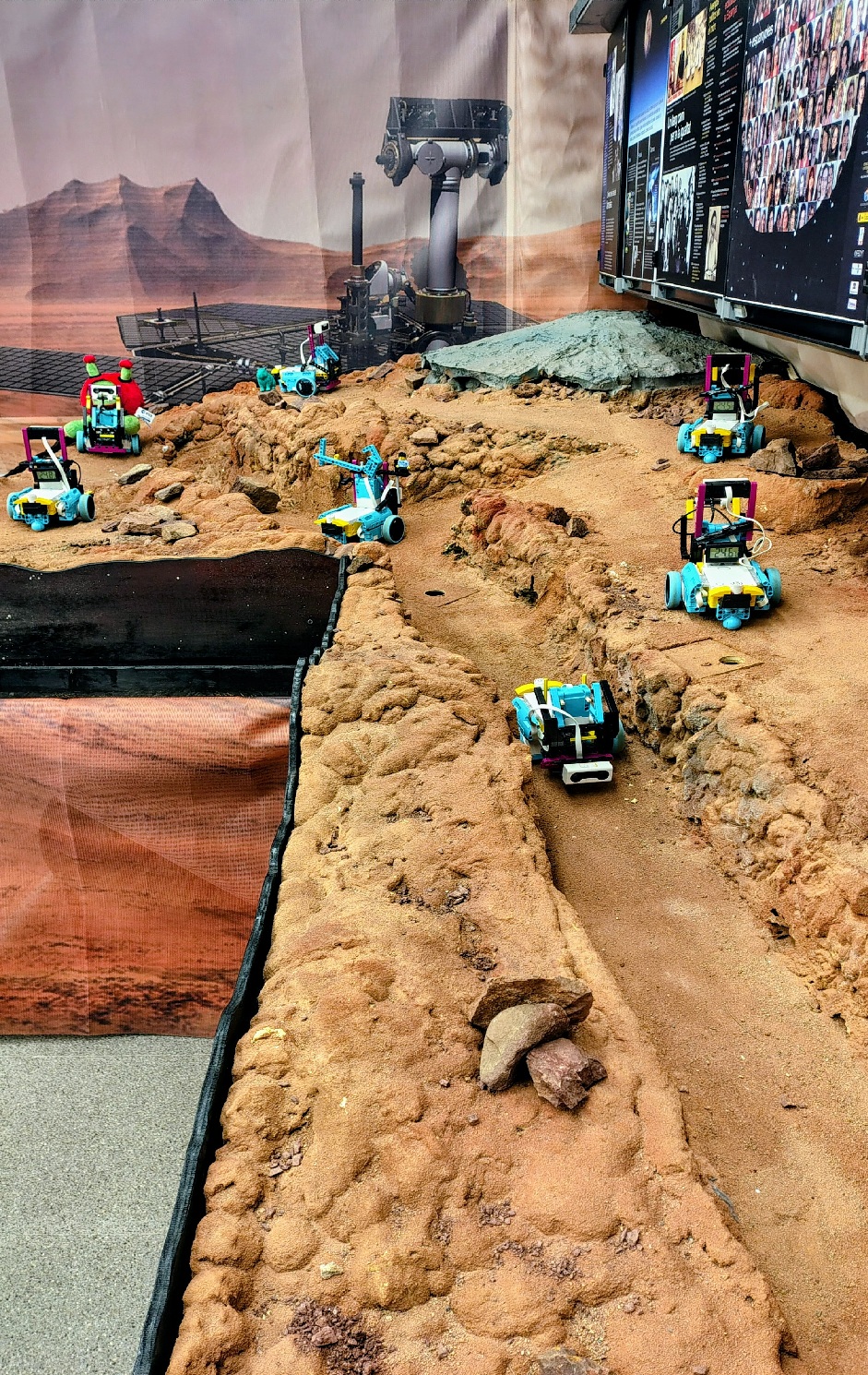
This code together with the rover performance are verified in a “real” environment, this is a custom-made Mars model that recreates (non-scale) both the Olympus mount and Marineris valley. This model has been handcrafted by a local artist specifically for the Aula del Cel.
Conclusion
At the end of the session, the students collect a commemorative badge that credits the accomplishment of all the milestones throughout the activity. They leave the Aula del Cel with a smile and a much richer view of Mars and computational science: a meaningful learning experience.
How to cite: Ramírez Velado, B., Moya Lucas, M. J., and Ortiz Gil, A.: Thinking as a Martian rover, Europlanet Science Congress 2026, The Hague, The Netherlands, 7–11 Sep 2026, EPSC2026-559, https://doi.org/10.5194/epsc2026-559, 2026.


