
 ,
,- GEOPS (Geosciences PARIS SACLAY), CNRS UMR8148, Université Paris-Saclay, Orsay, France
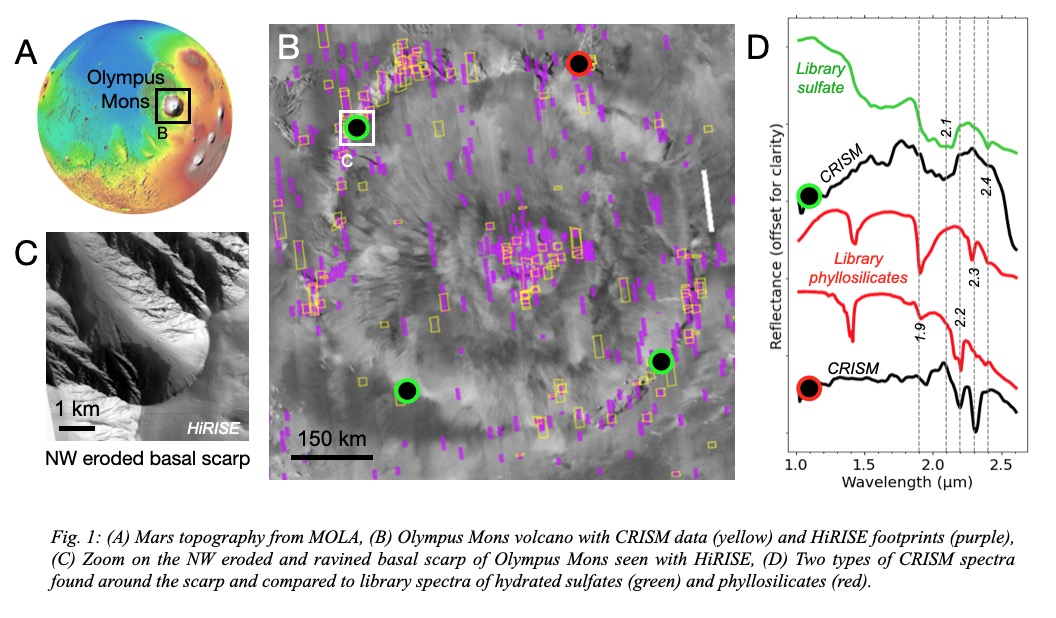
Introduction: The MGS/MOLA topography data of Mars shows a dichotomy between the highly craterised and elevated southern hemisphere compared to the northern smoother and low-altitude terrains1 (Fig. 1A). Many morphological and mineralogical clues today support the existence of a past liquid water ocean in the northern hemisphere of Mars, such as a large sedimentary formation in the North2-3; possible paleo-shorelines following the topographic dichotomy between the two hemispheres4-5; a network of fluvial valleys oriented northward6-7; deposits of an ancient tsunami caused by an impact8 as well as hydrated mineralogy9-12. However, the spatio-temporal extent of this ocean remains poorly constrained. It is argued that such an ocean could have existed until at least 3 Gyr in Mars’ history13. A recent study highlights the morphological resemblance between Olympus Mons, the largest volcano of the solar system on Mars located at the dichotomy, and terrestrial volcanic islands (Canary, Azores, Cape Verde, Hawaii…) today still surrounded by the ocean, which display a 15° basal scarp average slope break14. Could Olympus Mons once have been a volcanic island? Here we further explore this hypothesis by studying the mineralogy and morphology of Olympus Mons using hyperspectral and high resolution imagery data.
Methodology: Here we aim to determine if hydrated minerals can be found around the edifice of Olympus Mons, and thus imply a past interaction of volcanic rocks with water. We used hyperspectral data from the MRO/CRISM spectrometer15 to get insights on the mineralogy of Olympus Mons’ basal scarp (Fig. 1B). Pre-processing16 was followed by a photometric and atmospheric correction, a smoothing pipeline17 and the calculation of spectral parameter maps18 to localize potential hydrated minerals which typically absorb in the near infrared 1.0-2.6 µm range. To better constrain the precise geomorphology of a putative water-volcano contact where hydrated mineralogy is suspected, we also studied the morphology of the basal scarp using MRO/HiRISE images at a resolution of up to 30 cm/pixel19 (Fig. 1B).
Results & Discussion: The flanks and summit caldera of Olympus Mons, above 6 km of altitude and therefore supposedly never in contact with an ocean, spectrally show a highly widespread signal with no remarquable absorption bands on the range of 1.0 to 2.6 µm, interpreted as the iron-rich basaltic primary composition of rocks covered in a high amount of dust at the surface of the volcano. We also find dominant signatures of water ice with strong features at 1.5 and 2.0 µm, in several locations of the volcano flanks and basal scarp. However, we also find spectral signatures that we interpret as signs of hydrated mineralogy in several locations around the volcano. These spectra either show an absorption band around 2.1 µm, similarly to mono-hydrated sulfates, or bands at 2.2 and 2.3 µm, typically found for hydrated phyllosilicates (Fig. 1D). These features occur in the basal scarp (Fig. 1C), precisely where the rock is expected to outcrop under a lower dust cover in steep slope ravines. The scarcity of detections either suggests that the volcano’s mineralogy is barely hydrated, or that the hydrated spectral signatures are mainly hidden by the dust cover even in most places of the basal scarp. In any case, if these detections are not yet a confirmed evidence of an ancient volcano-ocean contact, they could be a sign of volcanic interaction with liquid water in the past of Mars in the region of Olympus Mons.
Conclusions & Perspectives: No in-situ data is today available in the area of Olympus Mons. Hence, to further test if Olympus Mons could have been an ancient volcanic island, we presently analyze a terrestrial volcanic analog that could inform on alteration conditions and processes of volcanic rock in contact with a liquid water ocean. We expect this comparative study to better constrain the observed spectral signatures around Olympus Mons.
Acknowledgments: This work has been financially supported by the National Planetology Program (PNP) of the National Institute of Universe Sciences (INSU-CNRS) and benefited from financial support from the CNES Research Proposal Call (APR).
References: [1] Smith, D. E. et al. (1998) Science 279 (5357): 1686–92. [2] Tanaka K. L. and Scott D. H. (1987) USGS IMAP 1802-C. [3] Carr M. H. and Head J. W. (2003) JGR: Planets 108 (5). [4] Parker J. T. et al. (1993) JGR 98 (E6). [5] Sholes S. F. et al. (2021) JGR : Planets 126 (5). [6] Carr M. H. and Clow G. D. (1981) Icarus, Vol. 4. [7] Baker et al. (1982) Reports of Planetary Geology Program. [8] Costard F. et al. (2017) JGR: Planets 122 (3): 633–49. [9] Poulet F. et al. (2005) Nature 438 (7068): 623–27. [10] Fueten F. et al. (2014) JGR: Planets119 (2): 331–54. [11] Flahaut J. et al. (2015) Icarus 248 (March):269–88. [12] Brossier J. et al. (2024) ResearchGate conference paper. [13] Schmidt F. et al. (2022) PNAS, Vol. 119, No. 4. [14] Hildenbrand A. et al. (2023) EPSL 619. [15] Murchie S. et al. (2007) JGR, 112. [16] Quantin-Nataf C. et al. (2018) Planetary and Space Science 150, 157-170. [17] Bultel B. et al. (2015) IEEE Journal of Selected Topics in Applied Earth Observations and Remote Sensing 8.6, 3039-3049. [18] Viviano-Beck C. E. et al. (2014) JGR: Planets 119 (6): 1403–31. [19] McEwen A. et al. (2007) JGR, 112.
How to cite: Cornillon, A., Bultel, B., and Hildenbrand, A.: Hydrated mineral features suggested around Olympus Mons on Mars using CRISM and HiRISE: implications on water-volcano interactions , Europlanet Science Congress 2026, The Hague, The Netherlands, 7–11 Sep 2026, EPSC2026-56, https://doi.org/10.5194/epsc2026-56, 2026.


