
 1,1,
1,1,- 1J.Heyrovsky Institute of Physical Chemistry, CAS, Prague, Czechia
- 2ELI Beamlines, Institute of Physics, CAS, Prague, Czechia
- 3Leipzig University, Chemical Technology, Leipzig, Germany
- 4Laboratoire de Physique et Chimie de l’Environnement et de l’Espace (LPC2E), Orléans, France
The ability to determine the composition of extraterrestrial material directly in space is fundamental for future planetary and astrobiological research. Mass spectrometry provides a versatile approach for the analysis of micrometeorites, cosmic dust, and particles originating from atmospheres and surfaces of distant planetary bodies.
HANKA (~ Mass Analyzer for Cosmic Applications ) is a next-generation high-resolution mass spectrometer developed for in-situ space applications under strict resource constraints. It represents a versatile payload candidate for CubeSats up to large-scale missions. HANKA employs an Orbitrap™ electrostatic ion trap analyzer known for exceptional high mass resolution, accuracy and wide mass range (up to 2000 amu).
A laboratory prototype of HANKA has been constructed, and its capability to meet the requirements of high-resolution mass spectrometry has been proved experimentally. Measurements of solid particles produced detailed mass spectra with a resolving power exceeding 100 000 (m/ΔmFWHM) at the m/z 200, together with valid mass accuracy and isotopic ratio determination.
In addition to its analytical performance, the instrument was designed with emphasis to minimize the size, weight, and power requirements. A proposed 4U CubeSat configuration of HANKA incorporates a hypervelocity impact ionization source, the concepts previously demonstrated by the CDA space instrument. Current development efforts to reduce power consumption and size of the electronics.
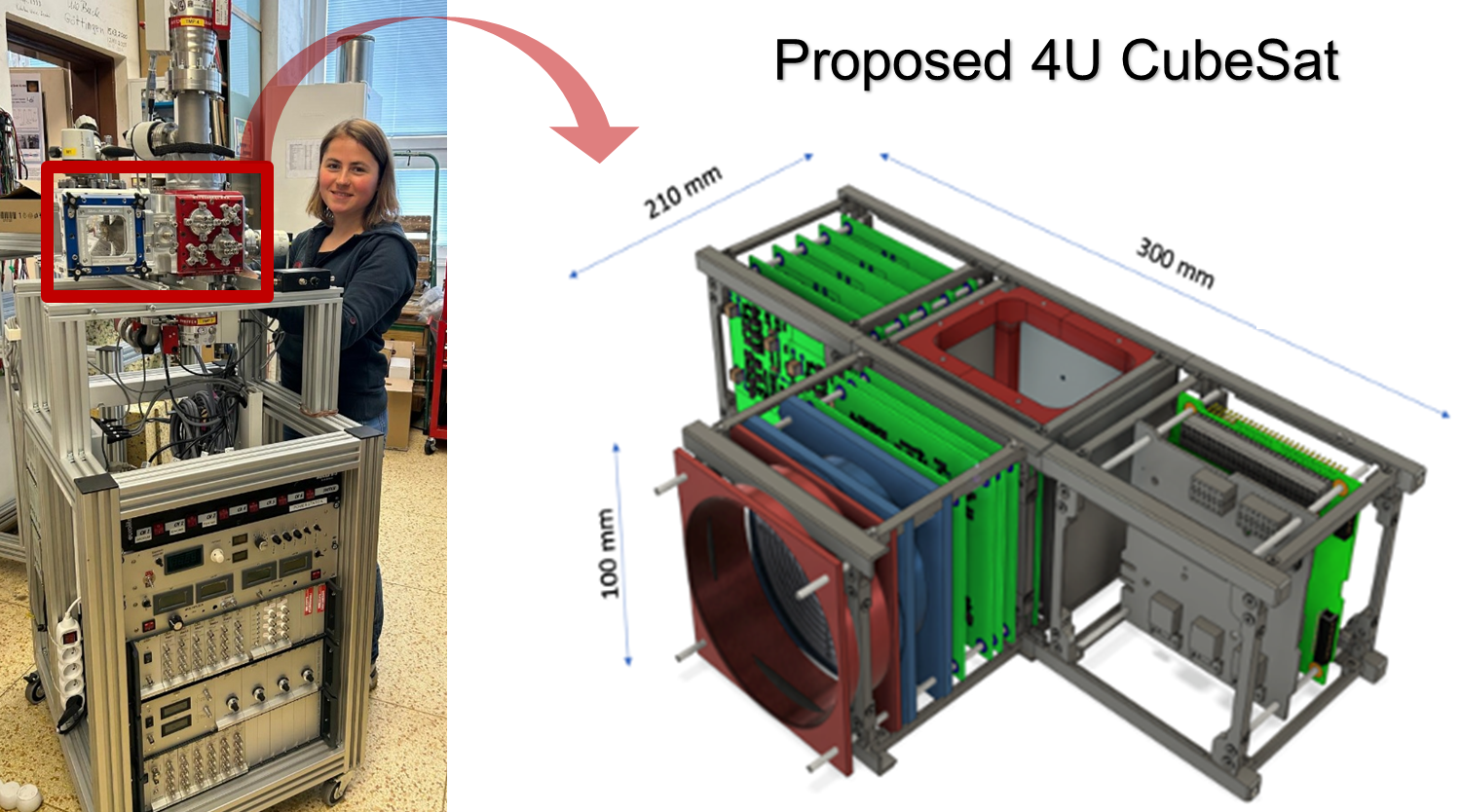
HANKA laboratory prototype (left), and proposed 4U CubeSat configuration (right).
In summary, HANKA combines high-resolution mass spectrometry and compact design. The instrument has the potential to provide comprehensive chemical characterization of complex space dust and micrometeorite particles during future space missions. The analytical performance and capabilities of the instrument will be demonstrated through experimental results obtained by the laboratory prototype.
Acknowledgements: This work was supported by European Union ERA-Chair Project 101186661 ─ SPACE, and the Czech Science Foundation through grant No. 24-13757L.
References
- Briois C., Thissen R., Thirkell L., et al.; Planet Space Sci. 2016, 131, 33‐45.
- Makarov A.; Anal. Chem. 2000, 72, 1156–1162.
- Sanderink A., Klenner F., Zymak I., et.al.; Anal. Chem. 2023, 95, 3621−3628.
- Zymak Y., Zabka J., Polášek M., et al.; al.; Aerospace 2023, 10(6), 522.
- J. Goldsworthy et al., A&A 2003, 409, 1151–1167
How to cite: Malečková, M., Žabka, J., Zymak, I., Spesyvyi, A., Charvát, A., Lebreton, J.-P., and Abel, B.: HANKA: CubeSat Space Dust Analyser, Europlanet Science Congress 2026, The Hague, The Netherlands, 7–11 Sep 2026, EPSC2026-564, https://doi.org/10.5194/epsc2026-564, 2026.


