EPSC Abstracts
Vol. 19, EPSC2026-577, 2026, updated on 02 Jul 2026
https://doi.org/10.5194/epsc2026-577
Europlanet Science Congress 2026
© Author(s) 2026. This work is distributed under the Creative Commons Attribution 4.0 License.

From Student Curiosity to Space Readiness: A Case Study of Hub Based, Multi Domain Pre-University Aerospace Pathway
- Lycée Vauban, Luxembourg (leonore.gibert@gmail.com)
Planetary science education frequently utilizes outreach events, competitions, and inspirational encounters as key components of its educational strategy. These factors can be influential, but their long-term impact is contingent on whether they become integrated into a cohesive developmental pathway. This contribution presents a case study of how space readiness can be developed before university through early exposure, mentorship, institutional access, technical projects, peer teams, and public science communication.
The case follows Léonore Gibert, a female high school student in Luxembourg whose journey began at the age of 14. At that time, she was not yet strongly STEM oriented, but rather a generalist student with broad interests. Her initial foray into research was initiated through a space-related citizen science project. Over the following years, this initial curiosity evolved into a multifaceted initiative encompassing space outreach, planetary defense, student engineering projects, robotics, amateur radio, aviation, scientific communication, and academic writing.
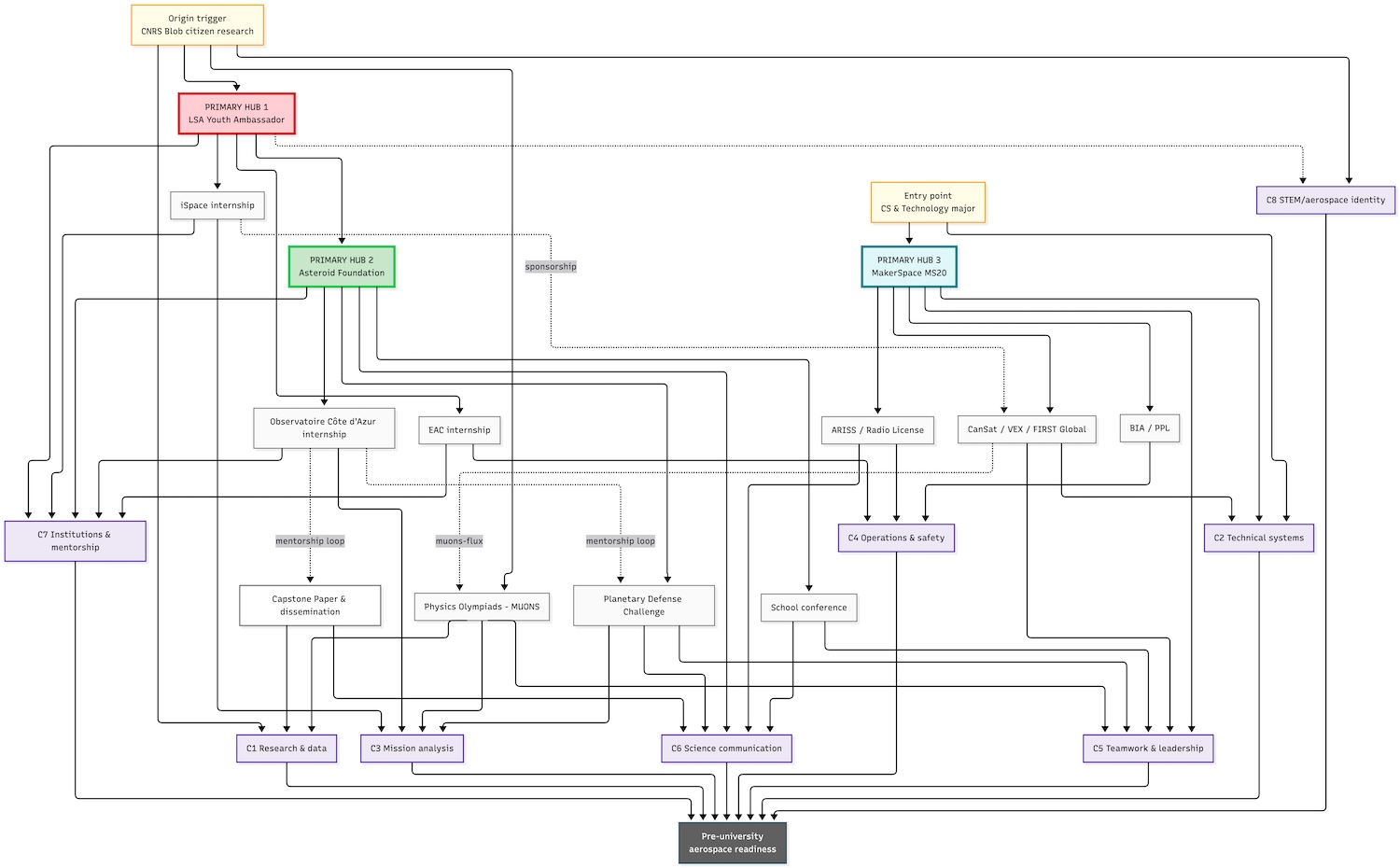
Rather than presenting the pathway as a chronological list of achievements, the paper analyzes it as a developmental network centered on hubs. Three primary hubs have been identified: a national space agency ambassador role, asteroid and planetary defense volunteering, and a school technical ecosystem. These hubs have yielded a variety of outcomes, including research exposure, mission-style student projects, public outreach, industry contacts, aviation, radio operations, and scientific communication. The case also examines feedback mechanisms: recognition created access, access created mentorship, mentorship clarified scientific standards, and those standards supported more advanced projects and further recognition. Concurrently, recurring student teams established a peer network that contributed to maintaining motivation and technical ambition across projects.
The case is pertinent to the issue of underrepresentation in the fields of planetary science and aerospace, a topic of crucial importance in our current business environment. It illustrates how a young girl who did not initially identify as a STEM major gradually entered a scientific career path through accessible entry points, visible role models, structured challenges, mentorship, and peer support. The case indicates that a student's affiliation with the field of planetary science is not solely determined by aptitude or early specialization, but rather by repeated experiences where the student is acknowledged as a legitimate participant.
The case identifies several dimensions of pre-university space readiness, including experimental research habits, scientific reasoning, mission analysis, technical confidence, operational discipline, teamwork, public communication, institutional navigation, mentorship, and self-efficacy. These dimensions did not develop independently. They reinforced one another through connected activities, repeated participation, and feedback loops.
This presentation is also part of the pathway itself. It serves as a culminating stage where accumulated experiences are transformed into academic reflection, structured analysis, and scientific communication. The contribution asserts that empowering the next generation of planetary scientists necessitates more than isolated inspiration. In order to achieve this objective, it is necessary to establish pathways that connect curiosity to research practice, mentorship to standards, student projects to authentic scientific questions, and outreach to sustained participation. The model is designed to assist educational institutions, space agencies, scientific foundations, researchers, and outreach programs in establishing inclusive and credible pathways into the fields of planetary science and space-related STEM before university enrollment.
How to cite: Gibert, L.: From Student Curiosity to Space Readiness: A Case Study of Hub Based, Multi Domain Pre-University Aerospace Pathway, Europlanet Science Congress 2026, The Hague, The Netherlands, 7–11 Sep 2026, EPSC2026-577, https://doi.org/10.5194/epsc2026-577, 2026.


