ODAC10 | Empowering the Next Generation of Planetary Scientists

ODAC10

Empowering the Next Generation of Planetary Scientists
Convener: Mariana Sastre | Co-conveners: Vanesa Ramirez, Mara Attia
Orals THU1
| Thu, 10 Sep, 08:30–09:54 (CEST)|Room Earth (Tango 1)
Posters TUE-POS
| Attendance Tue, 08 Sep, 18:00–19:30 (CEST) | Display Tue, 08 Sep, 08:30–19:30|Foyer 3, F3.75
Thu, 08:30
Tue, 18:00
Access to planetary science education and research remains uneven across regions and socioeconomic contexts. In many parts of the world, talented students face structural barriers that limit their opportunities to engage with scientific careers, despite strong motivation and potential. Over recent years, a wide range of initiatives have emerged to address these challenges through school outreach, mentoring programs, research internships, training networks, and community-based projects. These efforts aim to introduce planetary science at early stages, support students through key academic transitions, and provide practical research experience and professional guidance. Such programs play a crucial role in fostering diversity, strengthening local scientific capacity, and building sustainable research communities. Many of these initiatives operate in close collaboration with universities, research institutes, and international networks, creating bridges between education, research, and society. By combining scientific expertise with local engagement, they contribute not only to individual career development but also to long-term institutional growth and regional empowerment.


This session will showcase experiences and results from programs and organizations working to build inclusive pathways into planetary science, particularly in underrepresented groups or regions. Contributions may include outreach projects, mentorship and internship schemes, capacity-building initiatives, community partnerships, and evaluations of long-term impact. In addition, participants will be invited to share lessons learned, discuss common challenges, and explore opportunities for collaboration. The session aims to serve as a platform for connecting initiatives, exchanging best practices, and fostering new partnerships that strengthen the global planetary science community.

Orals: Thu, 10 Sep, 08:30–09:54 | Room Earth (Tango 1)

Chairpersons: Mariana Sastre, Vanesa Ramirez
08:30–08:42
|
EPSC2026-1384
|
On-site presentation
Solmaz Adeli, Arianna Piccialli, Anita Heward, Noah Jäggi, Marina Molla, and Ann Carine Vandaele and the The Europlanet Diversity Committee

Europlanet is a non-profit association that promotes the advancement of European planetary science and related fields, for the benefit of the community, and is open to individual and organisational members. We are dedicated to creating a diverse and inclusive network that supports planetary science and related fields across Europe and globally. This is the main task of the Eruoplanet Diversity Committee (1, 2).

Our main aims are to promote equality, diversity and inclusivity in planetary science and related fields, with a particular focus on our annual meeting, the Europlanet Science Congress (EPSC), and workshops organised through Europlanet and its membership. The Committee members are the diversity officers from all the Europlanet Regional Hubs, in addition to representatives from the Europlanet Early Careers (EPEC) network and the Europlanet Executive Board. This structure enables close links between the Diversity Committee, the Hubs and other Europlanet structures, and ensures that diversity is embedded within all activities of the Europlanet Society. The Europlanet Diversity Committee also coordinates efforts with partner societies globally.


The Europlanet Diversity Committee supports efforts to foster engagement and collaboration with individuals and institutions from groups and countries that are under-represented in planetary science and to increase awareness of challenges faced within the community. In recent years, mentoring, expert exchanges, training, discounted fees and targeted meetings have all been offered to support diversity and inclusion. We have run annual wiki-edit-a-thons since 2020 to highlight the valuable contributions of women and under-represented groups within the international planetary science community. Since 2011, we have tracked trends in participation by under-represented countries in EPSC to try to better understand the current situation and identify barriers to participation, and craft effective responses to reduce them. We have also offered sessions, round-tables and short courses at EPSC and other Europlanet meetings to support the sharing of best practice and training in areas such as bystander intervention, mental health and wellbeing.


The Europlanet Science Congress (EPSC) is the annual meeting place of the Europlanet Society and is largest planetary science meeting in Europe. It covers the entire range of planetary sciences with an extensive mix of talks, workshops and poster sessions while providing a unique space for networking and exchange of experiences. For an event with this dimension and importance, it is crucial to think, discuss and improve the diversity, inclusiveness, and accessibility plan of EPSC to enable as wide an access as possible for the entire planetary science community worldwide. This is one of the main tasks of the Europlanet Diversity Committee.

The target groups that have been addressed by the Europlanet Diversity Committee are mainly: women, early career participants, researchers from the under-represented European countries, non- EU participants, colleagues with disabilities, people of color, other minorities, and allies. Each year, the Committee organizes various opportunities during EPSC to open a dialogue with the community, to collect their needs and to address solutions.

Measures implemented through the activities of Diversity Committee in the venue selection and operation of EPSC include: provision of food suitable for those with various dietary requirements, access to gender neutral washroom facilities, a raising of awareness for conveners regarding implicit bias and the importance of having diverse panel members, and generally normalizing the promotion and discussion of diversity in STEM at academic meetings, offering childcare, to parents with young children, in close collaboration with the Local Organizing Committee (LOC). The provision of a ‘Silent Room’ is now a tradition at EPSC, enabling participants to find refuge from the crowded conference, and offering a private and comfortable space for nursing mothers, prayers, or any other needs requiring isolation for a short time. Accessibility to the venue is always closely reviewed by the LOC and the Diversity Committee. Offering the congress in hybrid mode is another way of ensuring accessibility for those who can’t travel to attend the congress.

Exchange with the community and collecting feedback from the individuals are vital to a committee trying to ensure a diverse and inclusive atmosphere. In order to achieve this, we organize an annual Diversity Roundtable, Diversity sessions in the scientific programme, a diversity keynote talk during the ice-breaker on Sunday prior to EPSC, and various types of workshops and training. Feedback from all EPSC participants is also solicited through a form that asks respondents to share their thoughts and comments on what they liked and didn’t like about the meeting, and suggestions for change at future meetings. The summary of these findings are discussed by the EPSC and Diversity Committees to ensure that lessons are learned and the meeting adapts to the needs of the community.

The Diversity Committee of the Europlanet Society aims to highlight diversity within the planetary science community and to reduce the gender gap on Wikipedia. Therefore, we have been organizing, in collaboration with Women in Red and WikiDonne, since EPSC 2020, the Planetary Science Wiki Edit- a-thon. An Edit-a-thon (‘edit marathon’) is an organized event where editors from an online community (such as Wikipedia in this case) write, translate and improve articles on a specific topic. During EPSC, we provide basic training to start editing/writing Wikipedia articles. We also meet regularly throughout the year to continue to add and translate articles of women biographies and other under-represented communities in planetary science.

References: (1) Adeli et al., EPSC 2024 – (2) Heward et al., EAS 2025

How to cite: Adeli, S., Piccialli, A., Heward, A., Jäggi, N., Molla, M., and Vandaele, A. C. and the The Europlanet Diversity Committee: Advancing Diversity and Inclusion within Europlanet, Europlanet Science Congress 2026, The Hague, The Netherlands, 7–11 Sep 2026, EPSC2026-1384, https://doi.org/10.5194/epsc2026-1384, 2026.

08:42–08:54
|
EPSC2026-577
|
ECP
|
On-site presentation
Léonore Gibert
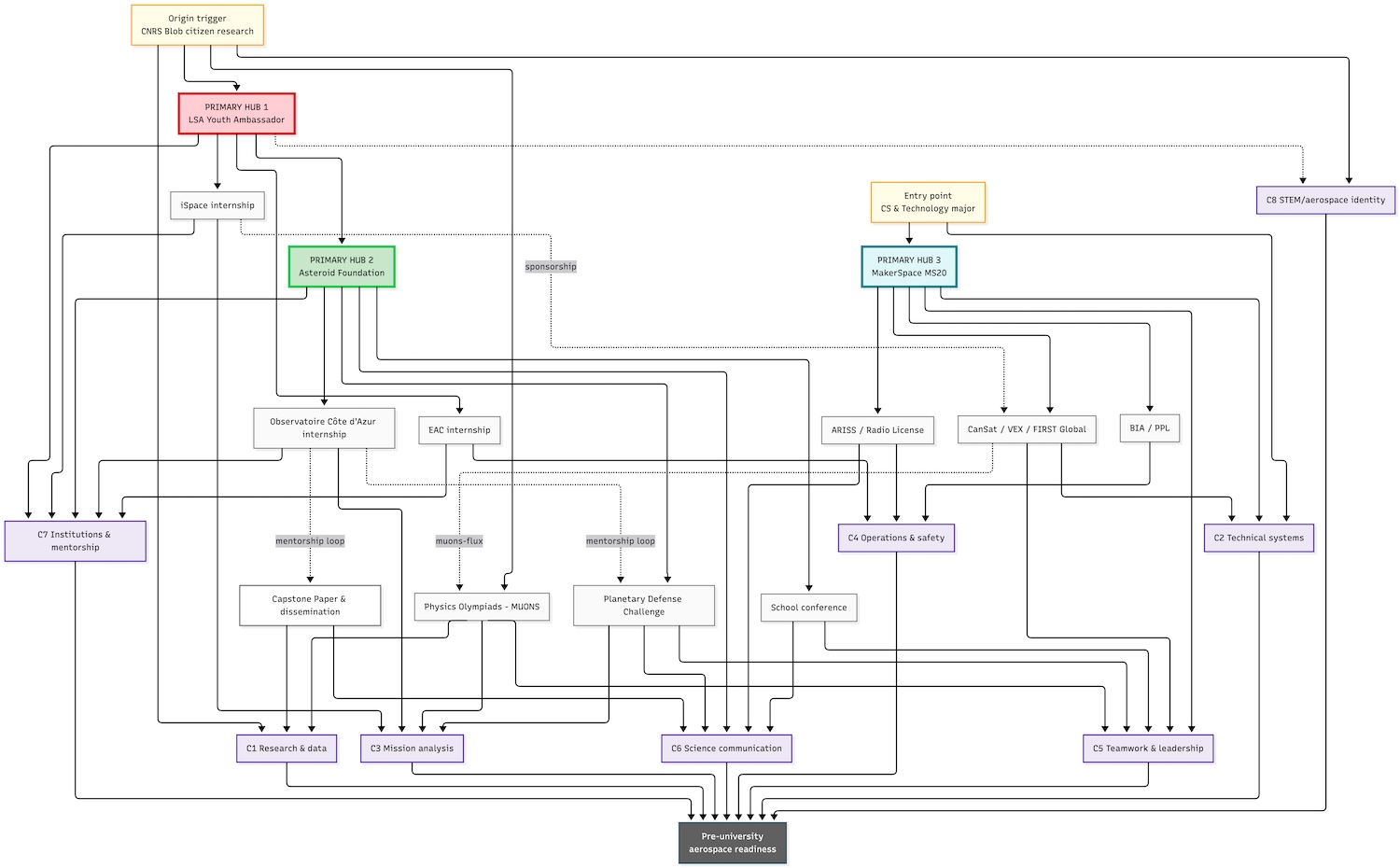
Planetary science education frequently utilizes outreach events, competitions, and inspirational encounters as key components of its educational strategy. These factors can be influential, but their long-term impact is contingent on whether they become integrated into a cohesive developmental pathway. This contribution presents a case study of how space readiness can be developed before university through early exposure, mentorship, institutional access, technical projects, peer teams, and public science communication.
The case follows Léonore Gibert, a female high school student in Luxembourg whose journey began at the age of 14. At that time, she was not yet strongly STEM oriented, but rather a generalist student with broad interests. Her initial foray into research was initiated through a space-related citizen science project. Over the following years, this initial curiosity evolved into a multifaceted initiative encompassing space outreach, planetary defense, student engineering projects, robotics, amateur radio, aviation, scientific communication, and academic writing.
Rather than presenting the pathway as a chronological list of achievements, the paper analyzes it as a developmental network centered on hubs. Three primary hubs have been identified: a national space agency ambassador role, asteroid and planetary defense volunteering, and a school technical ecosystem. These hubs have yielded a variety of outcomes, including research exposure, mission-style student projects, public outreach, industry contacts, aviation, radio operations, and scientific communication. The case also examines feedback mechanisms: recognition created access, access created mentorship, mentorship clarified scientific standards, and those standards supported more advanced projects and further recognition. Concurrently, recurring student teams established a peer network that contributed to maintaining motivation and technical ambition across projects.
The case is pertinent to the issue of underrepresentation in the fields of planetary science and aerospace, a topic of crucial importance in our current business environment. It illustrates how a young girl who did not initially identify as a STEM major gradually entered a scientific career path through accessible entry points, visible role models, structured challenges, mentorship, and peer support. The case indicates that a student's affiliation with the field of planetary science is not solely determined by aptitude or early specialization, but rather by repeated experiences where the student is acknowledged as a legitimate participant.
The case identifies several dimensions of pre-university space readiness, including experimental research habits, scientific reasoning, mission analysis, technical confidence, operational discipline, teamwork, public communication, institutional navigation, mentorship, and self-efficacy. These dimensions did not develop independently. They reinforced one another through connected activities, repeated participation, and feedback loops.
This presentation is also part of the pathway itself. It serves as a culminating stage where accumulated experiences are transformed into academic reflection, structured analysis, and scientific communication. The contribution asserts that empowering the next generation of planetary scientists necessitates more than isolated inspiration. In order to achieve this objective, it is necessary to establish pathways that connect curiosity to research practice, mentorship to standards, student projects to authentic scientific questions, and outreach to sustained participation. The model is designed to assist educational institutions, space agencies, scientific foundations, researchers, and outreach programs in establishing inclusive and credible pathways into the fields of planetary science and space-related STEM before university enrollment.

How to cite: Gibert, L.: From Student Curiosity to Space Readiness: A Case Study of Hub Based, Multi Domain Pre-University Aerospace Pathway, Europlanet Science Congress 2026, The Hague, The Netherlands, 7–11 Sep 2026, EPSC2026-577, https://doi.org/10.5194/epsc2026-577, 2026.

08:54–09:06
|
EPSC2026-184
|
ECP
|
On-site presentation
Javier Eduardo Suarez-Valencia, Nicole Jimeno-Ruiz, Daniela Mishell Caizapanta-Uribe, Karen Itzel Reyez-Ayala, Clayton Xavier Vanegas Aguilar, Laura Neves Ribeiro do Amaral, Mara Mantegazza, Franco Miguel Martinez Bolivar, and Camila Caviedes Cameron
  • Introduction

Latin America is a region that has important advantages for creating international scientific networks: most of the continent shares a sociocultural background, population is young and more educated year by year, and most importantly, all countries speak only two languages. Nevertheless, efforts to create a community centered in planetary science have proven difficult, mainly due to a low representation of scientists in the area. However, the situation has started to change in the last years, workshops and scientific events, supported by organizations like Europlanet and COSPAR, have brough together scientists from different countries. A result of these initiatives was the formation of the “Red Latinoamerica de Ciencias Planetarias y Exploración Espacial” (RCPyEE) in June of 2025, a community-driven organization to advance planetary science in the region. At this point the network has been active for one year and has gathered more than 200 people in the region and hosted multiple activities. 

  • How it came to be

The first encounter that paved the way for the formation of the RCPyEE was the “COSPAR Capacity Building Workshop in Planetary Science Data” (Figure 1). This event held in 2023 in Antofagasta, Chile, was driven by an interesting premise: networking was important, even more that the science discussed. Most of the participants were already doing master of doctoral studies in diverse areas of planetary sciences but were not aware of the work of the others or the groups they work on. This was especially true between participants from the south and north of Latin America, as international collaboration has occurred mostly at local levels.

This event resulted in lasting collaborations and was the starting point for future events on the upcoming years. Four workshops were organized by local scientific communities with the aid of Europlanet, two in Bolivia in 2023 and 2024, one in Argentina in 2023, and one in Colombia in 2025 (Figure 2).

Figure 1: COSPAR Capacity Building in Antofagasta, Chile, 2022.

Figure 2: First Europlanet Planetary Workshop in Bogotá, Colombia, 2025.

These opportunities were valuable to train young generations of planetary scientist and to strengthen the connections within them, this momentum eventually culminated in the next logical step, the creation of the RCPyEE in June of 2025, which gather both people that have been working on the field for decades as well as those that are just starting to incur in the field. 

  • Structure and activities

The RCPyEE is an open community with the aim of reaching all the countries of the region. We noticed that there is a big gap in development between countries with strong research systems like Brazil, Argentina, and Uruguay; and those that are just developing like Bolivia and Paraguay. By uniting the community from all the countries, we expect that those with more experience can give a hand to the ones that are just beginning, with the RCPyEE acting as a central point for this to happen.   

The RCPyEE is managed by three founding members and six members of the overseeing committee, all of them from different countries and in different stages of their careers. Most of the activities are developed by the national points of contact, usually two or three representatives of each country, which have the task of mapping and consolidating their local communities. A group of senior scientists from the region and beyond conform the international advisors, which have the role of supporting or suggesting activities for the network. Finally, the members are all the participants involved in the RCPyEE, which today are more than 250.

The main purpose of the network is to be a hub for those interested in planetary science across the region, for this reason, our initial effort went on the construction of a website (https://cienciasplanetariaslatam.com/) (Figure 3), which records the name, location, and institution of all the members, as well as the information of national networks collaborating with the RCPyEE. We also organize regular activities, like invited talks, seminars of articles, podcasts, outreach content in social media, introductory lessons to planetary science; and occasionally, workshops in specific countries and in collaboration with local universities, in order to bring attention to potential new members.

Figure 3: Webpage of the RCPyEE.

  • Future work

After the first year of activities, the next step for the network is to officialize its presence in one of the member countries, this will allow more opportunities for engagement and the development of larger projects. Since the main objective of the network is to bring the Latin American community together, we will start contacting the different actors in the region, so we can stablish a solid catalogue of their activities, location, and contacts, thus allowing an easier integration with the greater community.

The RLCPyEE is always interesting in having new members, those interested can easily join following this link: https://cienciasplanetariaslatam.com/new-member.


How to cite: Suarez-Valencia, J. E., Jimeno-Ruiz, N., Caizapanta-Uribe, D. M., Reyez-Ayala, K. I., Vanegas Aguilar, C. X., Neves Ribeiro do Amaral, L., Mantegazza, M., Martinez Bolivar, F. M., and Caviedes Cameron, C.: The “Latin American Network of Planetary Science and Space Exploration”, a community-driven initiative for the region, Europlanet Science Congress 2026, The Hague, The Netherlands, 7–11 Sep 2026, EPSC2026-184, https://doi.org/10.5194/epsc2026-184, 2026.

09:06–09:18
|
EPSC2026-755
|
ECP
|
Virtual presentation
Stephanie Colón Rodríguez, Danna Jaimes Fajardo, and Mariana Sastre

GeoLatinas is a volunteer, community-driven initiative dedicated to connecting and visibilizing the work of Latina women in the Geosciences worldwide. In its latest edition, GeoLatinas in Space, the initiative expands its scope to highlight the contributions and presence of Latina women in Space Physics and Planetary Sciences — both fields where representation remains a persistent challenge.

Through a mission centered on empowerment, inclusion, and access, GeoLatinas in Space works to promote the research of Latina women at all career stages, from early-career students to established scientists, while providing tools and resources to help them thrive. The initiative actively works to close the cultural and linguistic gap that separates many Latin Americans from opportunities in Geosciences, Space Sciences, and Planetary Sciences, distributing information on education, K-12 outreach, funding, and career pathways in English, Spanish, and Portuguese.

Beyond supporting those already in the field, GeoLatinas in Space aims to inspire the next generation of Latin American scientists by fostering curiosity and demonstrating that planetary sciences is a space where Latina voices belong. We aim to achieve this goal through K-12 and undergraduate outreach, as well as mentoring activities that provide guidance and help build the professional skills of future Latin American researchers. By building a visible, connected, and supported community, GeoLatinas in Space seeks not only to celebrate the women already shaping our understanding of planetary environments, the heliosphere, solar physics, and space physics, but to ensure that future generations see themselves reflected in the scientists who explore them.

How to cite: Colón Rodríguez, S., Jaimes Fajardo, D., and Sastre, M.: GeoLatinas in Space: Connecting and Empowering Women in Planetary Sciences Across the World, Europlanet Science Congress 2026, The Hague, The Netherlands, 7–11 Sep 2026, EPSC2026-755, https://doi.org/10.5194/epsc2026-755, 2026.

09:18–09:30
|
EPSC2026-225
|
On-site presentation
Fulvio Franchi and Saul Phiri and the FAST4Future & PAPSSN Teams

The collaboration between Europe and Africa in the field of planetary and space sciences and technology (PSST) has significantly contributed to the growth and development of human capital, institutional capacity, and research networks across Sub-Saharan Africa. Here we present the impact of three EU-funded projects, namely the Pan-African Planetary and Space Science Network (PAPSSN), Focus on Africa Space Science and Technology (FAST4Future) and the Pan African Network for Planetary Science and Technology (PAP2SN). These projects stem from a successful example of a South-South partnership with collaborations from EU partners. The partners are universities and industries in Botswana, Ethiopia, Namibia, Nigeria, South Africa and Zambia.

These projects aim at promoting inclusive and accessible learning pathways, including for people not involved in formal education careers, in order to promote equity, inclusivity and equality in STEM. Starting in 2020, 54 scholarships were awarded by project PAPSSN to students and researchers allowing them to pursue their studies and research collaborations in PSST in Africa. An additional 53 scholarships will be awarded by PAP2SN, starting in the 2026-27 academic year. Students from disadvantaged groups were enabled in their careers and supported by the projects. These projects have enhanced local expertise and also facilitated cross-border collaboration, enabling researchers from Africa to work alongside one-another and with European counterparts on frontier research in astrophysics, planetary science, and space technology. The project FAST4Future, on the other hand, focused on the harmonization of academic curricula across consortium institutions, ensuring that students and researchers in partner countries have access to high-quality training that aligns with global scientific standards. In addition to mobilities to strengthen inter-institutional researcher collaborations and administrative staff capacity, tthis work led to the creation of a Centre of Excellence in Space Science and Technology (CESST) hosting a learning platform that provides accessible high level academic content to a broad African audience. CESST has also sponsored an hands-on nanosat building programme for African researchers and postgraduate students.

We will assess how these projects have contributed to capacity building, institutional strengthening, and infrastructural development, while also addressing challenges linked to inclusivity and diversity in STEM in Africa. By highlighting success stories and key achievements of EU-Africa funded projects, we aim to showcase the transformative potential of international collaboration in shaping the future of astronomy and space science in Africa, ensuring that the region continues to thrive as a hub for inclusive research and innovation in the era of the Fourth Industrial Revolution.

How to cite: Franchi, F. and Phiri, S. and the FAST4Future & PAPSSN Teams: Impact of EU-funded Projects on Space Science and Technology in Sub-Saharan Africa , Europlanet Science Congress 2026, The Hague, The Netherlands, 7–11 Sep 2026, EPSC2026-225, https://doi.org/10.5194/epsc2026-225, 2026.

09:30–09:42
|
EPSC2026-734
|
Virtual presentation
Sofia Arboleda and Natalia Oliveros and the RECA (Network of Colombian Astronomy Students)

The Network of Colombian Astronomy Students (RECA) is a student-led association founded in 2014. Its mission is twofold: to connect the astronomical community to support early-career scientists in Colombia and to actively overcome the systemic barriers that often hinder progress in academia and research. While the organization is structured around seven specialized nodes to address various community needs, its primary impact stems from its focus on mentorship, international research exposure, education and outreach programs, and the cultivation of inclusive environments.

A cornerstone of RECA’s operations is the Mentors Program, now in its fifth version, which has supported over 250 students since 2020. This program addresses the lack of local guidance for students aspiring to pursue advanced degrees by connecting undergraduates with more than 90 Colombian and international astronomers established in top-tier institutions. These institutions include the Jet Propulsion Laboratory, the University of Michigan, Stanford University (SLAC), and the European Southern Observatory.

The program uses a multi-faceted approach to professional development: personalized meetings to help students navigate the complex graduate school application process, and online sessions open to the Spanish-speaking community that cover critical "soft" and technical skills, such as stress management, research ethics, data science, and scientific communication. The program also provides peer review of application materials and guidance on securing scholarships. This structured support has resulted in a 76% acceptance rate for students applying to PhD and MSc programs globally.

The RECA Internship is the first and only Research Experience for Undergraduates (REU) program in Colombia. Now in its sixth version, the program receives 50 to 100 applications annually for a select number of research projects led by professional astronomers worldwide. Projects range from star-cluster simulations and exoplanet characterization to deep-learning applications in cosmology. Students also participate in Python bootcamps and coding groups to ensure they have the computational tools necessary for modern astronomy and astrophysics research. They also have the opportunity to gain exposure to professional observational planning and to remote access to world-class telescopes, such as the Very Large Telescope (VLT) and the Nordic Optical Telescope. The program emphasizes academic writing, with many projects leading to refereed publications in major journals such as The Astrophysical Journal or to featured summaries in Astrobites. The internship concludes with a public symposium where students present their findings in 15-minute talks, fostering scientific communication skills.

RECA has integrated a dedicated Diversity, Equity, and Inclusion (DEI) node. This node operationalizes the conviction that equitable communities produce better science. RECA treats inclusion not as an ethical supplement to its research mission but as a prerequisite. The DEI node’s current focus is on creating a comprehensive resource bank of protocols and a clear code of conduct to set behavioral expectations within the network, and on developing specific strategies and formative spaces to prevent and address cases of gender-based violence or discrimination in astronomical environments, as well as to highlight the importance of diversity in scientific research. By institutionalizing these safe spaces, RECA ensures that the next generation of scientists, particularly those from marginalized groups, can pursue research without the burden of systemic exclusion.

The success of RECA's nodes, supported by funding from national and international entities, including the IAU Office of Astronomy for Development (OAD) and the Flatiron Institute, demonstrates the power of student-led communities. By connecting the astronomical community across all academic levels, RECA not only strengthens national scientific development in Colombia but also offers a blueprint for others. Fertile, safe, and inclusive communities of knowledge are part of what a sustainable future looks like, and RECA has spent a decade building the evidence that student-led networks can create them. It is proof that this is a model worth replicating, promoting, and funding. We encourage the global planetary science community to adopt similar networks to empower the next generation of researchers, grounded in equity, passion, and purpose.

How to cite: Arboleda, S. and Oliveros, N. and the RECA (Network of Colombian Astronomy Students): The RECA Model for Student-Led Community Development, Europlanet Science Congress 2026, The Hague, The Netherlands, 7–11 Sep 2026, EPSC2026-734, https://doi.org/10.5194/epsc2026-734, 2026.

09:42–09:54
|
EPSC2026-736
|
ECP
|
Virtual presentation
Alexandra Serrano-Mendoza, Natalia Oliveros-Gomez, Laura Ramirez-Martinez, Angela Arriero, Juan Angel Duque, Felipe Ortiz, Juan Pablo Uchima-Tamayo, and Gabriela Valencia

The Network of Colombian Astronomy Students (Red de Estudiantes Colombianos Astronomía, RECA -- in Spanish) is a civil association that aims to create and strengthen links between astronomy students in Colombia and Colombian professional astronomers. It promotes spaces for the exchange of ideas and meaningful experiences among its members, emphasizing collaboration to realize various academic projects and generating both professional and social impact. Since 2020, RECA has successfully implemented various programs: the RECA mentoring, the RECA Summer Internship, and, lastly, the RECA Education programs, which promote astronomy and are the focus of this talk. 

The RECA education Program aims to bring astronomy to schools across diverse socio-economic and geographical contexts in Colombia, encouraging scientific curiosity and critical thinking from an early age. One of the flagship initiatives, "Astronomy goes to your school", has been implemented in multiple editions since 2021, progressively reaching more schools and regions throughout the country.

In 2024, with the support of the IAU/OAD, RECA developed the project "BARCo: Bringing Astronomy to Rural Communities of Colombia". This initiative delivers physical educational kits containing astronomy activities, games, printed material, and audiovisual resources. Through this program, astronomy becomes accessible to students in remote regions, fostering inclusion and scientific engagement. We bring to more than 100 institutions, arriving for the first time in all the regions of the country.

In 2025, RECA also explored interdisciplinary approaches combining astronomy, art, and storytelling, with support from multiple institutions worldwide. For example, drawing contests and expositions in Spain with the support of the Colombian Embassy in Spain. Also, in collaboration with LeWiBo, stop-motion animation workshops were developed to encourage students to communicate scientific concepts creatively through audiovisual narratives. 

Most recently, thanks to the support of the Europlanet prize for Public Engagement of 2025 and the support of Swiss astronomy organizations, RECA has expanded its educational and cultural collaborations through the implementation of the Salome project, an educational comic focused on exoplanets and planetary science developed by the L’Agora d’Hypatie with the University of Geneva. In 2026, 400 printed copies were distributed to 46 schools across Colombia, along with teacher training sessions and educational activities. 

Through these initiatives, RECA continues to build bridges among astronomy, education, culture, and society, demonstrating how astronomy can serve as a powerful tool for scientific outreach, inspiration, and social transformation.

How to cite: Serrano-Mendoza, A., Oliveros-Gomez, N., Ramirez-Martinez, L., Arriero, A., Duque, J. A., Ortiz, F., Uchima-Tamayo, J. P., and Valencia, G.: Empowering the Next Generation of Scientists Through Astronomy Education in Colombia, Europlanet Science Congress 2026, The Hague, The Netherlands, 7–11 Sep 2026, EPSC2026-736, https://doi.org/10.5194/epsc2026-736, 2026.

Posters: Tue, 8 Sep, 18:00–19:30 | Foyer 3

Display time: Tue, 8 Sep, 08:30–19:30
Chairperson: Mariana Sastre
F3.75
|
EPSC2026-1315
PETRAS Summer School: a training initiative on Planetology, Exploration, Terrestrial Analogs, Robotics, Astrobiology, and Spectroscopy
Alessandro Pisello, Gianluigi Ortenzi, Massimiliano Porreca, Riccardo Urso, Simone Ieva, Alessia Cassaro, Vikram Unnithan, Frank Sohl, Mickael Baqué, Jana Börner, Patrick Irmisch, Christian Riedel, Giovanni Poggiali, and Tobias Bohnhardt