

- Western University, Earth Sciences, Canada (rsilber3@uwo.ca)
Impact cratering into terrestrial ice sheets represents a critical and complex problem in planetary science, as ice masses several kilometers thick create target conditions that diverge fundamentally from standard impacts into exposed rock. On Earth, these settings involve ice sheets overlying diverse geologic substrate, where the final cratering outcome is dictated by the mechanical coupling between ice and rock, target layering, and the unique partitioning of impact energy within volatile-rich environments. This study presents a comprehensive numerical investigation using the iSALE shock physics hydrocode to explore how systematic variations in pre-impact ice thickness and substrate properties influence the fundamental outcomes of hypervelocity events. We focus on diagnostic trends to characterize the transition between subaerial and ice-shielded cratering regimes.
Our sensitivity analysis evaluates how the presence of a low-impedance ice layer modifies shock transmission into the underlying substrate, changes the depth of excavation relative to the ice-rock interface, and alters the partitioning of melt and ejecta between ice and bedrock. Increasing ice thickness systematically subdues the expression of the rocky crater rim and alters the depth-to-diameter ratio, as a larger fraction of impact energy is expended in displacing and melting the ice layer. Furthermore, the ice sheet serves as a substantial barrier to the transport of rocky material, favoring the early, high-velocity ejection of ice and thus limiting the distal distribution of rocky ejecta. Figure 1 shows a conceptual diagram of several possible scenarios.
This investigation also quantifies the relative production of ice versus substrate melt, providing a basis for understanding how impact-generated meltwater may influence post-impact hydrothermal activity and the long-term preservation of subglacial structures. Ultimately, this work establishes a foundation for interpreting impact processes in ice-rich terrains on Earth and Mars, emphasizing how current or former ice cover complicates the morphological and geochemical interpretation of the terrestrial impact record.
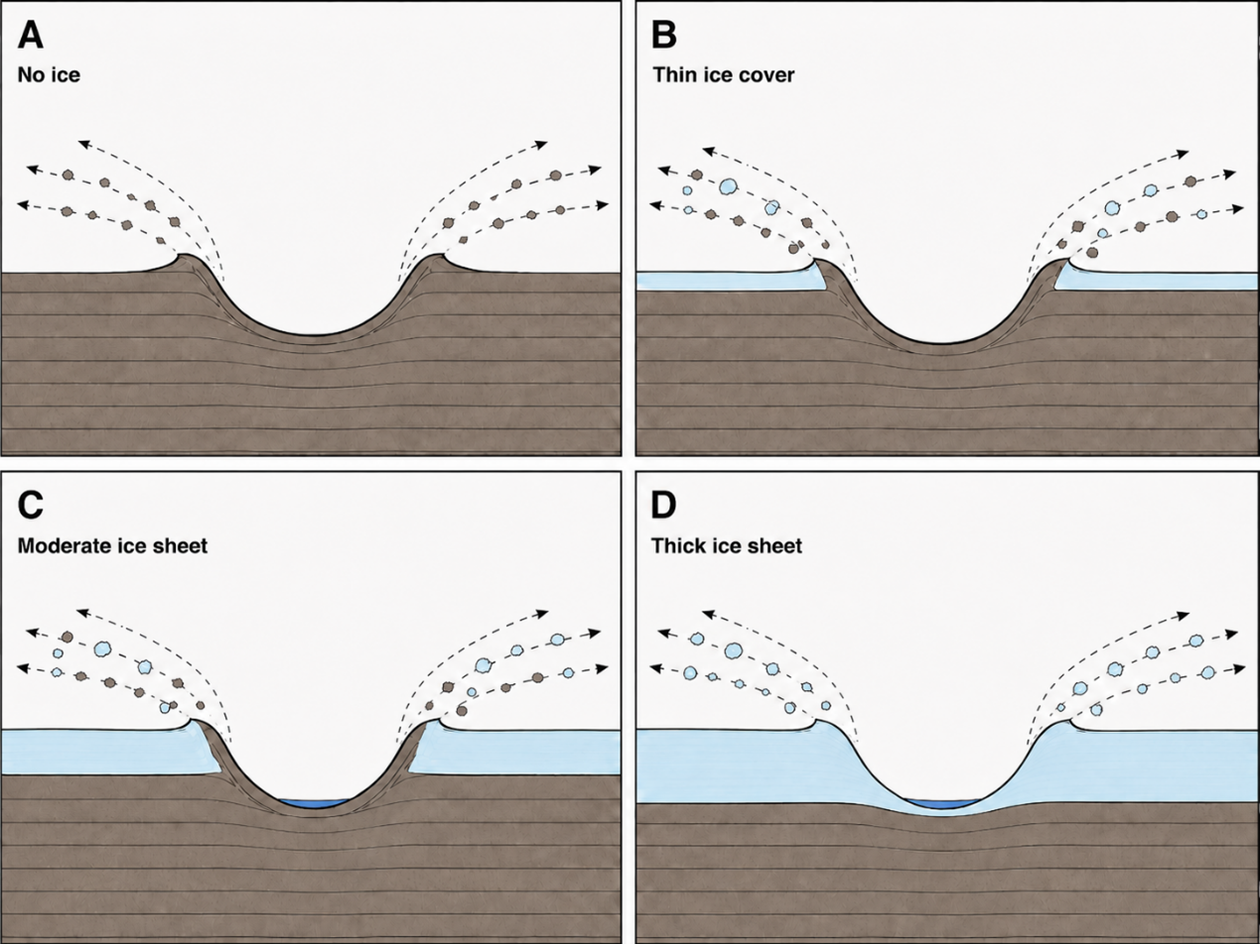
Figure 1: Conceptual impact-cratering scenarios for increasing terrestrial ice-sheet thickness. Panels show impacts into (A) exposed bedrock; (B) thin ice cover; (C) moderate ice sheet; and (D) thick ice sheet. The schematic is intended to illustrate target-state end members rather than quantitative model results. Diagram not to scale.
How to cite: Silber, R. and Silber, E.: Impact cratering into terrestrial ice sheets, Europlanet Science Congress 2026, The Hague, The Netherlands, 7–11 Sep 2026, EPSC2026-580, https://doi.org/10.5194/epsc2026-580, 2026.


