
 1,1,2,3,2,4
- 1Univ Toulouse, CNES, CNRS, IRAP, Toulouse, France (gaelle.le-bail@utoulouse.fr)
- 2LATMOS/IPSL, CNRS, Sorbonne Université, UVSQ Université Paris-Saclay, Paris, France
- 3LIRA, CNRS Sorbonne Université, Université Paris Diderot, Paris, France
- 4Centre National d'Etudes Spatiales (CNES), Toulouse, France
The Martian Moons eXploration (MMX) mission [1], led by the Japan Aerospace Exploration Agency (JAXA), is scheduled for launch in October 2026 and aims to investigate Phobos, Deimos, and the Martian atmosphere [2]. Among its payload, the MMX InfraRed Spectrometer (MIRS) [3] will observe the planet’s atmosphere in the infrared range (0.9–3.6 µm) [4], with the goal of improving our understanding of dust transport and water-ice cloud processes [5].
In preparation for the analysis of the first observations of the Martian atmosphere expected in autumn 2027, we simulate the I/F spectra that will be measured by MIRS in order to better constrain key aerosol (water ice and dust) properties [6], such as optical depth and particle radius. To this end, we use the pyRT_DISORT module from the DISORT (DIScrete-Ordinate-method Radiative Transfer) radiative transfer model [7,8] to generate the spectra across the MIRS spectral range.
These simulations require an accurate map of the surface albedo for specific martian regions defined by their given latitude and longitude coordinates. Surface albedo is a critical input parameter, particularly under clear atmospheric conditions [9], as it strongly influences the simulated I/F spectra. We therefore rely on an albedo map derived from OMEGA/MEX observations at 1.08 µm [10] (fig.1), which lies within the MIRS spectral range. However, due to instrumental and observational constraints, approximately 3% of the map contains missing data, or bright artifacts. To address this, we reconstructed these pixels using a complementary visible-wavelength albedo dataset from MARCI/MRO (band 5, 0.718 µm) [11], selected for its spectral proximity and global coverage. The resulting completed albedo map (fig. 2) provides continuous albedo coverage over the entire simulations’ domains, enabling the generation of realistic spectra for all pixels. Instrument-like noise provided by the CNES is then added to reproduce conditions representative of future MIRS observations.
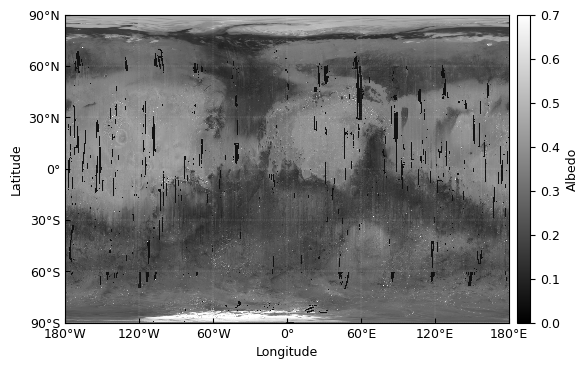
Figure 1 : OMEGA albedo map at 1.08 µm [10].
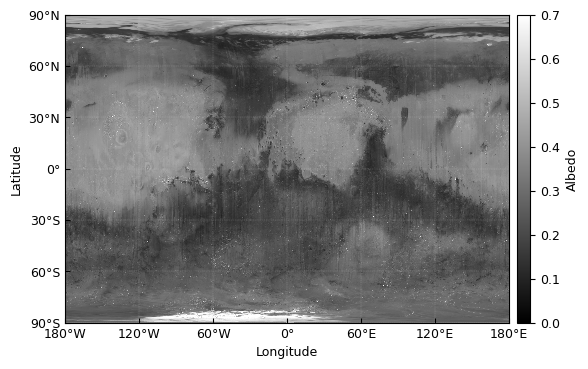
Figure 2 : Improved OMEGA albedo map at 1.08 µm, after the dark and bright pixels corrections.
These synthetic spectra, to which we added noise, are then intended to serve as test observations for the development and validation of an inversion framework based on comparison with a precomputed Look-Up Table (LUT) (Table 1). The LUT itself is constructed from DISORT simulations through an extensive sensitivity analysis covering the main parameters controlling the signal, including surface albedo, aerosol optical depth, particle radius, and observation geometry (incidence, emission, and phase angles).
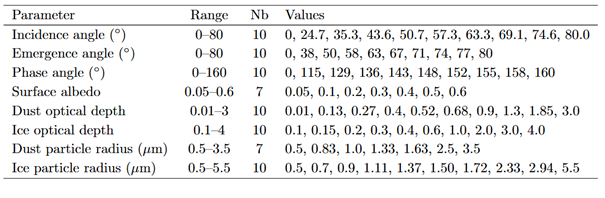
Table 1 : Final LUT defined from the sensitivity analysis.
The parameter values were chosen to ensure a uniform distribution of the resulting I/F spectra across the explored spectral domain, covering atmospheric conditions from optically thin (clear atmosphere) to increasingly optically thick (opaque atmosphere) cases. Preliminary tests have recently been initiated using a search algorithm inspired by face-recognition techniques, namely Facebook AI Similarity Search (FAISS) [12]. This approach is expected to enable efficient identification of the synthetic spectrum within the LUT that best matches an observed MIRS spectrum, and therefore retrieval of the associated aerosol properties.
Acknowledgments :
We thank M. J. Wolff and S.W. Lee for sharing the MARCI albedo map (personal communication). We thank the MMX JAXA teams for their efforts and CNES for the financial support and collaboration to build the MIRS instrument.
References :
[1] Kuramoto K. et al., Earth, Plan. and Space, 74, 12.
[2] Nakamura T. et al., Earth Plan. and Space, 2021, 73.
[3] Barucci M. A. et al., Earth, Plan. and Space, 2021, 73, 211.
[4] Barucci M. A. et al., Progress in Earth and Planetary Science, 2025, 12, pp.69.
[5] Määttänen A. et al., Space Science Reviews. 2024. 220. 10.1007/s11214-024-01092-z.
[6] Leseigneur Y. et al. (2025) EPSC-DPS2025-1672
[7] Stammes K. et al., Applied Optics, 1988, 27, 2502-2509.
[8] Connour K. and Wolff M. (2022) pyRT_DISORT: A pre-processing front-end to help make DISORT simulations easier in Python, version 1.0.0.
[9] D.F. Wellington, J.F. Bell, Icarus, Volume 349, 2020, 113766, ISSN 0019-1035.
[10] Ody A. et al., Journal of Geophysical Research, 2012, Vol. 117, E00J14.
[11] Bell, J. F.III, et al., J. Geophys. Res., 2009, 114, E08S92.
[12] M. Douze et al., "The Faiss Library," in IEEE Transactions on Big Data, vol. 12, no. 2, pp. 346-361, April 2026.
How to cite: Le Bail, G., Lasue, J., Stcherbinine, A., Leseigneur, Y., Bertrand, T., Gautier, T., and Théret, N.: Preparing MMX InfraRed Spectrometer (MIRS) observations : Simulations of the Martian Atmosphere for Aerosol Retrieval, Europlanet Science Congress 2026, The Hague, The Netherlands, 7–11 Sep 2026, EPSC2026-581, https://doi.org/10.5194/epsc2026-581, 2026.


