

- University of Vienna, Department of Meteorology and Geophysics, Vienna, Austria (aiko.voigt@univie.ac.at)
During the Neoproterozoic, Earth experienced at least two extreme glaciations with ice extending to tropical latitudes. While the Snowball Earth hypothesis proposes a fully ice-covered planet, geological evidence and the persistence of life suggest that parts of the ocean may have remained ice-free. This has motivated the concept of Waterbelt states: alternative climate equilibria featuring open equatorial oceans that could act as refugia for early life and expand the range of habitable climates relevant to Earth-like exoplanets. Despite their appeal, Waterbelt states remain disputed due to uncertainties in the mechanisms required to halt the ice–albedo feedback at low latitudes, including the role of bare sea-ice albedo and cloud radiative effects.
Here, we investigate whether Waterbelt states are robust solutions of the coupled climate system and identify the processes controlling the stability of low-latitude ice margins. Using a hierarchy of climate models, this work combines mechanistic insights from a Budyko–Sellers energy balance model with an ensemble of global climate models. In particular, we present results from a coordinated model intercomparison that includes three versions of the ICON model and five versions of the CAM model, all run in the same aquaplanet slab-ocean setup. The simulations are analyzed with respect to three key factors that have been proposed to influence Waterbelt stability: the area of exposed bare sea ice, cloud masking of the ice–albedo feedback, and shortwave cloud radiative feedbacks.
We demonstrate that stable Waterbelt states can be found in a wide variety of climate models. While ICON Waterbelt states depend on cloud tuning, all CAM models readily simulate stable Waterbelt states over a substantial range of CO2 radiative forcing. These differences are primarily due to cloud radiative effects: the CAM models exhibit stabilizing shortwave cloud feedbacks and stronger cloud masking than ICON (Fig. 1). Overall, this suggests that clouds do not present a fundamental obstacle to Waterbelt climates, but instead play a modulatory role that varies across models. This implies that Waterbelt states may be more physically plausible than studies based on single models have suggested, while at the same time emphasizing the importance of clouds for deep-time climate and exoplanet habitability.
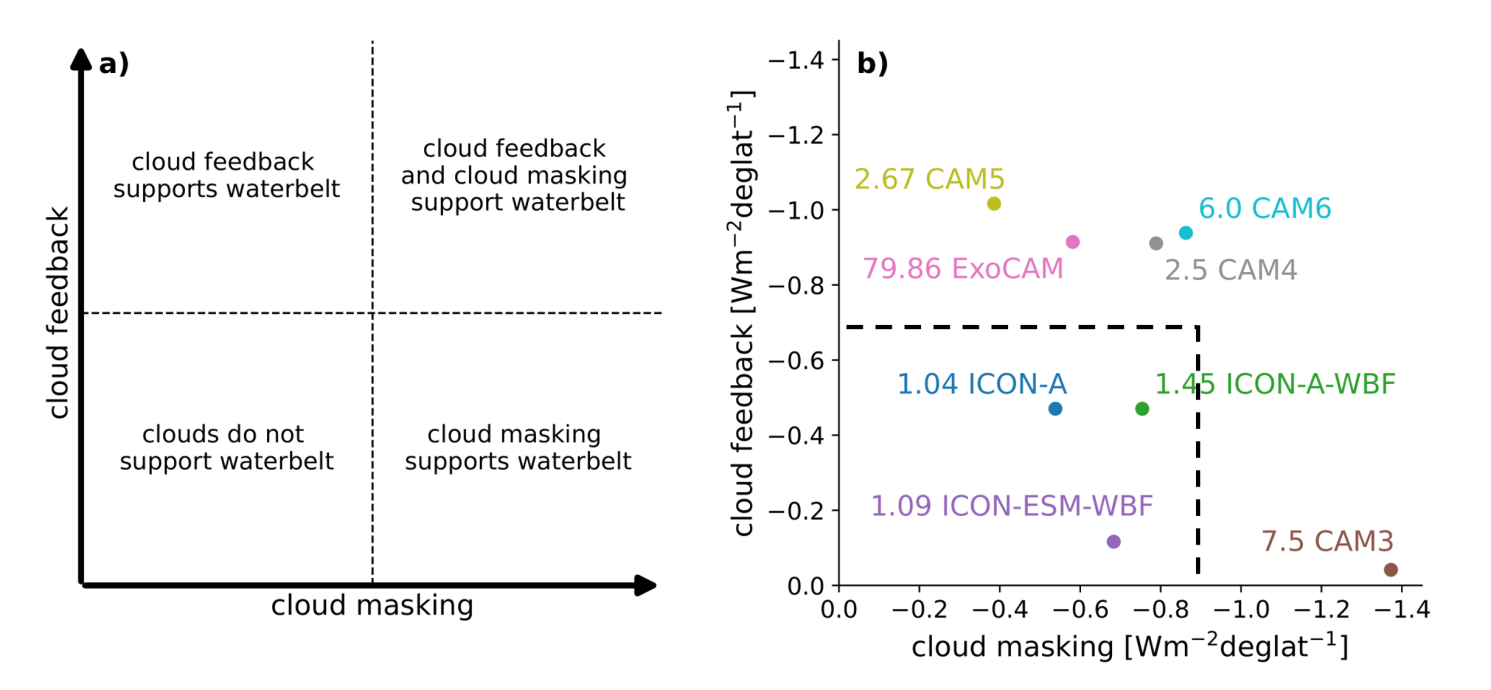
Fig. 1: Summary of Waterbelt states and their dependence on cloud-radiative interactions across the ensemble of eight global climate models. The numbers next to the model names in the right panel measure the range of atmospheric CO2 levels over which Waterbelt states exist.
How to cite: Voigt, A. and Hörner, J.: Waterbelt solutions as a habitable climate state of Earth-like exoplanets, Europlanet Science Congress 2026, The Hague, The Netherlands, 7–11 Sep 2026, EPSC2026-583, https://doi.org/10.5194/epsc2026-583, 2026.


