
 2,4,5
2,4,5- 1Département de géomatique appliquée, Université de Sherbrooke, Sherbrooke, Québec, Canada (guilhem.calas@usherbrooke.ca)
- 2Département de géomatique appliquée – Laboratoire GEODES, Université de Sherbrooke, Sherbrooke, Québec, Canada
- 3Géosciences Paris Sud (GEOPS), University of Paris Saclay, Orsay, France
- 4Lunar and Planetary Laboratory, University of Arizona, Tucson, United States
- 5Applied Physics Laboratory, Johns Hopkins University, Laurel, United States
Introduction
The Lunar Vertex mission [1, 2] will study the Reiner Gamma magnetic anomaly and swirl at the surface of the Moon (Figure 1). The Reiner Gamma swirl is a curvilinear albedo feature that is co-located with a magnetic anomaly, both of unknown origin. The scientists is studying Reiner Gamma in the fields of plasma physics, magnetism, and geology, each having played a role at some point on the evolution of the Reiner Gamma formation dating back to ~2.9 Ga [3].
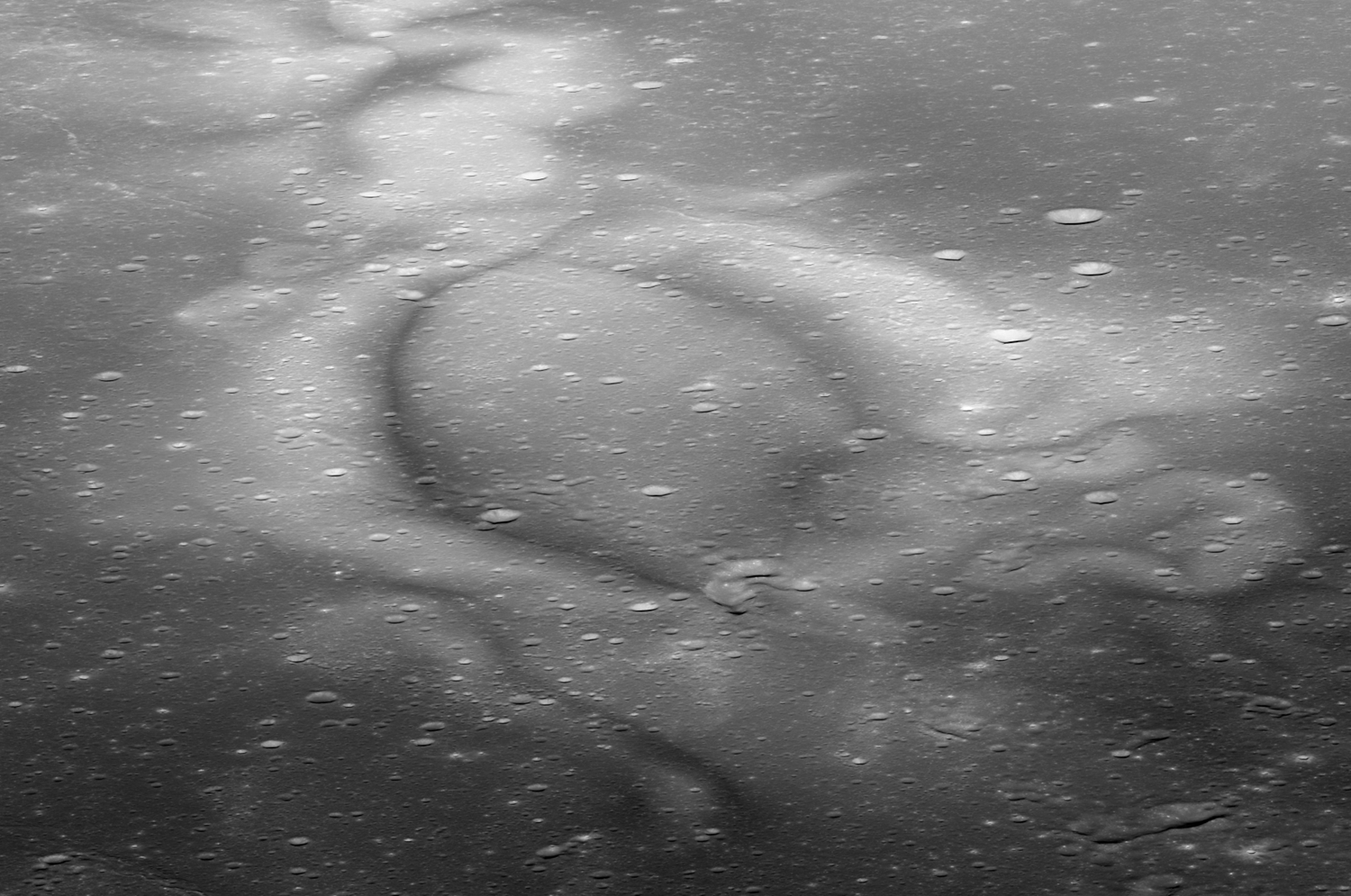
Figure 1. Reiner Gamma Swirl. Oblique view from west to east, captured by the NAC camera aboard LRO satellite. NAC image reference: M1127569280L,R
Our research focuses on geology. The intriguing layout of two large craters in the vicinity of Reiner Gamma suggests they have potentially played a role in resurfacing the swirl via ballistic sedimentation of their ejecta. Hood et al. [3, 4] documented the presence of clusters of ellipsoid craters on the western part of Reiner Gamma in Lunar Orbiter IV images. These craters seem to be the extension of ejecta deposits, which extrapolated to the distance, pass through the center of the Cavalerius crater. The geologic map of the Reiner Gamma region at 1:5 M [5] also suggests the presence of lineaments (ejecta deposits) directionally leading to the Reiner and Cavalerius craters.
Our main objective is to determine whether fresh material from surrounding craters could have been deposited on the Reiner Gamma magnetic anomaly after its formation. The specific objectives are to (1) identify the material ejected from Reiner and Cavalerius craters at a fine spatial scale, and (2) study the similarity between the material found on the Reiner Gamma magnetic anomaly and that of these craters.
Dataset
The Narrow Angle Camera (NAC) aboard the American Lunar Reconnaissance Orbiter (LRO) spacecraft has been imaging the lunar surface of the Moon since 2009, at an altitude of ~50 km [6]. These cameras capture panchromatic images in the 400–760 nm wavelength range with ~50 cm spatial resolution.
SLDEM2015 [7] is a digital elevation model (DEM) created for the lunar surface covering latitudes of ±60°. It has a vertical resolution of ~3 to ~4 m and a spatial resolution of 60 m. SLDEM2015 is a combination of LOLA (LRO) and Terrain Camera (Kaguya) products and was created to provide users with a more accurate DEM.
The “Multiband Imager” (MI) camera aboard the Japanese satellite Kaguya was placed into lunar orbit in 2007 at an altitude of 100 km. The instrument has 9 bands, including 5 in the visible spectrum (415, 750, 900, 950, and 1,000 nm) at 20 m spatial resolution and 4 in the near-infrared spectrum (1,000, 1,050, 1,250, and 1,550 nm) at 62 m spatial resolution. Maps of the Optical Maturity (OMAT) index [8] can be derived from MI data. The physical evolution of the lunar surface due to exposure to the space environment is termed maturation, and maturity is the degree to which a particular lunar soil possesses quantitative characteristics consistent with that exposure.
The Imaging Infrared Spectrometer (IIRS) camera aboard the Indian Chandrayaan-2 satellite was placed into lunar orbit in 2019 at an altitude of 100 km. The instrument has 256 continuous spectral bands at 80 m spatial resolution. The spectral resolution is approximately 20 nm. The spectral range is between 0.8 and 5 μm.
Methodology
We will first map the distribution of four ejecta facies in and around Reiner and Cavalerius as defined in Thesniya et al. [9]. Facies A represents the proximal ejecta extending from the crater rim to one crater radius. Facies B represents smooth deposits of low-albedo molten material generally present in topographic depressions. Facies C represents areas of smooth, low-albedo melt deposits interspersed with chaotically dispersed blocks of varying sizes, extending from the crater rim and exhibiting preferential flow toward topographically low areas. Facies D represents a cluster of ellipsoidal craters located near the rim crest extending to the distal part of the ejecta. Each Facies represents an ejecta unit with specific characteristics in terms of its surface texture, pattern, and the type and nature of deposition [9]. We will then identify small fresh craters in the continuous ejecta blankets of Reiner and Cavalerius craters near their rim crest (Facies A) and ellipsoidal craters arising from both Reiner and Cavalerius craters on the surface of the lunar swirl (Facies D) and study their respective spectra.
Scope of the research
The ejecta facies of the Reiner and Cavalerius will be mapped for the first time. Our research will allow us to determine the extent of spectral similarity between Reiner and Cavalerius and the Reiner Gamma swirl itself. This information will provide context for the Lunar Vertex mission and contribute to the understanding of lunar swirl formation. Our project will also open research avenues for conducting detailed mapping at other lunar swirls.
References
[1] Blewett et al. (2023). PRISM-1 Lunar Vertex: Five Instruments and a Rover. Annual Meeting of the Lunar Exploration Analysis Group (vol. 2887, p. 2892). https://ui.adsabs.harvard.edu/abs/2023LPICo2887.2892B
[2] Blewett et al. (2024). The Lunar Vertex PRISM Payload: Ready to Launch. 55th Lunar and Planetary Science Conference (vol. 3040, p. 1553). https://ui.adsabs.harvard.edu/abs/2024LPICo3040.1553B
[3] Hood et al. (1979b). The Moon: Sources of the Crustal Magnetic Anomalies. Science, Volume 204, Issue 4388, pp. 53-57. https://ui.adsabs.harvard.edu/link_gateway/1979Sci...204...53H/doi:10.1126/science.204.4388.53
[4] Hood et al. (1979a). Lunar nearside magnetic anomalies. Lunar and Planetary Science Conference, 10th, Houston, Tex., March 19-23, 1979, Proceedings. Volume 3. (A80-23677 08-91) New York, Pergamon Press, Inc., 1979, p. 2235-2257. https://ui.adsabs.harvard.edu/abs/1979LPSC...10.2235H/abstract
[5] Fortezzo et al. (2020). Unified Map of the Moon U.S. Geological Survey. https://www.usgs.gov/media/images/fortezzo-et-al-2020-unified-map-moon
[6] Robinson et al. (2010). Lunar Reconnaissance Orbiter Camera (LROC) Instrument Overview. Space Science Reviews, 150(1‑4), 81‑124. https://doi.org/10.1007/s11214-010-9634-2
[7] Barker et al. (2016). A new lunar digital elevation model from the Lunar Orbiter Laser Altimeter and SELENE Terrain Camera. Icarus, 273, 346‑355. https://doi.org/10.1016/j.icarus.2015.07.039
[8] Lucey et al. (2000). Imaging of lunar surface maturity. Journal of Geophysical Research: Planets, 105(E8), 20377‑20386. https://doi.org/10.1029/1999JE001110
[9] Thesniya et al. (2025). Investigation of morphology and impact ejecta emplacement of the Copernican Das crater on the lunar farside. Planetary and Space Science, 258, 106052. https://doi.org/10.1016/j.pss.2025.106052
How to cite: Calas, G., Lemelin, M., Bultel, B., Hood, L., and Blewett, D. T.: Study of material from Reiner and Cavalerius craters in the Reiner Gamma region, Europlanet Science Congress 2026, The Hague, The Netherlands, 7–11 Sep 2026, EPSC2026-59, https://doi.org/10.5194/epsc2026-59, 2026.


