
 1,3,1,3,1,1,
- 1German Aerospace Center (DLR), Institute of Space Research. Berlin, Germany.
- 2Freie Universitat Berlin, Earth Sciences, Germany.
- 3University of Münster, Institute of Mineralogy. Münster, Germany.
Venus is similar to Earth in size, mass, and bulk density. However, its thermal, tectonic, and atmospheric evolution has been very different. Its hot, dense CO₂-rich atmosphere, surface dominated by volcanic features [Hahn & Byrne, 2023], and potentially ongoing volcanic activity [Herrick and Hensley, 2023] make Venus a key target for understanding magmatic processes and their role in shaping the surfaces of terrestrial planets.
The composition of Venus’ surface is poorly known because in situ surface investigations are difficult to conduct in such a harsh surface environment, and orbital measurements of Venus’ surface can only be performed for narrow near-infrared spectral windows, as the opaque and thick atmosphere of Venus restricts direct surface observations. These atmospheric windows are central to upcoming Venus missions such as EnVision and VERITAS [Smrekar et al., 2022; Straume-Lindner et al., 2025], which aim to constrain surface composition, volcanic activity, and geodynamic evolution through orbital observations. Since surface emissivity measurements are sensitive to rock composition, including the FeO content of these rocks [Dyar et al. 2020; Helbert et al. 2021], they provide a potential link between observable surface materials and the interior processes that generated them. In turn, the FeO content influences mantle density, melting behaviour, and melt composition, and variations in bulk mantle FeO can affect the thermal evolution and magmatic history of Venus. Some of the only direct compositional constraints on Venus’ surface rocks come from the Venera and Vega landers [Surkov et al., 1984, 1986], which measured basaltic compositions at the surface.
Jennings et al. [2026] used Perple_X thermodynamic modelling to investigate Venus mantle compositions and proposed candidate compositions, including M80, capable of producing Venera- and Vega-like melts. Building on this work, we combine geodynamical modelling with GAIA and Perple_X-derived melting curves to investigate how variations in bulk mantle FeO content influence melting behaviour, melt production, and melt properties under Venus-like mantle conditions. These results are linked to high-temperature emissivity measurements of Venus analogue materials, with the broader goal of supporting the interpretation of future observations from EnVision and VERITAS.
We use the mantle convection code GAIA in a 2D spherical annulus geometry [Hüttig et al., 2013; Fleury et al., 2024] to model the long-term thermal and magmatic evolution of Venus’ mantle with the different bulk mantle FeO generated by Perple_X. The simulations include temperature- and pressure-dependent viscosity, thermal conductivity, and thermal expansivity, and account for internal radiogenic heating [Breuer et al., 2009; Moroz et al., 1980] and core cooling [Steinbach & Yuen, 1994].
The different FeO content between the simulations is reflected in the mantle solidus and liquidus temperature, whose parameterisation is based on Perple_X thermodynamic calculations. We use M80 composition from Jennings et al. [2026] as the reference composition and compare it with the FeO-variable suite M301–M306, generated by varying bulk FeO relative to M80 in steps of approximately ΔFeO ≈ 3 wt%. The Perple_X-derived solidus and liquidus curves were smoothed, segmented, and fitted with piecewise polynomial functions before being implemented in GAIA.
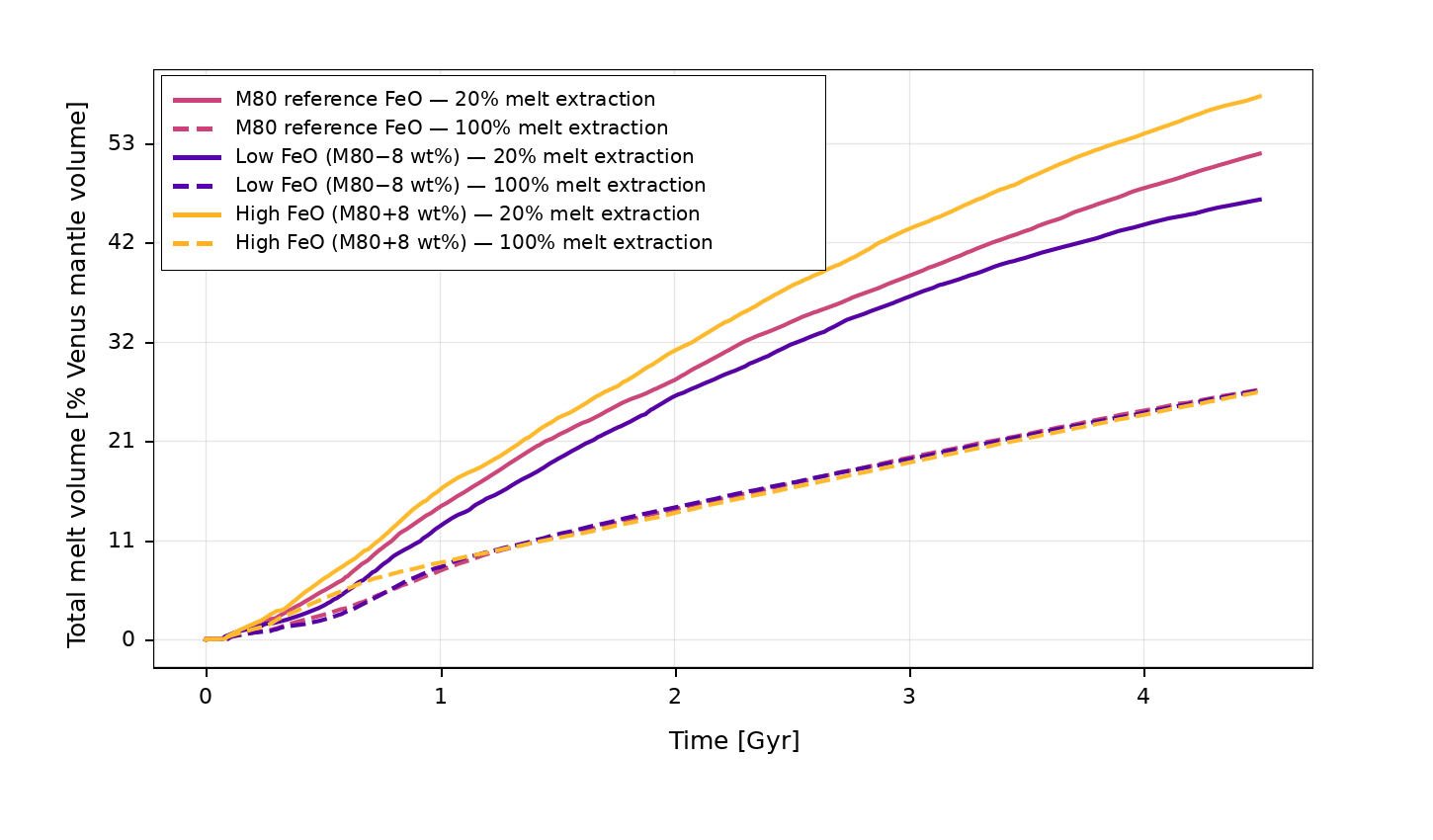
We compare two magmatic emplacement regimes: a fully extrusive case and a mixed case with 20% intrusive and 80% extrusive melt emplacement, with intrusions placed at 50 km depth. Simulation outputs are post-processed to analyse thermal evolution, melt production, cumulative melt volume, melt depth, melt temperature, and lithospheric thickness.
The simulations show that the effect of bulk mantle FeO content depends strongly on the magmatic emplacement regime. In fully extrusive cases, melt production rates, cumulative melt volumes, melt depths, and melt temperatures converge across FeO compositions, suggesting limited compositional sensitivity when melt is efficiently extracted to the surface. In contrast, the mixed intrusive–extrusive regime shows clearer FeO-dependent behaviour, with higher-FeO cases producing larger melt volumes and stronger variations in melt-related quantities.
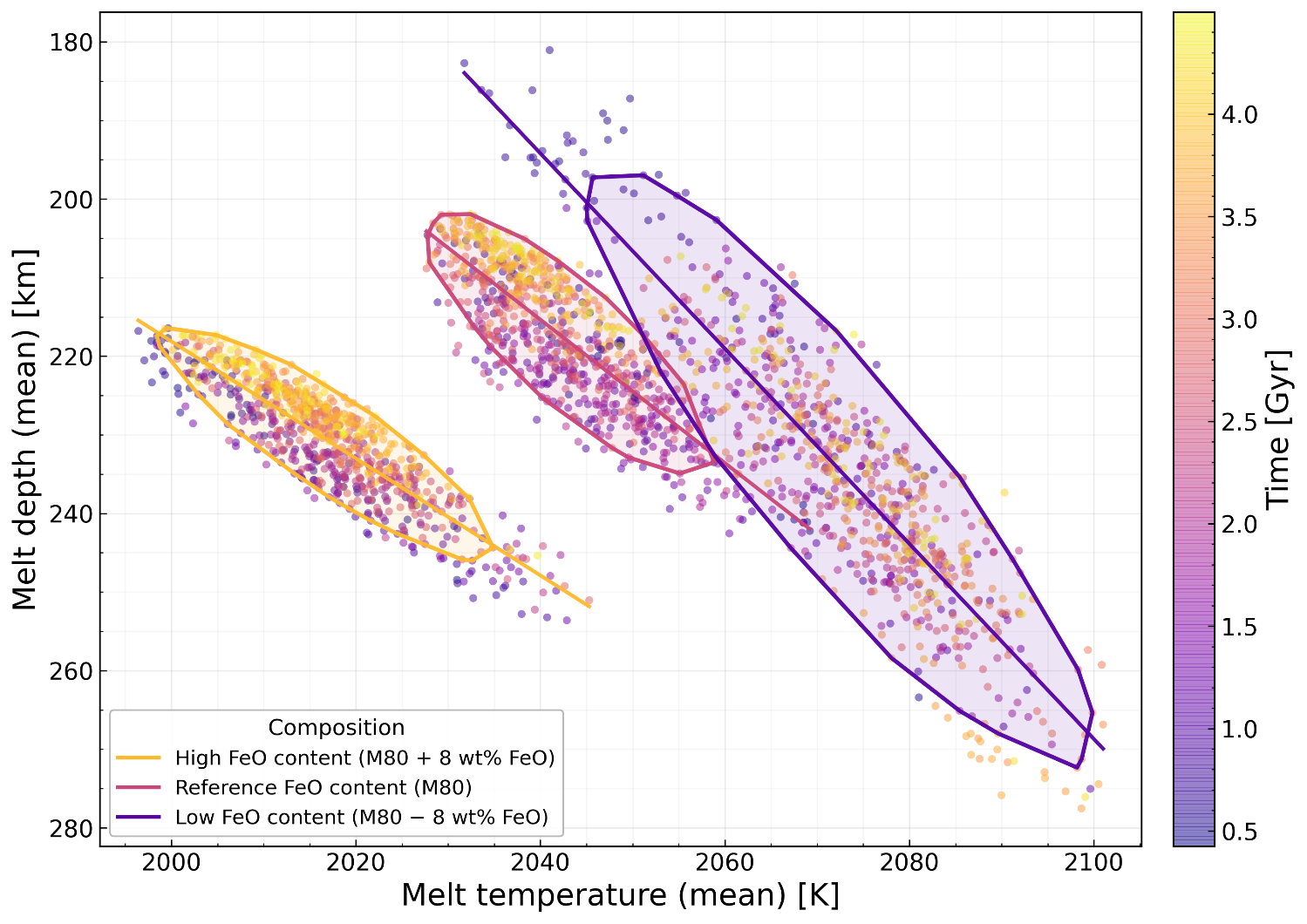
The temperature and depth of melting also vary with composition. Low-, reference-, and high-FeO cases occupy different regions in melt temperature–melt depth space, indicating that FeO content affects the range of depths and temperatures at which melt is generated. In the mixed intrusive–extrusive regime, higher-FeO cases show a broader spread of melt-generation conditions, suggesting that FeO influences not only the amount of melt produced, but also where and under which thermal conditions melting occurs.
Laboratory emissivity measurements provide the observational link to the geodynamic results. We compare the model outputs with high-temperature emissivity spectra of two FeO-variable Venus analogue glasses synthesised at the University of Münster. These glasses represent partial melt compositions calculated with Perple_X from the M80 and M302 mantle compositions. The spectra were measured at Venus surface temperature in the Planetary Spectroscopy Laboratory and calibrated using hemispherical reflectance and blackbody measurements.
The two glasses show systematic emissivity differences within the near-infrared atmospheric windows targeted by VEM/VenSpec-M. Together, the geodynamic and laboratory results suggest that bulk mantle FeO content affects Venus’ melting history and may produce surface materials with distinguishable emissivity signatures relevant to future Venus missions. The combined approach presented here provides a framework for linking modelled mantle melting, melt properties, and surface spectral observations.
How to cite: Mohamed, Y., Herrera, C., Jennings, L., Alemanno, G., Plesa, A.-C., and Klemme, S.: On the role of bulk FeO content in Venus’ mantle thermal evolution, melt production, and surface emissivity, Europlanet Science Congress 2026, The Hague, The Netherlands, 7–11 Sep 2026, EPSC2026-595, https://doi.org/10.5194/epsc2026-595, 2026.


