
 1,
1,- 1German Space Agency DLR-PF, Planetary physic, Berlin, Germany (valentin.bonnetgibet@proton.me)
- 2Ecole Normale Supérieure de Lyon, Université de Lyon, Université Claude Bernard Lyon 1, Université Jean Monet, CNRS, Laboratoire de Géologie de Lyon, Terre, Planètes, Environnement
Long-wavelength variations in crustal thickness are a common feature of rocky planets, but their origin remains unclear. Mars and the Moon have prominent hemispheric crustal thickness asymmetries, whereas Mercury appears to lack such a global dichotomy in the available data. This study examines whether such long-wavelength variations can arise on stagnant-lid planets from endogenous mechanism, without invoking external events such as giant impacts. We focus on two positive feedback mechanisms that operate during the early stages of mantle convection and crust formation. Both mechanisms rely on mantle melting that is enhanced beneath thinner lithospheric lids, where pressures are lower. The first mechanism links crustal thickness to the extraction rate of heat-producing elements from the mantle: because these elements are incompatible and are preferentially concentrated in melts, thicker crust locally enriches the lid in radiogenic material, which results in a hotter and thinner lid and promotes further melting and crust extraction from the convective mantle below (Bonnet Gibet al. 2022). The second mechanism links lid thickness to its own growth rate through the melt dependence of mantle rheology: melt decreases mantle viscosity and modifies the efficiency of convective heat transport. As explained above, thinner lids result in larger melt fractions in the convective mantle below and therefore in a more efficient mantle heat flux, which leads to a lower lid growth rate where the lid is thinner (Watson al. 2022). Linear stability analyses show that both feedbacks preferentially amplify degree-1, hemispheric scale instabilities, with the lid thickening feedback mechanism operating faster than the crustal thickening feedback mechanism (Bonnet Gibet et al. 2026).
To investigate these mechanisms quantitatively, we use a parameterized stagnant-lid convection model with crustal growth by melt extraction. The convective mantle is treated as a well-mixed interior overlain by a conductive lid. The model includes the redistribution of heat-producing elements between crust and mantle during crust formation, as well as the influence of melt on mantle rheology. To represent hemispheric asymmetry, the lid is divided into two hemispheres that evolve independently while remaining coupled to the same convective mantle. We can therefore follow crust formation, lid growth, and the global thermal evolution of the planet over 4.5 Gyr of evolution. In this model, the main parameters are the efficiency of melt extraction and the reference mantle viscosity, which together regulate planetary cooling, hence how long mantle melting persists. We systematically explored the parameter space for two end-member cases: with or without melt-dependent rheology (see Figure 1).
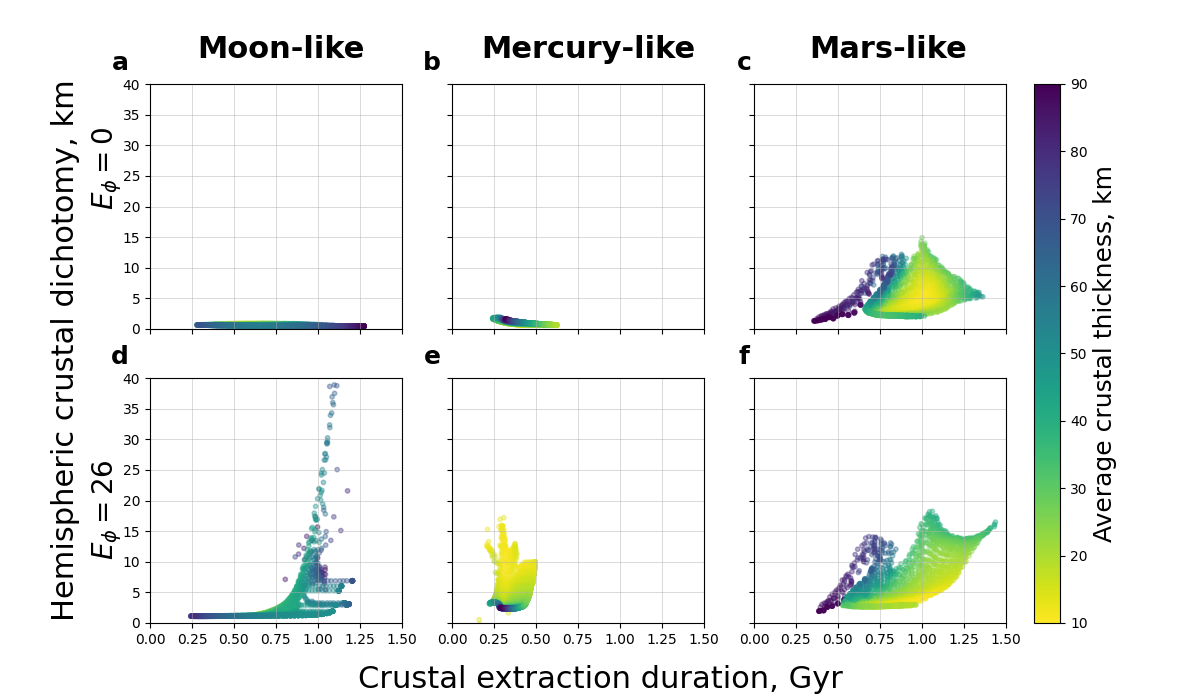
Figure 1: Final hemispheric dichotomy in crustal thickness (km) as a function of the total crustal extraction duration the crustal extraction duration, i.e. the total time over which the crust forms (Gyr) with the global volume-averaged final crustal thickness in colour- scale for different planet cases. The first row shows model calculated using Eϕ = 0 (without melt-dependent rheology) while the second row shows models calculated using Eϕ = 26 (with melt-dependent rheology).
The comparative behaviour of Mars, the Moon, and Mercury depends strongly on planet size, mantle thickness, and hence on the duration of crust extraction. On Mars, the crustal thickening feedback alone is sufficient to generate a crustal thickness dichotomy similar to the observed one (Figure 1c), and the inclusion of the lid thickening feedback mainly enhances the growth of the asymmetry (Figure 1f). On the Moon, the crustal thickening mechanism alone is insufficient to produce the observed nearside-farside asymmetry (Figure 1a). A significant dichotomy only develops when both feedbacks interact (Figure 1d). In this case, a lid thickness asymmetry first appears rapidly, then promotes an asymmetric melt extraction, and finally allows a crustal thickness contrast to grow, which subsequently triggers the crustal thickening feedback mechanism. Mercury evolves differently because its rapid cooling, caused by its thin mantle, limits the duration of crust extraction and therefore limits the ability of the crustal thickening mechanism to develop (Figure 1b). In this case, the lid thickening feedback is able to generate a significant hemispheric asymmetry, but only for sufficiently thin crusts (Figure 1e). More broadly, our results show that long-wavelength crustal variations can arise naturally from positive feedback mechanisms involving mantle partial melting, lid asymmetry, and crustal growth.
Building on these results, current work aims to investigate the interaction between crust extraction and mantle convection using 2D global geodynamical models for stagnant-lid planets. In these models, crust formation is coupled self-consistently to mantle melting through melt extraction at Darcy velocity, while the influence of partial melting on mantle rheology and convective dynamics is explicitly taken into account. This approach will allow us to explore how mantle plumes in a partially molten mantle interact with the positive feedback mechanisms described here, and to determine how these processes control the wavelength and amplitude of crustal thickness variations on Mars and Mercury.
How to cite: Bonnet Gibet, V., Michaut, C., and Tosi, N.: The formation of long-wavelength variations in crustal thickness on Mars, Mercury and the Moon. , Europlanet Science Congress 2026, The Hague, The Netherlands, 7–11 Sep 2026, EPSC2026-599, https://doi.org/10.5194/epsc2026-599, 2026.


