
 1,1,2,3,
- 1Paris Sciences et Lettres - Observatoire de Paris, Laboratoire Temps Espace - LTE, Paris, France (raphael.lallemand@obspm.fr)
- 2Institut Polytechnique des Sciences Avancées IPSA, Ivry-Sur-Seine, France
- 3Uranoscope de l’Ile de France, 77220 Gretz-Armainvilliers, France
- *A full list of authors appears at the end of the abstract
Among the most fascinating objects in our solar system, Ganymede stands out as the largest moon of Jupiter and one of its four Galilean satellites, discovered by Galileo Galilei in 1610. Its colossal size, even surpassing that of the planet Mercury, makes it a prime target for scientific exploration in the JUICE ESA mission. However, its close proximity to Jupiter presents a unique challenge : the influence of the planet complicate efforts to determine Ganymede’s precise position in space. To overcome this hurdle, we choosed to observe Ganymede using the stellar occultation technique. Stellar occultations occur when a solar system object passes in front of a star, briefly blocking its light, creating a shadow detectable by the observer. As the object moves, the shadow also moves along way, creating an occultation path on the surface of the Earth. The analysis of the light curve emitted by the star using aperture photometry allows the determination of key physical parameters of the object - such as size, shape, orientation, and relative component geometry [1,2] - with kilometric accuracy [3]. On October 14, 2025, Jupiter’s largest natural satellite occulted a 6-magnitude star all over Europe. This occultation has been observed by 52 observers, with 36 positives chords Europe (Figure 1). Amateur and professional astronomers gathered to provide unique insight in Ganymede astrometry. An overview of this campaign will be presented. A focus will be made on the analysis of the results with the implications for the future flyby of JUICE over Ganymede in 2029.
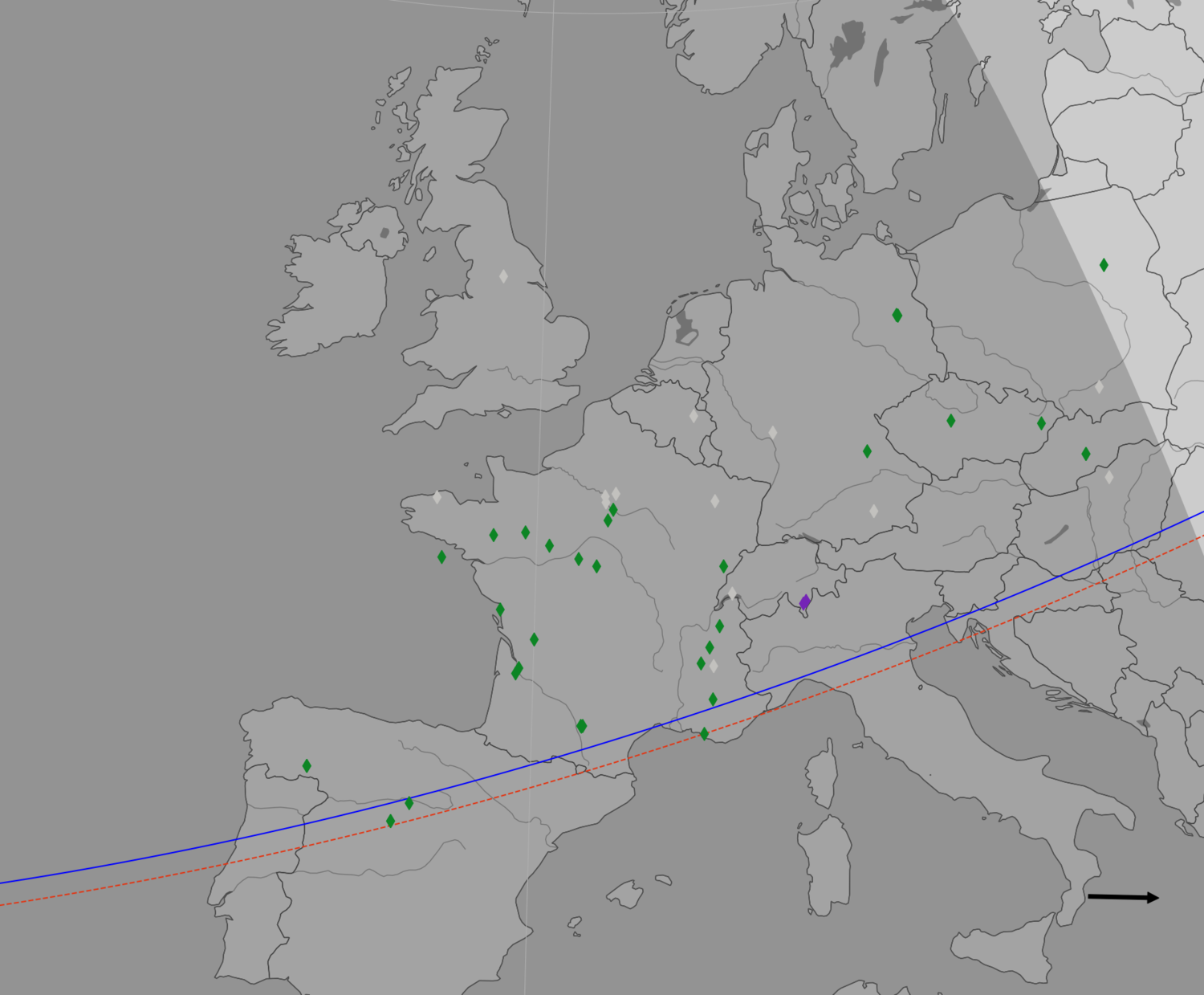
Figure 1: Post occultation map of the stellar occultation by Ganymede on October 14, 2025. The observing stations are displayed with the following colour code: Green - Positive, White - Overcast, Purple - Technical issues. The black arrow shows the direction of motion of the shadow. The dark grey region corresponds to astronomical night, while the light grey region corresponds to astronomical twilight.
Acknowledgement
The organisation of the observation campaigns for this work was supported by Occultation Portal - Kilic et al. (2022). Occultation Portal: A web-based platform for data collection and analysis of stellar occultations. MNRAS, Volume 515, Issue 1, pp. 1346-1357. This work made use of the SORA package - Gomes-Júnior et al. (2022). SORA: Stellar occultation reduction and analysis. MNRAS, Volume 511, Issue 1, March 2022, Pages 1167–1181. This work made use of the PRAIA package - Assafin M., 2023a, Differential aperture photometry with PRAIA, Planetary and Space Science Planetary and Space Science, Volume 239, article id. 105816. This work made use of the Pymovie package - Anderson, B. (2019) PyMovie – A Stellar-Occultation Aperture-Photometry Program, Journal for Occultation Astronomy (ISSN 0737-6766), Vol. 9, No. 4, p. 9-13. We made use of Astropy, a community-developed core Python package for Astronomy. The team gratefully acknowledges the amateur communities of IOTA/ES and Planoccult for their essential support, dedication, and significant contributions to this work. The authors would like to thank the Action Pluriannuelle Incitative (API) Pro-Am initiated and supported by Paris Observatory in the ROADIES program context.
[1] Morgado et al, 2022, The Astrophysical Journal, Milliarcsecond astrometry for the Galilean moons using stellar occultations
[2] Kiliç et al., 2026, Astronomy & Astrophysics, Constraining the size, shape, and albedo of the large Trans-Neptunian Object (28978) Ixion with multi-chord stellar occultations
[3] Desmars et al., 2019, Astronomy & Astrophysics, Pluto's ephemeris from ground-based stellar occultations.
Stefano Sposetti, Cédric Latgé, Jan Mánek, Aurélien Genin, Michel Giraud, Andrea Manna, Frederic Denjean, Thomas Salomon, Christian Sartini, Yann Pinard, Pascal André, Adrien Stachowicz, Konrad Guhl, C. Weber, M OConnell, Jean-Marie Covet, Eric Barbotin, Lionel Rousselot, Arnaud Debuchy, Laurent Miralabe, Paula Libic, Peter Nosal, Patrick LAGRANGE, Fabien CAVAILLE, Jocelyn Sérot, José Prieto, Pierre Barroy, Sébastien Cretier, Thierry Midavaine, Wojciech Burzynski, Daniel Verilhac, Jean-Baptiste Marquette, Michael Irzyk, Pablo Molina, Enrique Velasco, Jérôme Delpau, Jörg Scholz, Christoph Zielke, Joachim Siegert, Petr Zeleny, José Luis Hernández Verdejo, Aurélien Genin, Alex Pratt, Thomas Mollier, Wolfgang Beisker, Michel Boutet, Oliver Klös, Olivier Schreurs, Róbert Szakáts, Daniel Błażewicz, Isabelle Auvray, Stephane Neveu, Stephane Moulin, Jean Guerard, Ziyu Liu, Jean-François Coliac
How to cite: Lallemand, R., Desmars, J., Lainey, V., and Leroy, A. and the co-authors: Pro/Am Collaborative Observation of Ganymede Stellar Occultation on 2025/10/14, Europlanet Science Congress 2026, The Hague, The Netherlands, 7–11 Sep 2026, EPSC2026-6, https://doi.org/10.5194/epsc2026-6, 2026.


