
 1,1,2,1,1
- 1Delft University of Technology, Faculty of Aerospace Engineering, Planetary Exploration, Delft, the Netherlands (q.b.vanwoerkom-1@tudelft.nl)
- 2ESA ESTEC, Noordwijk, the Netherlands
The surfaces of several outer Solar System moons display activity that cannot result from radiogenic and primordial heat alone, indicating that tidal heating drives their interior evolution. Tidal heating is the result of orbital eccentricities sustained over geological timescales by mean-motion resonances between moons [1], coupling interior and orbital evolution. Such resonances are common in the Solar System, and potentially also in compact exoplanetary systems: they drive sustained volcanism on Io [2] and maintain subsurface oceans on Europa and Enceladus today [3]. Understanding moons in the Solar System and beyond therefore requires a comprehensive picture of their coupled interior-orbital evolution.
In the past, tools used to study the interior-orbital evolution have typically been closed-source, limited to a specific body or set of assumptions or difficult to start working with. This raises the barrier-to-entry for researchers without the prerequisite background and makes reproducing results difficult. To solve these problems, we are developing DelfTIDE (Delft Tidal, Interior and Dynamical Evolution toolkit), an open-source, accessible and flexible framework for coupled interior-orbital modelling in multibody systems.
DelfTIDE represents the bodies in a system modularly: the model describing a body is separated into an interior, orbital and tidal model. We provide default implementations for each, based on common models in literature but users can also provide their own.
Regarding interior evolution, DelfTIDE’s layered interior models enable the user to flexibly model layered, spherically symmetric bodies. Currently implemented layers include conduction (time-dependent and equilibrium profiles), parametrised convection, and ocean layers. Application of boundary conditions, transitions between heat transport mechanisms (e.g., ocean formation or convection onset) and mass conservation are handled automatically by the code (e.g., Fig. 1).
Tidal heating and its radial distribution are computed self-consistently with the interior model using the matrix propagator approach [4, 5, 6]. Orbital evolution can be evaluated for isolated moons or those in simple two-moon resonances using averaged equations of motion ( e.g., Fig. 2) [7], or in resonances analogous to the Laplace resonance [8].
To open the tool for use by non-experts and students, DelfTIDE puts special emphasis on accessibility. For instance, it includes a web-based GUI that allows one to compute the tidal response of planetary objects. We also provide the user with an LLM interface tailored to our codebase, enabling them to quickly set up simulations of new bodies and systems, or ask questions about the code.
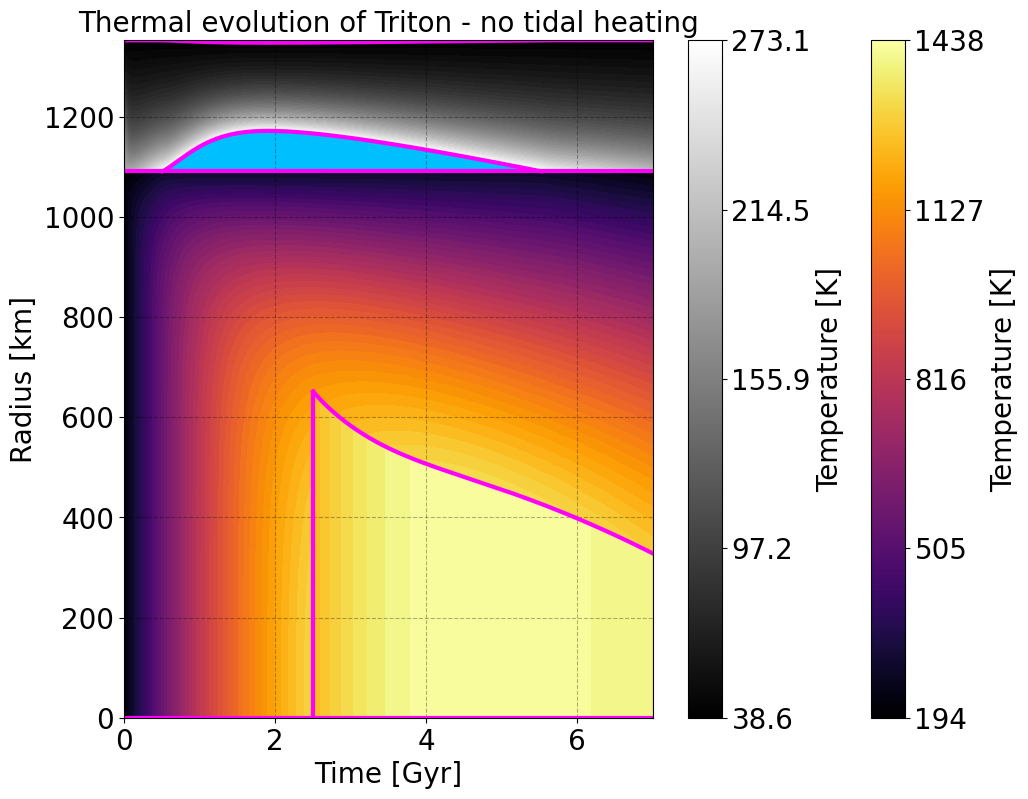
Figure 1: Interior evolution for Triton accounting only for CI-chondrite radiogenic heating (from [9]), and no tidal heating. Boundaries between various layers are marked by the magenta lines: from top to bottom, these are the convective part of the mantle (when present), the conductive part of the mantle, the ocean (when present), and the icy shell.
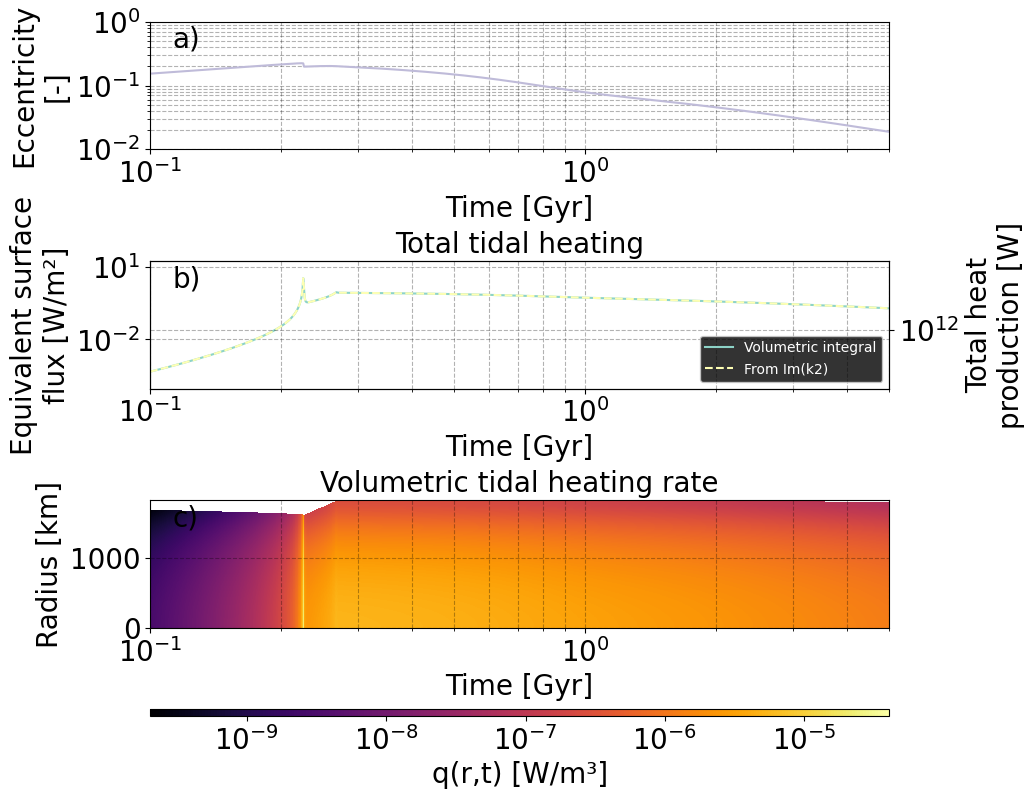
Figure 2: Eccentricity (a), and total (b) and volumetric (c) tidal heating rate for an Io-like moon in a 2:1 resonance. The interior is comprised of a conductive lithosphere atop a convective mantle: dissipation is limited to the convective region. Feedback between interior and orbital evolution establishes an equilibrium tidal heating rate and corresponding eccentricity.
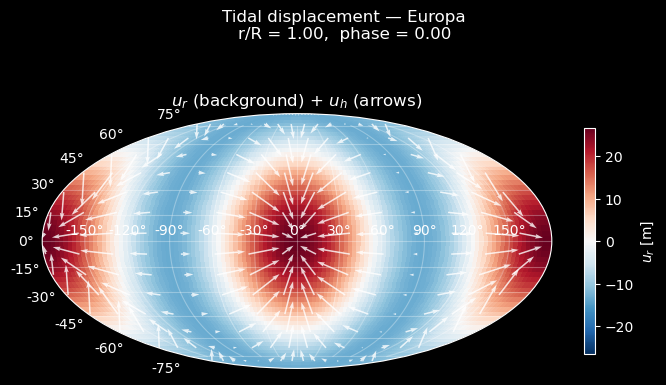
Figure 3: Surface deformation in the radial (background) and tangential (arrows) directions for a Europa-like moon, computed using DelfTIDE’s tidal module. The interior is comprised of a liquid core, silicate mantle, liquid ocean and a convective icy shell with a conductive lid, with representative homogeneous mechanical properties. Tidal forcing is applied at Europa’s orbital frequency.
[1] Murray, C. D., & Dermott, S. F. (1999). Solar System Dynamics. Cambridge University Press.
[2] Peale, S. J., Cassen, P., & Reynolds, R. T. (1979). Melting of Io by tidal dissipation. Science, 203(4383), 892–894. https://doi.org/10.1126/science.203.4383.892
[3] Nimmo, F., & Pappalardo, R. T. (2016). Ocean worlds in the outer solar system. Journal of Geophysical Research: Planets, 121(8), 1378–1399. https://doi.org/10.1002/2016JE005081
[4] Sabadini, R., Vermeersen, B., & Cambiotti, G. (2016). Global Dynamics of the Earth (Second). Springer Nature.
[5] Tobie, G., Mocquet, A., & Sotin, C. (2005). Tidal dissipation within large icy satellites: Applications to Europa and Titan. Icarus, 177(2), 534–549. https://doi.org/10.1016/j.icarus.2005.04.006
[6] Beuthe, M. (2013). Spatial patterns of tidal heating. Icarus, 223(1), 308–329. https://doi.org/10.1016/j.icarus.2012.11.020
[7] Dermott, S. F., Malhotra, R., & Murray, C. D. (1988). Dynamics of the Uranian and Saturnian Satellite Systems: A Chaotic Route to Melting Miranda? Icarus, 76, 295–334.
[8] Hussmann, H., & Spohn, T. (2004). Thermal-orbital evolution of Io and Europa. Icarus, 171(2), 391–410. https://doi.org/10.1016/j.icarus.2004.05.020
[9] Hussmann, H., Choblet, G., Lainey, V., Matson, D. L., Sotin, C., Tobie, G., & van Hoolst, T. (2010). Implications of rotation, orbital states, energy sources, and heat transport for internal processes in icy satellites. Space Science Reviews, 153(1–4), 317–348. https://doi.org/10.1007/s11214-010-9636-0
How to cite: van Woerkom, Q., Rovira-Navarro, M., Fayolle, S., Veenstra, A., and van der Wal, W.: Accessible modelling of coupled orbital-interior evolution using DelfTIDE, Europlanet Science Congress 2026, The Hague, The Netherlands, 7–11 Sep 2026, EPSC2026-601, https://doi.org/10.5194/epsc2026-601, 2026.


