
 1,1,1,2,6,
- 1INAF - Osservatorio Astrofisico Arcetri, Firenze, Italy (manuela.lippi@inaf.it)
- 2NASA – Goddard Space Flight Center, 8800 Greenbelt Rd, Greenbelt, MD 20771, US
- 3School of Physics and Astronomy, University of Leeds, Leeds, LS2 9JT, UK
- 4Institut de Planétologie et d’Astrophysique de Grenoble (IPAG), Grenoble, France
- 5Center for Astrophysics, Harvard & Smithsonian, Cambridge, United States
- 6American University, Washington DC, US
- 7Observatoire de Paris, LESIA, Meudon, France
Comets are frozen remnants from our solar system’s birth, 4.6 billion years ago. Comparing their composition with that found in planet-forming disks surrounding young solar analogues (104 — 106 years old) provides a diagnostic of the evolutionary processes that can shape planetary systems. Moreover, it allows the tracing of chemical signatures from parental molecular clouds to planets, bridging the gap between interstellar chemistry and planetary formation (Ceccarelli C., et al., 2023, Mumma M. J., & Charnley S. B.).
Nevertheless, systematic comparisons between protostellar environments, disks, and comets remain scarce, often limited to a few target selections (e.g., Drozdovskaya M.et al., 2019; Bianchi E., et al., 2019).
In this work, we present the first statistical analysis of [CH3CN]/[CH3OH] abundance ratios across a diverse sample, including 13 comets, 24 low-mass hot corinos, and 6 planet-forming disks. This statistical approach allows us to identify whether inconsistencies are present in existing datasets and provides a more comprehensive view of the various stages of planet formation (Lippi M., et al., 2024).
While we observe significant variations of the [CH3CN]/[CH3OH] abundance ratios within the planet-forming disk sample – most likely driven by evolutionary processes – in comets and hot corinos this ratio shows a remarkable similarity (see Figure 1). This suggests that the transition from protostellar envelopes to cometary bodies is driven by a consistent chemistry that converges over time, even when material is continuously reprocessed.
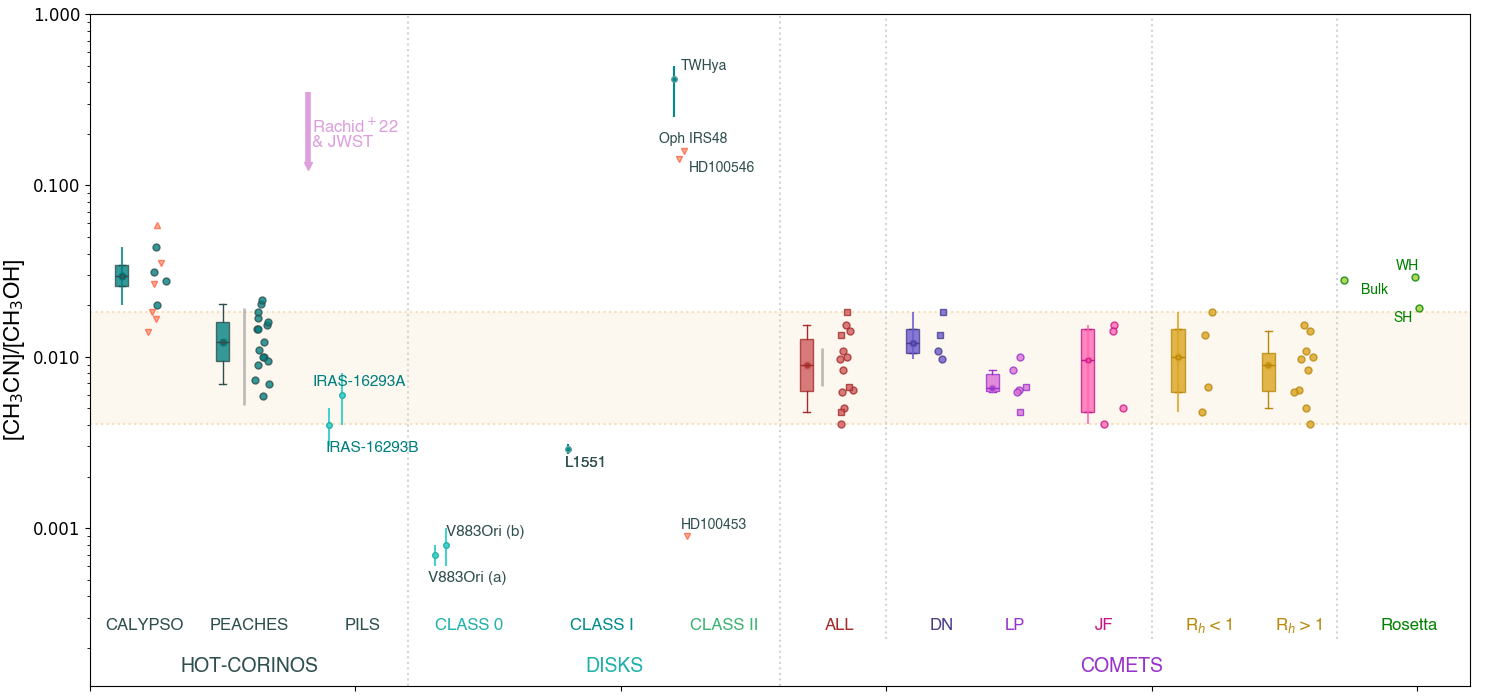
Figure 1: Comparison of the [CH3CN]/[CH3OH] abundance ratio in hot corinos, Class 0 to Class II disks, and comets.
References: Ceccarelli, C., Codella, C., Balucani, N., et al. 2023, in Astronomical Society of the Pacific Conference Series, Vol. 534, Protostars and Planets VII; Mumma M. J., Charnley S. B., Annual Review of Astronomy and Astrophysics, 2011, 49, 471-524; Drozdovskaya, M. N., van Dishoeck, E. F., Rubin, M., Jørgensen, J. K., & Al- 470; Bianchi, E., Codella, C., Ceccarelli, C., et al. 2019, MNRAS, 483, 1850; Lippi M., Podio L., Codella C., Faggi S., De Simone M., Villanueva G. L., Mumma M. J., Ceccarelli C., The Astrophysical Journal, 2024, 970.
How to cite: Lippi, M., Podio, L., Codella, C., Cordiner, M., Walsh, C., Ceccarelli, C., Giani, L., Booth, A., Faggi, S., Villanueva, G. L., Biver, N., and Bockelee-Morvan, D.: Tracing the Evolution of the [CH3CN/CH3OH] Ratio From Protostars to Comets, Europlanet Science Congress 2026, The Hague, The Netherlands, 7–11 Sep 2026, EPSC2026-602, https://doi.org/10.5194/epsc2026-602, 2026.


