EPSC Abstracts
Vol. 19, EPSC2026-609, 2026, updated on 02 Jul 2026
https://doi.org/10.5194/epsc2026-609
Europlanet Science Congress 2026
© Author(s) 2026. This work is distributed under the Creative Commons Attribution 4.0 License.

Assessment of penetrator technologies for Enceladus
 1,1,1
1,1,1- 1Finnish Meteorological Institute, Helsinki, Finland (mark.paton@fmi.fi)
- 2Department of Mechanical Engineering, Politecnico di Milano, Italy
- 3Instituto Nacional de Técnica Aeroespacial (INTA), Madrid, Spain
- 4Added Value Solutions (AVS), Elgoibar, Spain
Introduction
Penetrators offer a low-mass method for accessing subsurface material on icy worlds compared to conventional landers. They can also minimise surface contamination as they do not need rocket motors when ballistically emplaced. Enceladus is of interest due to evidence of a possibly habitable subsurface ocean with plume emissions at the south polar terrain. However, the mechanical properties of its near-surface icy regolith is unclear. In addition, testing under the conditions on Enceladus is challenging on Earth.
This study was motivated during an ESA penetrator project (Technologies for Penetrator Payloads), which highlighted the need to study penetration mechanics in low-density icy materials.
Background
The south polar tiger stripes of Enceladus continuously vent water vapour and grains into space (Figure 1). The slower moving grain aggregates fall back to the surface forming a highly porous icy regolith that may extend from decimetres to hundreds of metres in thickness (Buratti et al., 2014; Martin et al., 2023). Microwave observations from Cassini support the interpretation of a low-density porous surface layer (Le Gall et al., 2023). Subsurface heating close to the tiger stripes could increase sintering. However, it may be that porosity remains high over geological time scales (Molaro et al., 2019).
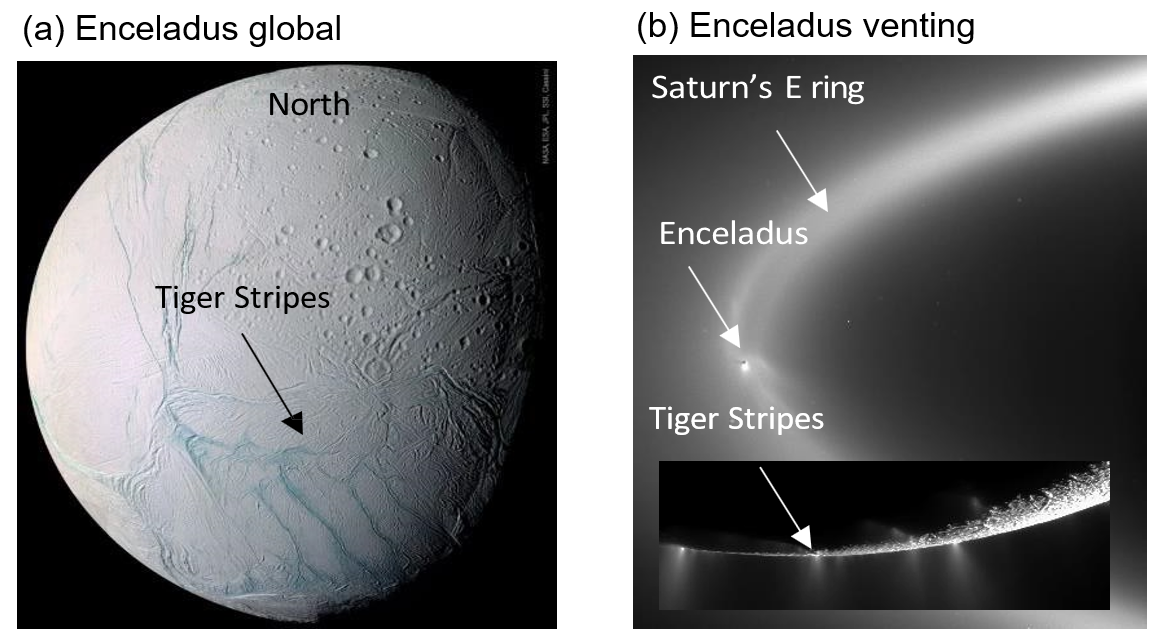
Figure 1. Images of Enceladus and its vents. Images: Cassini’s Imaging Science Subsystem.
Penetrators and other impact devices have been designed and built for the Moon and for Mars and in some cases flown. A selection of planetary penetrators is shown in Figure 2. Mars 96, Deep Space 2 and the Philae anchor (an instrumented harpoon-like device) were all flown but did not deploy correctly. MetNet and Lunar A were flight ready but did not get a mission to fly on and Akon is a prototype penetrator used in tests. So far, the Huygens impact penetrometer (on Titan), together with the Philae MUPUS penetrator (on a comet), are examples of low-velocity impact devices deployed on icy bodies and provided information on its subsurface, e.g. Zarnecki et al. (2005); Paton et al. (2012).
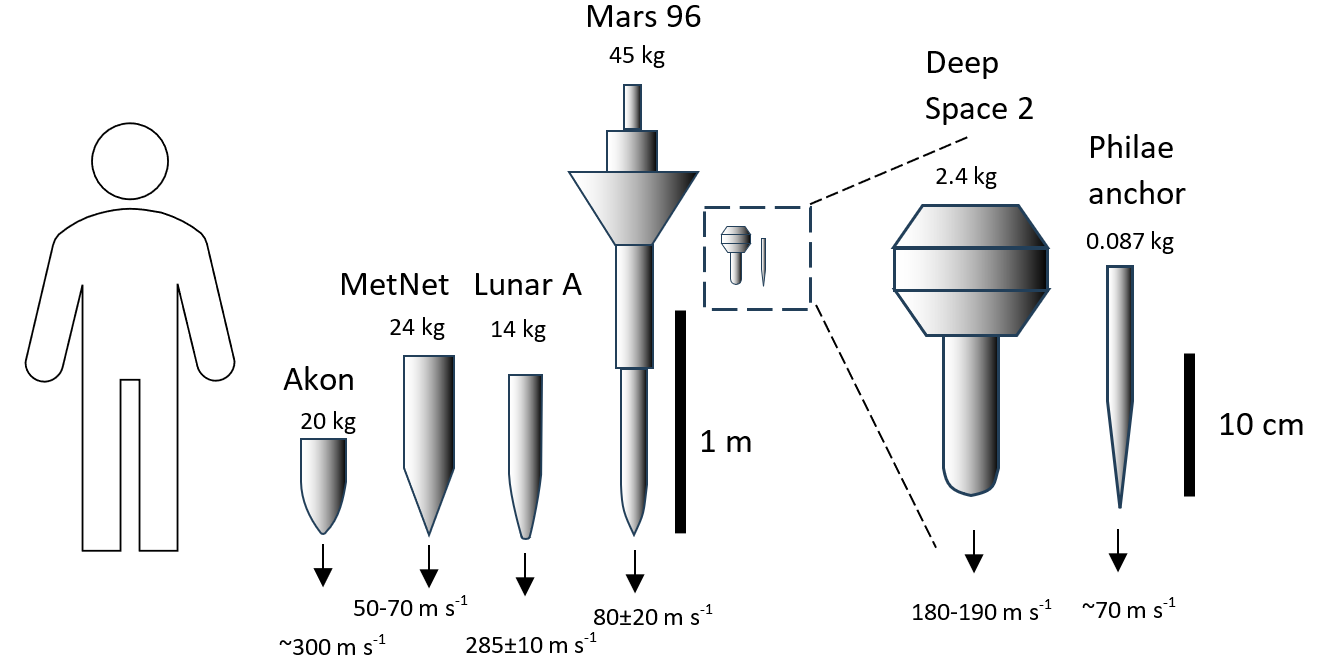
Figure 2. Various heritage, flight ready and prototype penetrators used in this study.
Method
Penetrator dynamics are modelled using the well-known Poncelet equation (Poncelet, 1839). A physically based derivation of the Poncelet drag coefficient is developed to estimate first-order penetration deceleration profiles in porous icy materials observed on Enceladus.
The model is compared with publicly available penetration tests in sand (Bless et al., 2024) at impact velocities of 150 to 200 m s⁻¹, comparable to expected Enceladus penetrator impact speeds. Heritage penetrator concepts including Lunar-A, MetNet, Mars 96 and Deep Space 2 are used as reference for penetration simulations.
Results
The drag coefficient model reproduces experimentally inferred Poncelet drag coefficients across a range of granular target densities and penetrator geometries. The results suggest that the effective compaction density changes with initial target density, with lower-density materials generating weaker confinement and hence lower compaction states.
The dynamic response of a penetrator to sintered near-vent materials currently remains unclear due to the scarce experimental penetrator data for high porosity cryogenic icy material. However, due to significantly higher strength of sintered ice grains, the resistance to penetration is likely to be several times higher than in unsintered porous plume deposits.
Application of the model to heritage penetrators produces maximum g-levels and penetration depths consistent with previous studies. Simulated Enceladus penetration scenarios generate preliminary deceleration profiles that provide constraints on impact shock environments relevant to future penetrator payload designs for icy worlds.
References
Bless, S., et al. (2024) Robust prediction of ordnance depth of burial in soils using field calibrated phenomenological model & probabilistic simulations. Final Report, SERDP Project MR19-1277. New York University, Manhattan College and Southwest Research Institute, May 2024.
Buratti, B. J., et al. (2014) Enceladus: Surface texture and roughness as clues to what lies beneath. In: 45th Annual Lunar and Planetary Science Conference, p. 2038
Le Gall, A., et al. (2023) Microwaving Mimas, Enceladus, Tethys, Dione, Rhea, Iapetus and Phoebe: insights into the regolith properties and geological history of Saturn’s icy satellites. Icarus, 394 (April), p. 115446.
Molaro, J. L., et al. (2019) The microstructural evolution of water ice in the solar system through sintering. Journal of Geophysical Research: Planets, 124(2), pp. 243–277.
Martin, E. S., et al. (2023) Measurements of regolith thicknesses on Enceladus: Uncovering the record of plume activity. Icarus, 392, 115369.
Newman, S.F., et al. (2008) Photometric and spectral analysis of the distribution of crystalline and amorphous ices on Enceladus as seen by Cassini. Icarus, 193(2), pp. 397–406.
Paton, M. D., et al. (2012) Microstructural penetrometry of asteroid regolith analogues and Titan’s surface. Icarus, 220(2), pp.787–807.
Poncelet, J. V. (1839) Introduction à la mécanique industrielle, 2nd edn. Brussels: Méline, Cans et Compagnie, p. 271.
Zarnecki, J. C., et al. (2005) ‘A soft solid surface on Titan as revealed by the Huygens Surface Science Package’, Nature, 438, pp. 792–795.
Acknowledgement:
'Technologies for penetrator payloads” project is funded by the European Space Agency under the ESA Contract No. 4000148443/25/NL/KML.
How to cite: Paton, M., Scaccabarozzi, D., Martínez-Oter, J., Genzer, M., Appiani, A., Erauzquin, M., Gonzalez, M., Juárez, D., Haukka, H., and Harri, A.-M.: Assessment of penetrator technologies for Enceladus, Europlanet Science Congress 2026, The Hague, The Netherlands, 7–11 Sep 2026, EPSC2026-609, https://doi.org/10.5194/epsc2026-609, 2026.


