
 1,2,1,1,
- 1Istituto Nazionale di Astrofisica – Istituto di Astrofisica e Planetologia Spaziali (INAF-IAPS), Via del Fosso del Cavaliere, Rome, Italy
- 2Dipartimento di Fisica, Sapienza Università di Roma, Piazzale Aldo Moro, 5, 00185 Rome, Italy
- 3Dipartimento di Scienze della Terra, Università degli Studi di Firenze, Florence, Italy
- 4Agenzia Spaziale Italiana, Via del Politecnico, snc, 00133 Rome, Italy
Introduction: The accurate removal of thermal emission from near-infrared hyperspectral observations is a prerequisite for the reliable detection and quantification of OH/H2O absorptions on the lunar surface. The Moon Mineralogy Mapper (M³), operating aboard Chandrayaan-1 across the 0.43–3.00 µm spectral range [1], is particularly affected by this problem at wavelengths beyond ~2 µm, where thermal contamination can substantially alter the shape and depth of hydration-related absorption features. Lunar surface temperatures vary dramatically over the course of a lunar day, ranging from ~40 to ~400 K [2] as a function of latitude, local solar time, solar incidence angle, surface albedo, and regolith thermophysical properties. Existing thermal correction strategies for M3 data include data-driven approaches [3], laboratory-calibrated empirical models [4], and advanced thermophysical models (TPMs) [5,6]. While each method has demonstrated utility, the laboratory-based empirical approach [4], which remains widely used in both local and global hydration studies, exhibits known limitations in transferability across diverse surface compositions and illumination geometries [7]. TPMs, despite their physical rigor and ability to account for anisothermal effects, remain computationally demanding for both global-scale and local-scale applications. In this context, we present LENNA (Lunar thermal-Emission Neural Network Approach), a supervised Machine-Learning framework for rapid, Diviner-consistent prediction of bolometric temperatures from M³ observations, whose outputs are coupled with a Hapke-based radiative transfer model [8] to retrieve spectral directional emissivity and OH/H2O-related absorption signatures (OHIBD [5] and ESPAT [9]).
Methods and data: LENNA is implemented as a fully connected feed-forward neural network trained to predict Diviner-like bolometric temperatures from geometrical and M³-derived input parameters on a pixel-by-pixel basis. The nine input features combine geometric quantities — latitude, local solar time (LST), and the topographically corrected cosine of the incidence angle — with selected spectral quantities, including the mean reflectance over 0.89–1.62 µm as a proxy for surface albedo, the reflectance values at four spectral channels in the 2.54–2.67 µm range sensitive to residual thermal emission, and the spectral slope between 2.02 and 2.67 µm.
Training targets are Diviner bolometric temperatures [2] derived from spatially and temporally co-registered M3 and Diviner observations, matched within a LST tolerance of ±0.05h. The training dataset encompasses several regions of interest (ROIs) distributed across diverse latitudes, surface compositions, optical maturities, and illumination conditions. Model performance is evaluated via a random split approach and a Leave-One-ROI-Out (LORO) cross-validation strategy. Eight additional spatially independent test ROIs — spanning anorthositic highlands, pyroclastic deposits, and lunar maria — are used to assess generalization capability and the potential influence of spatial or temporal leakage. Predicted bolometric temperatures are subsequently coupled with a Hapke-based radiative transfer formulation to retrieve thermally and photometrically corrected reflectance spectra.
Results and conclusions: LENNA reproduces Diviner-derived bolometric temperatures with high fidelity across all testing ROIs, outperforming the empirical benchmark [4] in terms of both precision and bias. The LORO cross-validation yields an overall standard deviation of ~8.8 K and an RMSE of ~9.4 K, with pixel-level biases remaining below 5 K across all tested regions. Propagation of this uncertainty into thermally corrected reflectance spectra yields maximum absolute uncertainties of approximately ±0.40% at 2.54 µm and ±2.50% at 3.00 µm, at least in testing ROIs. The distribution of normalized reflectance residuals at 2.54 µm is broadly consistent with a near-Gaussian behavior, suggesting that systematic effects remain limited across the tested conditions. The LENNA-predicted near-noon bolometric temperature maps (Figure 1) reproduce the expected trends, in agreement with the global Diviner reference dataset [10]. The 2.54 µm directional emissivity map derived via the Hapke formulation (Figure 2) reveals spatially coherent patterns correlated with surface composition and albedo, consistent with independent mineralogical analyses. Comparison with an advanced TPM [6] over two hydration-rich near-noon regions, such as Copernicus crater and the western border of Mare Crisium, shows broadly consistent spatial distributions of OH/H2O.
The ESPAT latitudinal profiles derived from LENNA (Figure 3) indicate systematically higher hydroxyl/water abundances than those reported in [9] at the same LSTs, in agreement with previous studies employing physically more complete correction frameworks (e.g., [5,6]).
Although calibrated on M³-derived features, LENNA is potentially transferable to other VIS-NIR imaging spectrometers operating in the same reference domain, provided their spectral range is at least partially overlapping with that of M3. Promising candidates include the Chang'e-5/LMS and Chang'e-6/LMS, Chandrayaan-2/IIRS, and instruments that acquired lunar observations during flyby operations, such as JUICE/MAJIS.
Future developments will aim to map the OH/H2O distribution across the entire lunar surface by expanding the set of representative training ROIs and/or input parameters, in order to better capture data-related effects such as latitudinal/longitudinal striping [5].
Acknowledgments: The authors acknowledge support from the Space It Up project, funded by the Italian Space Agency and the Italian Ministry of University and Research. Contract n. 2024-5-E.0 – CUP n. I53D24000060005.
References:
[1] Green, R.O. et al. (2011) Journal of Geophysical Research, Planets, 116(E10).
[2] Paige, D. A. et al. (2010) Science, 330, 6003.
[3] Clark, R.N. et al. (2011) Journal of Geophysical Research, Planets, 116(E6).
[4] Li, S. & Milliken, R.E. (2016) Journal of Geophysical Research, Planets, 121(10).
[5] Wöhler, C. et al. (2017) Science Advances, 3(9).
[6] Wohlfarth, K. et al. (2023) Astronomy & Astrophysics, 674(A69).
[7] Clark, R.N. et al. (2024) The Planetary Science Journal, 5(9).
[8] Hapke, B. (2005) Theory of Reflectance and Emittance Spectroscopy.
[9] Li, S. & Milliken, R.E. (2017) Science Advances, 3(9).
[10] Williams, J.–P. et al. (2017) Icarus, 283(300-325).
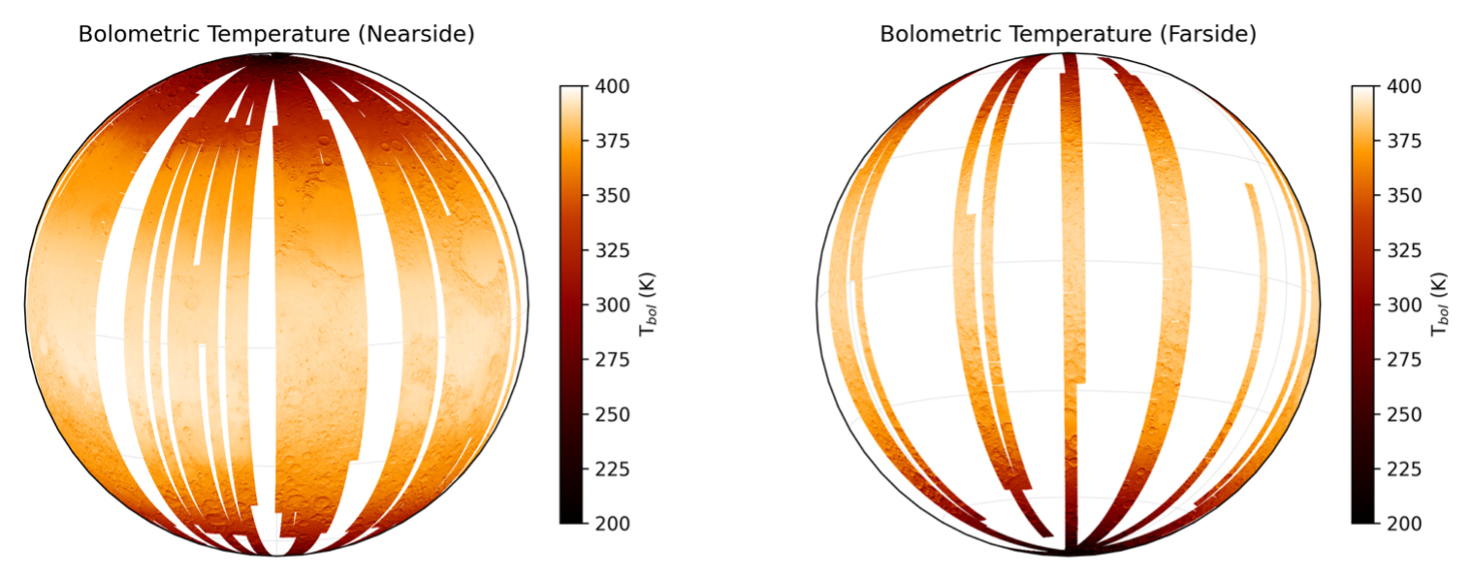
Figure 1. Bolometric temperature maps for both nearside and farside using LENNA on part of near-noon M3 observations (OP2C [1]).
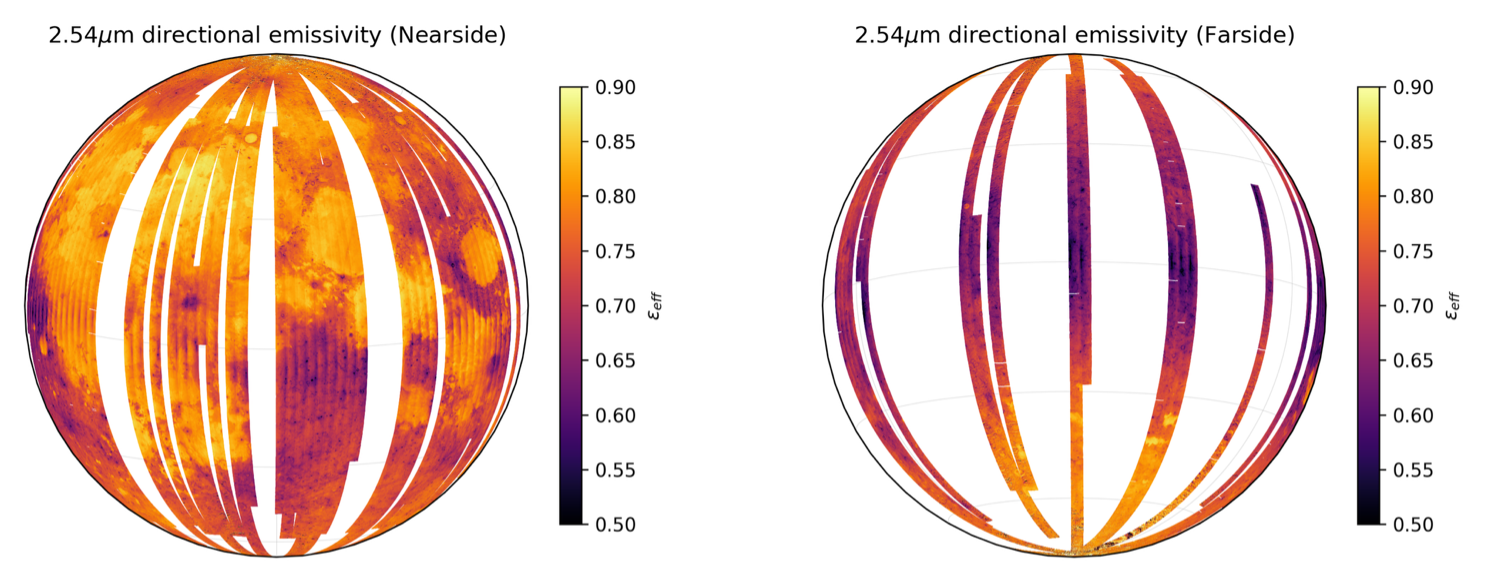
Figure 2. 2.54 µm directional emissivity maps for both nearside and farside using LENNA on part of near-noon M3 observations (OP2C [1]).
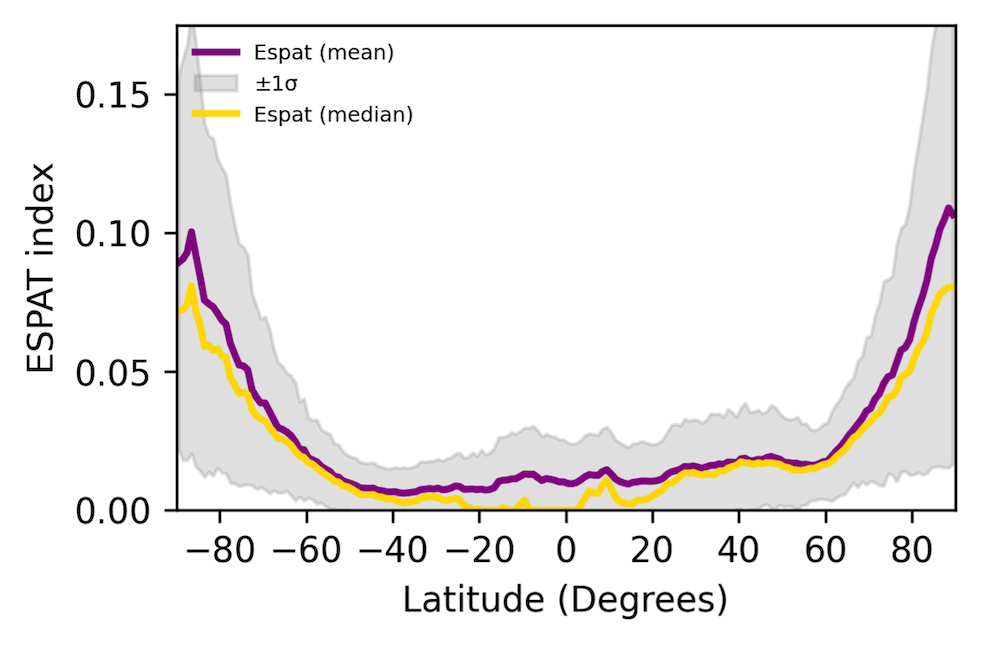
Figure 3. The latitudinal trend of the ESPAT parameter computed at ~2.85 µm in analogy with [9].
How to cite: Colaiuta, F., Tosi, F., Zambon, F., Pratesi, G., Baldetti, C., and Bellucci, M.: Retrieving Lunar Bolometric Temperature, Directional Emissivity, and Hydration Signatures with LENNA: A Machine-Learning Framework for Moon Mineralogy Mapper (M3) Data, Europlanet Science Congress 2026, The Hague, The Netherlands, 7–11 Sep 2026, EPSC2026-616, https://doi.org/10.5194/epsc2026-616, 2026.


