
 1,2,2,
- 1Imperial College London, London, United Kingdom
- 2Space Research Institute (IWF), Austrian Academy of Sciences, Graz, Austria
- 3TU Braunschweig, Braunschweig, Germany
- 4CBK, Warsaw, Poland
Comet Interceptor, the next ESA mission to a comet, aims at visiting a long period comet, ideally a dynamically-new comet which will be reaching the inner Solar System for the first time. The mission is taking advantage of the newly commissioned Vera Rubin Observatory and soon-running Large Synoptic Survey Telescope (LSST) survey to detect potential targets while they are still at large heliocentric distances. Launch onboard an Ariane 64 lancer from Kourou is currently planned for late 2028/early 2029. Comet Interceptor is the first rapid response mission: as the target has not yet been identified, it will park at L2 ready to transfer and fly by the comet. This original mission is composed of three spacecraft (spacecraft A and probe B2 from ESA, and probe B1 from JAXA), which offers an exciting multipoint capability.
The magnetometer on probe B2 (FGM-B2) is part of the Dust, Field, & Plasma (DFP) instrument suite led by CBK, Poland, and composed of instrument teams from Austria, France, Germany, Italy, Czech Republik, Sweden, and the UK. This dual fluxgate magnetometer, which will be measuring the three components of the magnetic field vector, builds upon a strong heritage from space missions, such as Rosetta/Philae, VEx, and MMS. It is led by Imperial College London with a major hardware component from IWF Graz, Austria.
Beside cameras, magnetometers are the only instrument present on all three spacecraft, hence fully exploiting the multi-point capability of Comet Interceptor and offering the first opportunity:
- to assess the 3D structure of magnetic boundaries, such as the bow shock and the diamagnetic cavity, resulting from the interaction of the solar wind with the cometary plasma
- to disentangle time versus space in evaluating the energy transfer through waves generated and propagating across the different interaction regions.
Coordination between all three magnetometer teams (TU Braunschweig for A, Kyoto University for B1, and Imperial College London for B2) is critical for optimising the operation, including calibration, and ensuring a meaningful comparison between the different datasets. In addition, while spacecraft A will reach a minimum distance of 1000 km from the comet and probe B1, of 800 km, probe B2 will approach the nucleus at closest distance down to 400 km. This should allow the magnetometer on probe B2 to detect the magnetic cavity for a cometary outgassing of at least 5x1028 s-1, and potentially even lower.
The FGM-B2 magnetometer flight model, shown in Fig. 1, was delivered to CBK in August 2025 and integrated in the DFP-B2 flight unit. Subsequently, DFP-B2 was the first Comet Interceptor instrument delivered to the Prime Contractor, namely Sener for Probe B2, in May 2026. FGM-B2 flight model is fulfilling all its performance requirements. A summary of its characteristics is provided in Table 1.
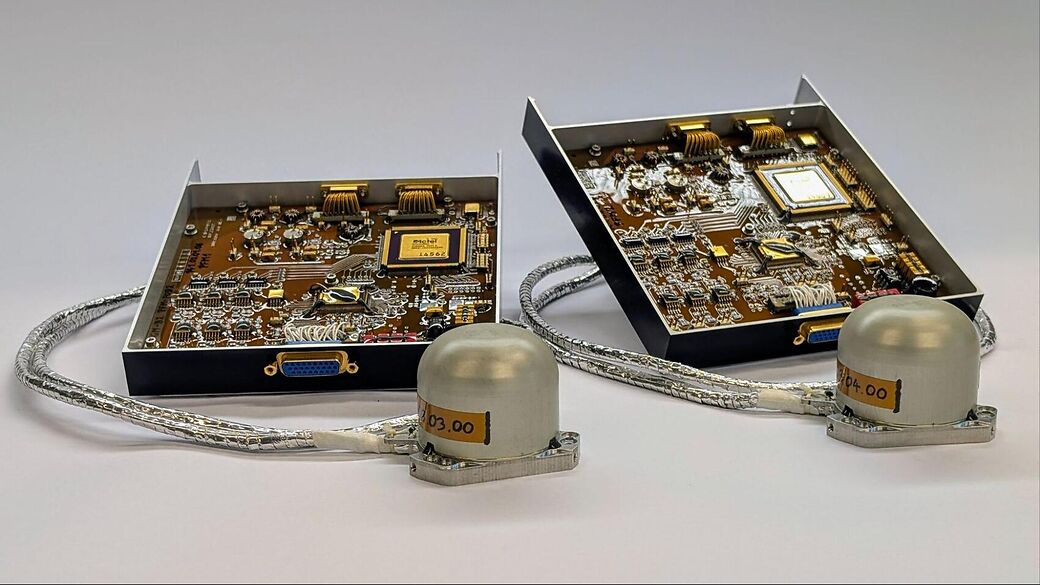
Fig. 1: Picture of the FGM-B2 flight sensors along with their FGM-B2 electronic board (credit: IWF)
|
Physical quantity |
Value |
|
Total power per sensor (incl. electronics) |
650 mW |
|
Magnetometer base range |
+/- 1000 nT |
|
Magnetometer ground test range |
+/- 9000 nT |
|
Raw sampling rate |
128 Hz |
|
Resolution |
24 bits |
|
Board & sensor temperature range (calibration) |
-40°C/+60°C |
|
Noise @1Hz for each of the three components |
< 10 pT/sqrt(Hz) |
Table 1: Characteristics of the FGM-B2 magnetometer
To address the two main objectives, there are additional requirements resulting from:
- the target. The comet outgassing and solar wind conditions will affect the location of the physical boundaries and regions. These parameters will drive the value of the minimum flyby speed required to ensure that probe B2 is released from spacecraft A in the solar wind well upstream of the bow shock. For the scenario of 1P/Halley during the Giotto flyby, the minimum speed is 20 km/s, which is likely to be fulfilled.
- dust impacts during the flyby. As probe B2 will approach the comet the closest, it may very likely suffer from dust impacts. These may affect the spinning stability of probe and yield to the nutation of the probe.
- the magnetic environment of probe B2. FGM-B2 will be located on one of the legs of the tripod of probe B2, between the platform – hosting numerous magnetic disturbers from spacecraft subsystem and other instrument – and the intersatellite link antenna. This renders the data cleaning in such a “dirty” magnetic environment very challenging. It is critical to characterise as accurately as possible the magnetic environment of probe B2.
Now the FGM-B2 has been successfully delivered to the Prime, the next milestones include:
- cross calibration and time synchronisation between the magnetometers on spacecraft A and probe B2 (2ndcampaign following the original one in November 2025)
- integration of FGM-B2 – and more generally DFP-B2 – into probe B2 (summer 2026)
- B2 magnetic characterisation (spring 2027)
Stay tuned!
How to cite: Galand, M., Cupido, E., Valavanoglou, A., Carr, C., Jernej, I., Magnes, W., Ruiz Rodriguez, I., Volwerk, M., Auster, U., and Rothkaehl, H.: FGM-B2, the magnetometer onboard probe B2 for the ESA/Comet Interceptor mission, Europlanet Science Congress 2026, The Hague, The Netherlands, 7–11 Sep 2026, EPSC2026-632, https://doi.org/10.5194/epsc2026-632, 2026.


