
 1,2,1,4,6,1,1,1
- 1São Paulo State University, UNESP, School of Natural Sciences and Engineering, Mathematics, Guaratinguetá, SP, Brasil (valerio.carruba@unesp.br)
- 2Laboratório Interinstitucional de e-Astronomia, Rio de Janeiro, RJ, Brasil
- 3NSF--DOE Vera C. Rubin Observatory / NSF NOIRLab, Tucson, AZ, USA
- 4Instituto de Astronomía y Ciencias Planetarias, Universidad de Atacama, Copiapó, Chile
- 5São Paulo State University, UNESP, Instituto de Geociências e Ciências Exatas, Rio Claro, SP, Brasil
- 6São Paulo State University, UNESP, School of Engineering, São João da Boa Vista, SP, Brasil
- 7Universidad Tecnológica del Perú (UTP), Area de Ciencias, Lima, Peru
The Vera C. Rubin Observatory will transform the study of solar system minor bodies by providing multi-band photometry over an unprecedented range of temporal and spatial scales. Early Science Validation (SV) observations obtained during 2025–2026 represent one of the first large datasets suitable for asteroid physical characterization, albeit with sparser, irregular, and heterogeneous sampling compared to later survey phases. These data provide a critical testbed for developing methodologies capable of extracting reliable physical parameters under realistic survey conditions.
In this work, we present a unified framework to derive asteroid rotational and compositional properties from Rubin SV observations. Building on methods previously applied to Rubin First Look data, we extend the analysis to multi-band (griz) photometry with reduced temporal coverage. Our approach combines two complementary techniques for rotation period determination: (i) high-order Fourier (HFO) light-curve modeling and (ii) a multi-band Lomb–Scargle (LSM) periodogram analysis. The HFO method models the observed light curve as a Fourier series that incorporates phase-angle corrections and band-dependent magnitude offsets, enabling flexible representation of complex rotational signals. In contrast, the LSM approach emphasizes computational efficiency and robustness to irregular sampling by fitting a shared periodic signal across filters with a fixed-order harmonic model.
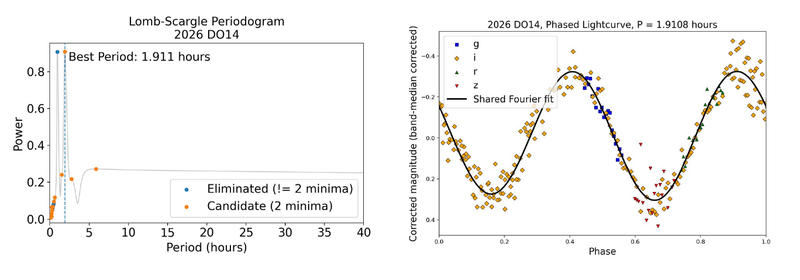
Figure 1: LSM periodogram and phased multi-band light curve for 2026 DO14, showing a robust ~1.91 h rotation period and double-peaked morphology.
To ensure reliability, we implement a wrapper-level validation framework that compares the outputs of both methods using quantitative criteria based on band coverage, photometric amplitude, and inter-method consistency. Objects are classified as reliable only when both approaches yield consistent rotation periods within a defined tolerance and the observational dataset satisfies minimum completeness requirements. This strategy mitigates common degeneracies such as aliasing and harmonic ambiguities, which are particularly severe in sparsely sampled datasets.
Once rotation periods are established, we derive light-curve amplitudes and estimate minimum axial elongations under the assumption of triaxial ellipsoid shapes. The amplitude is corrected for phase-angle effects and converted into lower limits on the axis ratio a/b, providing constraints on asteroid shape distributions. For well-sampled objects, these estimates are consistent with expectations for collisionally evolved populations, while extreme values may indicate highly elongated or contact-binary configurations.
A key component of our framework is the derivation of rotation-corrected colors and taxonomic classifications. Because Rubin observations in different filters are not simultaneous, we model all photometric measurements with a shared periodic function and band-dependent offsets, allowing color indices to be extracted without bias from rotational variability. From these offsets, we compute standard color indices (e.g., g-r, r-i, i-z) and derive spectral slopes using calibrated reflectance transformations. Taxonomic classes are then assigned in the (i-z, gri slope) parameter space, following empirical boundaries established from SDSS data.
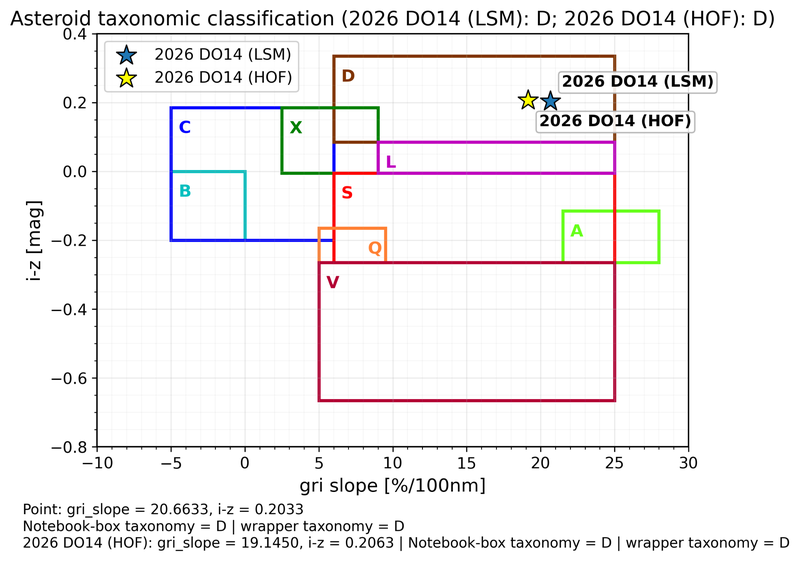
Figure 2: Taxonomic classification of 2026 DO14 in (i-z, gri slope) space, consistent with a D-type asteroid.
The inclusion of z-band photometry is particularly important, as it provides sensitivity to absorption features near 1 µm and significantly improves compositional discrimination compared to traditional gri-based taxonomy. This enables the identification of distinct asteroid classes, including C-, S-, D-, X-, and V-type objects, and represents one of the first demonstrations of Rubin data being used for taxonomic classification.
We validate the methodology using both real and simulated datasets. A well-sampled asteroid (2026 DO14) serves as a benchmark case, for which both HFO and LSM methods converge on a consistent rotation period (~1.9 hours) and yield compatible color and taxonomy estimates (see Figures 1 and 2). However, most objects in the SV dataset exhibit sparse and clustered temporal sampling. To quantify the impact of observational limitations, we simulate reduced datasets by subsampling observations into a small number of temporal clusters. These experiments indicate that reliable period determination depends strongly on the number of observing clusters and their temporal extent. In particular, HFO methods require at least three well-separated clusters to produce robust solutions, whereas the LSM approach remains more stable under limited sampling conditions.
Application of the framework to the February 2026 Rubin Minor Planet Center dataset yields preliminary rotational and compositional properties for a small sample of asteroids. While only a subset of objects meet strict reliability criteria, the results demonstrate that meaningful physical parameters—including rotation periods, amplitudes, colors, and taxonomy—can be extracted even from early, incomplete datasets. The derived taxonomic distribution is broadly consistent with expectations from previous surveys, confirming the validity of the approach.
Overall, this study emphasizes that data quality—particularly temporal coverage and signal amplitude—is the primary limiting factor in early Rubin analyses. Nevertheless, the methods developed here provide a robust and scalable foundation for future large-scale studies. As Rubin survey operations continue and observational coverage improves, this framework can be applied to millions of objects, enabling systematic investigations of asteroid spin states, shapes, and compositions. These results establish a practical pathway toward population-level characterization of the Solar System in the Legacy Survey of Space and Time era, demonstrating that even early Rubin data can yield valuable scientific insights when analyzed with appropriately designed methodologies.
References
V. Carruba, S. Greenstreet, M. Mastropietro, S. Aljbaaed, G. Caritá, R. C. Domingos, M. Huaman, M. M. Bala, R. D. Z. Pedroso, E. M. D. S. Delfino, 2026, Extracting Asteroid Physical Properties from Vera C. Rubin Observatory Science Validation Survey Data: Rotational Periods, Colors, and Taxonomies, Planetary and Space Sciences, under review.
How to cite: Carruba, V., Greenstreet, S., Mastropietro, M., Aljbaae, S., Caritá, G., C. Domingos, R., Huaman, M., Bala, M., Pedroso, R., and Delfino, E.: Extracting Asteroid Physical Properties from Vera C. Rubin Observatory Science Validation Survey Data: Rotational Periods, Colors, and Taxonomies, Europlanet Science Congress 2026, The Hague, The Netherlands, 7–11 Sep 2026, EPSC2026-64, https://doi.org/10.5194/epsc2026-64, 2026.


