
 1,1,1,3,
- 1Département de géomatique appliquée, Université de Sherbrooke, 2500 Bd de l'Université, Sherbrooke, Québec, J1K 2R1, Canada (gaelle.belleau-magnat@usherbrooke.ca)
- 2Natural Resources Canada, Geological Survey of Canada, 601 Booth Street, Ottawa, Ontario, K1A 0E8, Canada
- 3Department of Earth and Planetary Sciences and Geotop Research Centre, McGill University, 845 Rue Sherbrooke O, Montréal, Québec, H3A 0G4, Canada
- 4Geosciences Department, John Abbott College, 21 275 Rue Lakeshore Road, Sainte-Anne-de-Bellevue, Québec, H9X 3L9, Canada
- 5Département d’Astrophysique, de Géophysique et d’Océanographie, Université de Liège, 19C Allée du 6 Août, B-4000, Liège, Belgium
- 6Canada Aviation and Space Museum, 11 Aviation Pkwy, Ottawa, Ontario, K1K 2X5, Canada
- 7Centre de Géomatique du Québec, 534 Rue Jacques-Cartier E, Chicoutimi, Québec, G7H 1Z6, Canada
- 8Sacred Heart High School, 5870 Abbott St E, Stittsville, Ontario, K2S 1X4, Canada
Introduction
Martian analogue environments provide valuable opportunities to investigate the preservation of biosignatures and to refine strategies for their detection on Mars. Reactive gossans in permafrost - such as those found in the Canadian Arctic - constitute potential Martian analogues because of mineralogical similarities observed between terrestrial gossans and orbital or rover-based observations on Mars. Gossans are the superficial expression of sulfide-bearing rocks that have undergone chemical weathering through interaction with oxygenated groundwater. Gossans constitute one of the few iron-rich aqueous environments known to provide a habitable setting on Earth and potentially on Mars [1]. Previous studies have proposed that gossans, or related processes involving the chemical alteration of sulfide minerals, may have occurred on Mars in the past and that some of these reactions could persist today within the Martian permafrost [e.g. 2, 3, 4, 5].
The Terrestrial Mineral Analysis by Remote Sensing (T-MARS) project investigated Arctic gossans located at the head of Expedition Fiord, Axel Heiberg Island, Nunavut, Canada (Fig. 1) [6]. It included the detection and study of gossans from orbit to the ground using instrumentation relevant to present and upcoming Mars exploration missions. The scientific objectives were (1) to characterize their geochemistry and mineralogy; and (2) understand their formation processes. The operational objectives were (3) to develop strategies for detecting and studying them on Earth and Mars; and (4) to detect potential biosignatures.
Methods
Prior to field work
Before the field campaigns, target gossans were selected according to both their accessibility and their scientific relevance. A principal component analysis (PCA) was applied to a WorldView-2 image. A colour composite was then generated using the principal components showing the strongest contrast between the eigenvector values associated with the original red and blue bands referring to the red/blue ratio often used to detect iron oxides (Fig. 1). Previously identified gossan sites helped identify additional potential outcrops for field investigation on the colour composite. A slope map was used to assess the accessibility of the selected sites.
Field work
Two field campaigns to Expedition Fiord on Axel Heiberg Island, NU were carried out in July 2022 and July 2023 in the vicinity of the McGill Arctic Research Station. The investigated gossans were sampled both at the surface and at depth through vertical trenches. Both sterile and non-sterile sampling procedures were applied depending on the selected follow up laboratory protocols. A HySpex SWIR-384 hyperspectral camera was used to image gossan occurrences and evaluate the potential of this technology as a reconnaissance tool for mineral mapping. A drone was also deployed to examine hard‑to‑reach areas and to capture broader views of outcrops that were not visible from the ground (Fig. 2).
Laboratory analyses
Samples were characterized using elemental analyses for sulfur, nitrogen and carbon, together with X-ray diffraction and X-ray fluorescence techniques [7, 8, 9]. Additional measurements included loss on ignition, pH, and SEM-EDX analyses. Sterile samples were also investigated for lipid biosignatures through n-alkane quantification by gas chromatography–mass spectrometry [7], as well as for organic carbon content using Raman spectroscopy [8]. Spectroscopic measurements were acquired with rover-mountable instruments, including visible to near-infrared reflectance spectroscopy and mid- to thermal-infrared diffuse reflectance spectroscopy.
Remote sensing
The VNIR reflectance spectra were used as endmembers for the Spectral Feature Fitting algorithm in ENVI to identify gossan occurrences in WorldView-2 and PRISMA imagery [9].
Results and discussion
Elemental and spectroscopic analyses revealed mineral assemblages and oxidation gradients characteristic of gossans [10, 11, 12], with twenty-four mineral phases identified. Gypsum and quartz were common across all sites. Variations in primary sulfides and secondary sulfates indicate different oxidation stages, from actively weathering gossans to fully oxidized systems dominated by secondary sulfates. Organic carbon and potential lipid biosignatures were detected at depth. Classic gossan stratigraphy, with an oxidized surface layer over an unoxidized horizon, was observed at several sites, alongside additional stratification patterns ranging from distinct layering to strong heterogeneity (Fig. 3).
The results suggest that these gossans formed through alteration of primary sulfides in diabase/gabbro intrusions or from mobilized evaporitic sulfates, likely driven by paleohydrothermal activity or fluid circulation associated with the emplacement of sills in the host sedimentary rocks.
Field and laboratory observations made in this study indicate that successful identification of gossans on Mars will likely depend on targeting faulted regions where fracturing may have increased permeability, focusing on erosion-resistant ridges, using high-resolution orbital data and detecting co-located iron sulfides, oxides and sulfates.
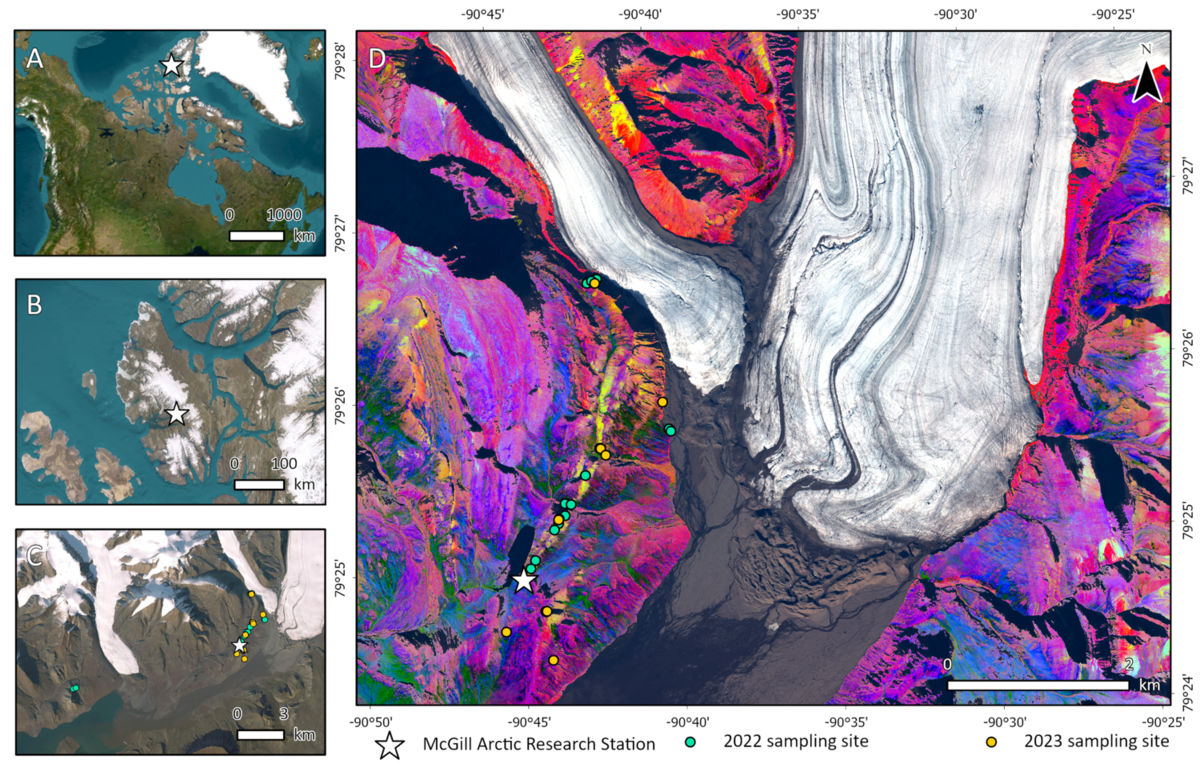
Figure 1. Geology of the Expedition Fiord area, Nunavut. A) Location of Axel Heiberg Island in the Canadian Arctic Islands. B) Location of the McGill Arctic Research Station on Axel Heiberg Island. C) Footprint of the study area. Basemap for insets A-B-C: Esri World Imagery (2025). D) PCA colour composite. Figure modified after [6].
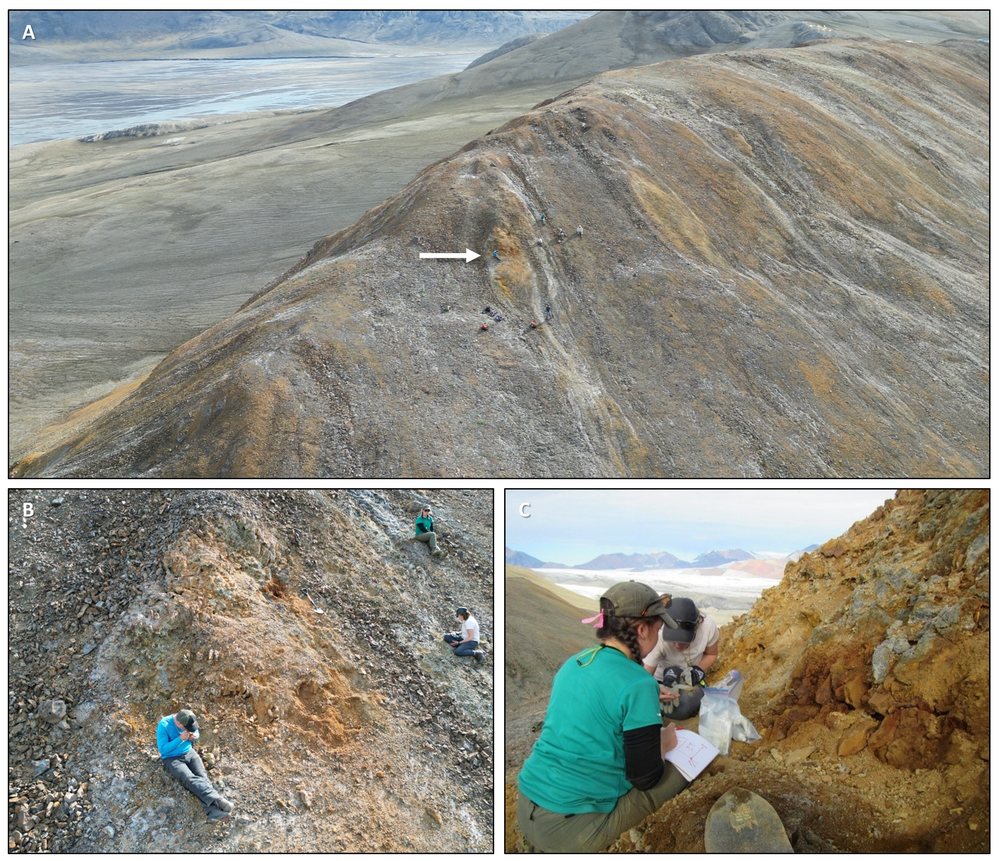
Figure 2: Multi-scale field images. A) Contextual overview of a sampling location acquired by drone. The white arrow indicates the gossan center shown in B (people present in the image for scale). B) Drone image of the gossan center, where a trench was excavated. C) Image captured by a team member on the ground showing gossan sampling. Figure from [6].
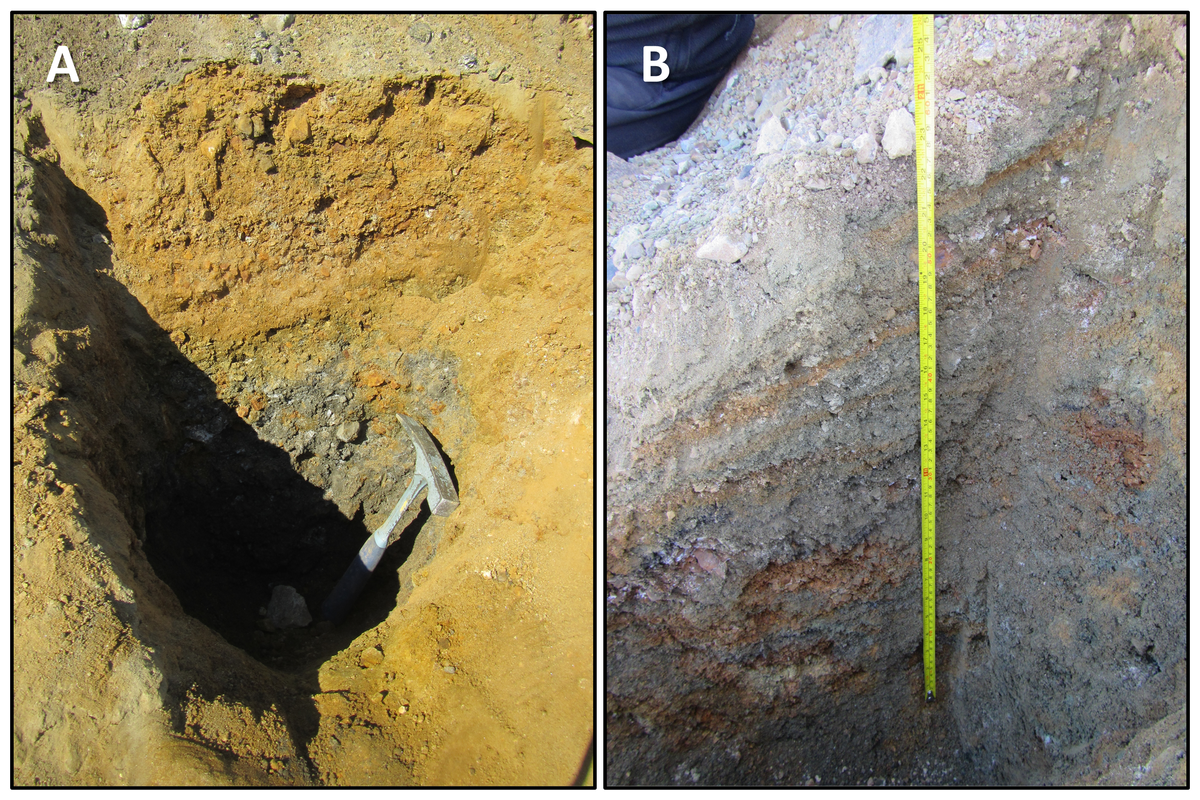
Figure 3: Stratification patterns observed in trenches. A) Classical gossan stratigraphy with unoxidized primary sulfide zone at depth and oxidized zone at the surface in a gossan (35 cm hammer). B) Finely stratified pattern of alternating oxidized and unoxidized layers in a gossan, measuring tape for scale (~60 cm deep). Figure from [6].
References
[1] Hays et al. (2017) Astrobiol., 17, 363-400.
[2] Burns, R.G. (1988) Lunar Planet. Sci. Conf. Proc., 18, 713–721.
[3] Dehouck et al. (2012). Geochem. Cosmochim. Acta, 90, 47–63.
[4] Moore and Szynkiewicz (2023) Icarus, 391, 115342.
[5] Gil-Lozano et al. (2025) Front. Astron. Space Sci. 12, 1504288.
[6] Lemelin et al. (2026) Planet. Space Sci., 106258.
[7] Aoid et al. (2023) Master’s degree thesis, McGill University.
[8] Belleau-Magnat et al. (2024) Planet. Space Sci., 256, 106036.
[9] Brassard et al. (2024) 55th LPSC, Abstract #1635.
[10] West et al. (2009) Planet. Space Sci. 57, 1302–1311.
[11] Peterson et al. (2014) Earth Planet Sci. Lett. 400, 88–93.
[12] Percival and Williamson (2016) Appl. Clay Sci. 119, 431–440.
How to cite: Belleau-Magnat, G., Lemelin, M., Williamson, M.-C., Léveillé, R., Brassard, É., Aoid, H., Fauconnier, B.-V., Douglas, P. M. J., Lachance, S., Marion, C. L., Castillo-Guimond, L., and Clark, S.: T-MARS Project: Reactive Gossans as Iron-Rich Martian Analogue Environments of Astrobiological Interest, Europlanet Science Congress 2026, The Hague, The Netherlands, 7–11 Sep 2026, EPSC2026-656, https://doi.org/10.5194/epsc2026-656, 2026.


