
 1,1,
1,1,- 1Jet Propulsion Laboratory, California Institute of Technology, Planetary Geology, Pasadena, CA, USA (marie.barthez@jpl.nasa.gov)
- 2Laboratory for Atmospheric and Space Physics, University of Colorado, Boulder, CO, USA
- 3Geological and Planetary Science Division, California Institute of Technology, Pasadena, CA, USA
- 4Department of Earth and Environmental Geosciences, Colgate University, Hamilton, NY, USA
Valles Marineris is a natural cross-section exposing rocks from the ancient Martian crust. The mineralogical composition of these rocks has been studied at the 18 m/pixel spatial scale from orbit using Visible to Short-Wave Infrared (VSWIR) spectroscopy with the Compact Reconnaissance Imaging Spectrometer for Mars (CRISM, MRO, [1]). The oldest Martian crustal blocks are light-toned and associated with spectral absorptions indicative of Low-Calcium Pyroxene (LCP) [2, 3]. Nearby, plagioclase feldspar rich layers have also recently been detected, suggesting the ancient Martian crust may have had a more felsic composition than the basalts found on the surface [4, 5]. In situ data from the rocks exposed in Valles Marineris’ walls would improve our ability to characterize the geologic setting and composition of these ancient terrains and address key questions about the formation of the early Martian crust such as whether the light-toned rocks containing LCP and plagioclase are related to alkaline magmatism, and which formation processes could explain the juxtaposition of both mafic and felsic crustal materials [6].
The study presented below is funded through NASA’s Planetary Science Technology and Analog Research program and aims to advance the scientific and technical basis for a future in situ mission to access the ancient terrains exposed in the walls of Valles Marineris. Specifically, a helicopter equipped with a VSWIR imaging spectrometer could investigate the mineralogical composition of the rocks at a much higher spatial resolution than is currently possible from orbit, resolving key information about their texture and mineralogy which is necessary to distinguish between crustal formation models. Of great interest is the abilities of a helicopter-mounted spectrometer to detect the 1.3 µm spectral absorption associated with plagioclase feldspars [7], which can only be detected if ferrous iron is incorporated in its chemical lattice [8], which can be quickly obscured by darker, mafic minerals [9]. Within whole rocks, plagioclase crystal size [10, 11, 12] and the degree of weathering [12, 13] have been identified as key parameters that affect the detectability of plagioclase absorptions.
In this study, we use spectral datasets collected at multiple spatial resolutions to determine how plagioclase crystal size, distribution, weathering state, and transparency affect the detectability of the 1.3 µm plagioclase absorption at different spatial scales. These results will inform requirements for VSWIR spectral data acquired by future Mars helicopter payloads and help interpret the data they collect. We analyzed hyperspectral datasets of whole plagioclase-phyric basalts from outcrops of the Steens basalt unit collected at several locations in southeast Oregon, including Steens Mountain and Hart Mountain. The Steens basalt unit is part of the Columbia River Basalt Group (CRBG) and is the oldest (~17 Ma) and most mafic member of this Large Igneous Province [14]. Alongside olivine and pyroxene contained in this basalt, it is notable for its dominant microlithic porphyritic texture characterized by centimeter-scale plagioclase phenocrysts [15]. The plagioclase phenocrysts share a similar chemistry (An57–74) throughout the section [15], but they remain diverse in size, shape, and abundance, providing an ideal location to explore how these physical properties affect bulk spectral properties. These basaltic samples were also selected as potential analogs for Martian rocks. Indeed, a plagioclase-phyric basalt has been proposed as one possible lithology for the plagioclase rich layer in Valles Marineris [5].
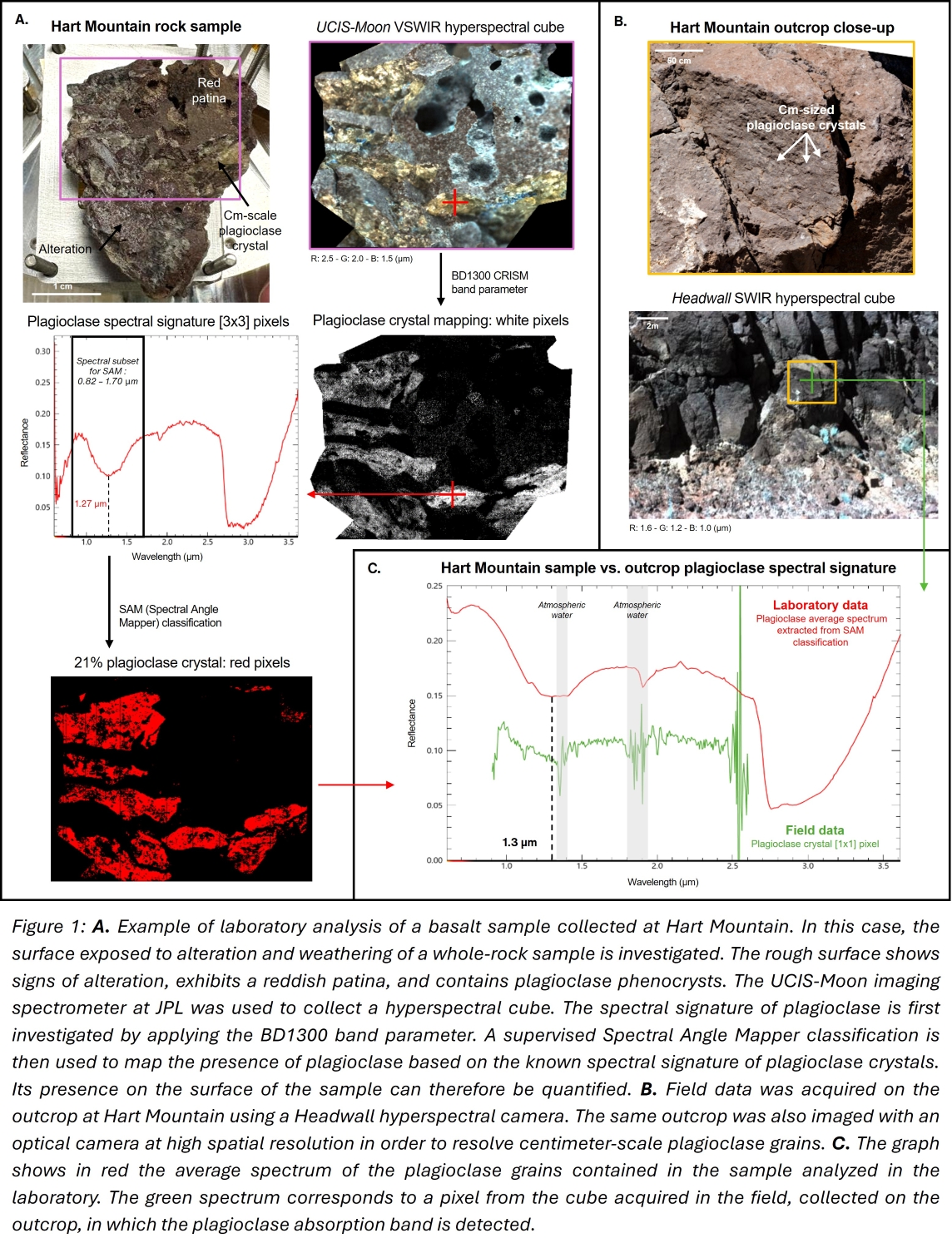
Rock samples were first imaged as cut slabs and rough surfaces at JPL using the Ultra-Compact Imaging Spectrometer for the Moon (UCIS-Moon) hyperspectral camera that operates between 0.6 and 3.6 µm [16]. The high spatial resolution, of about 80 µm/pixel, allowed identification and spectral characterization of individual plagioclase crystals. To complement laboratory analyses, outcrops at Steens Mountain and Hart Mountain were imaged at the landscape scale using a Headwall SWIR hyperspectral camera operating between 0.9 and 2.6 µm, with a spatial resolution on the order of centimeters per pixel under our acquisition conditions [17].
Here we will present preliminary results from this investigation (Figure 1). At the 80 µm/pixel scale, large plagioclase crystals (ranging from the millimeter scale up to several centimeters >> 80 microns) in these rocks are readily identified by a ~1.3 µm absorption, even in weathered surfaces. The depth and shape of the plagioclase absorption is dependent on surface texture (fresh rough surface vs. saw cut face) and crystal transparency. Spectra are averaged over several pixels, simulating lower spatial resolution data, and the absorption is less readily detected in samples with very small plagioclase crystals than large ones, even if plagioclase on average takes up the same surface abundance within an averaged region. Plagioclase absorptions are also mappable in the outcrop-scale hyperspectral images, and their shape and depth vary throughout the outcrop. These first results demonstrate that airborne sensors operating at tens of centimeter spatial resolutions on Mars could reliably detect plagioclase phenocrysts in steep, natural outcrops. Natural rock textures will generally favor detection relative to cut samples, and large phenocrysts rather than microlites is the dominant control spectral detectability, rather than volumetric abundance. The persistence of plagioclase signatures under weathering is also encouraging for the detection of plagioclase in Valles Marineris using VSWIR spectro-imaging datasets.
References:
[1] Murchie, S., et al. (2007), J. Geophys. Res., 112, E05S03.
[2] Flahaut, J., et al. (2012), Icarus, 221(1).
[3] Quantin, C., et al. (2012, Icarus, 221(1).
[4] Viviano-Beck, C.E., et al. (2017), Icarus, 284.
[5] Flahaut, J., et al. (2023), Geophys. Res. Lett., 50, e2022GL100772.
[6] Payré, V., et al. (2024), Minerals, 14, 452.
[7] Adams, J.B., and Goullaud, L.H. (1978), Lunar Planet. Sci. Conf. 9th.
[8] Hafner, S.S., et al. (1971), Earth Planet. Sci. Lett., 12.
[9] Crown, D.A., and Pieters, C.M. (1987), Icarus, 72.
[10] Rogers, A.D., and Nekvasil, H. (2015), Geophys. Res. Lett., 42.
[11] Barthez, M., et al. (2023), J. Geophys. Res.: Planets, 128, e2022JE007680.
[12] Barthez, M., et al. (2026), Icarus, 453, 117027.
[13] Mandon, L., et al. (2022), Earth Space Sci., 9, e2021EA001871.
[14] Moore, N.E., et al. (2020), Geochem. Geophys. Geosyst., 21, e2020GC008910.
[15] Moore, N.E., et al. (2018), Geosphere, 14(6).
[16] Haag, J.M., et al. (2020), Proc. of SPIE, 11504(03).
[17] Greenberger, R.N., et al. (2020), J. Geophys. Res.: Planets, 125, e2019JE006218.
How to cite: Barthez, M., Fraeman, A. A., Liu, Y., Ehlmann, B. L., Kamps, O., Levy, J., and Brockers, R.: Constraining plagioclase detectability in potential Martian crust analogs for future helicopter-based imaging spectroscopy, Europlanet Science Congress 2026, The Hague, The Netherlands, 7–11 Sep 2026, EPSC2026-657, https://doi.org/10.5194/epsc2026-657, 2026.


