
 1,2,1,2,
- 1Western University, Earth and Space Exploration, Physics and Astronomy, 1151 Richmond Street, N6A 3K7, London, ON, Canada
- 2Western University, Institute for Earth and Space Exploration, Perth Drive, N6A 5B7, London, ON, Canada
- 3European Space Agency, ESTEC, Keplerlaan 1, 2201 AZ Noordwijk, The Netherlands
- 4Technical University of Munich, Lise-Meitner-Str.9, 85521 Ottobrunn, Germany
We present work supporting the preliminarily selected MeteorCam instrument for the LightShip-1 mission (shown in Fig.1). Earlier LightShip studies considered both nightside Martian fireball imaging and in situ dust impact detection [1], but our focus is the selected space-based meteor camera concept and how modelling can define its expected scientific return. This supports MEPAG Goal IV, Sub-Objective A2, which calls for characterization of the meteoroid environment around Mars before future exploration [2].
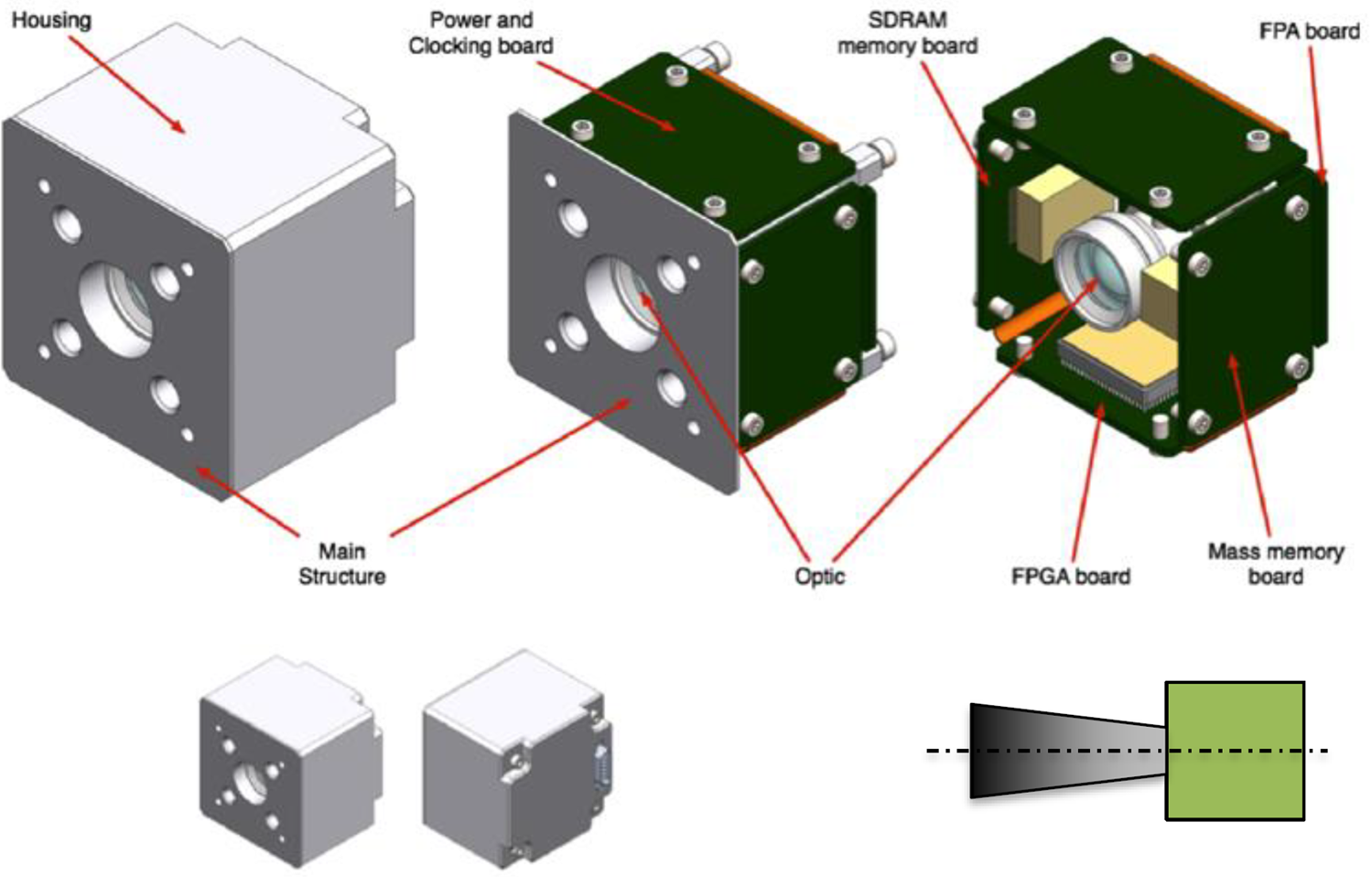
Fig.1 MeteorCam global architecture, with envelope dimensions 100x100x150 mm3
Using our Mars meteoroid simulation framework (example of simulated Mars meteors are shown in Fig.2), we evaluate the types of fireballs detectable from orbit with a SPOSH/MeteorCam-type instrument [3,4]. The platform altitude is 5720 km, with 20 degrees inclination and a 46 degree field of view covering the full Martian disc and part of the surrounding atmosphere. The current concept assumes 15 FPS, an apparent stellar limiting magnitude of +4 mag, a spectral range of 400–800 nm, and optical transmission above 85%.
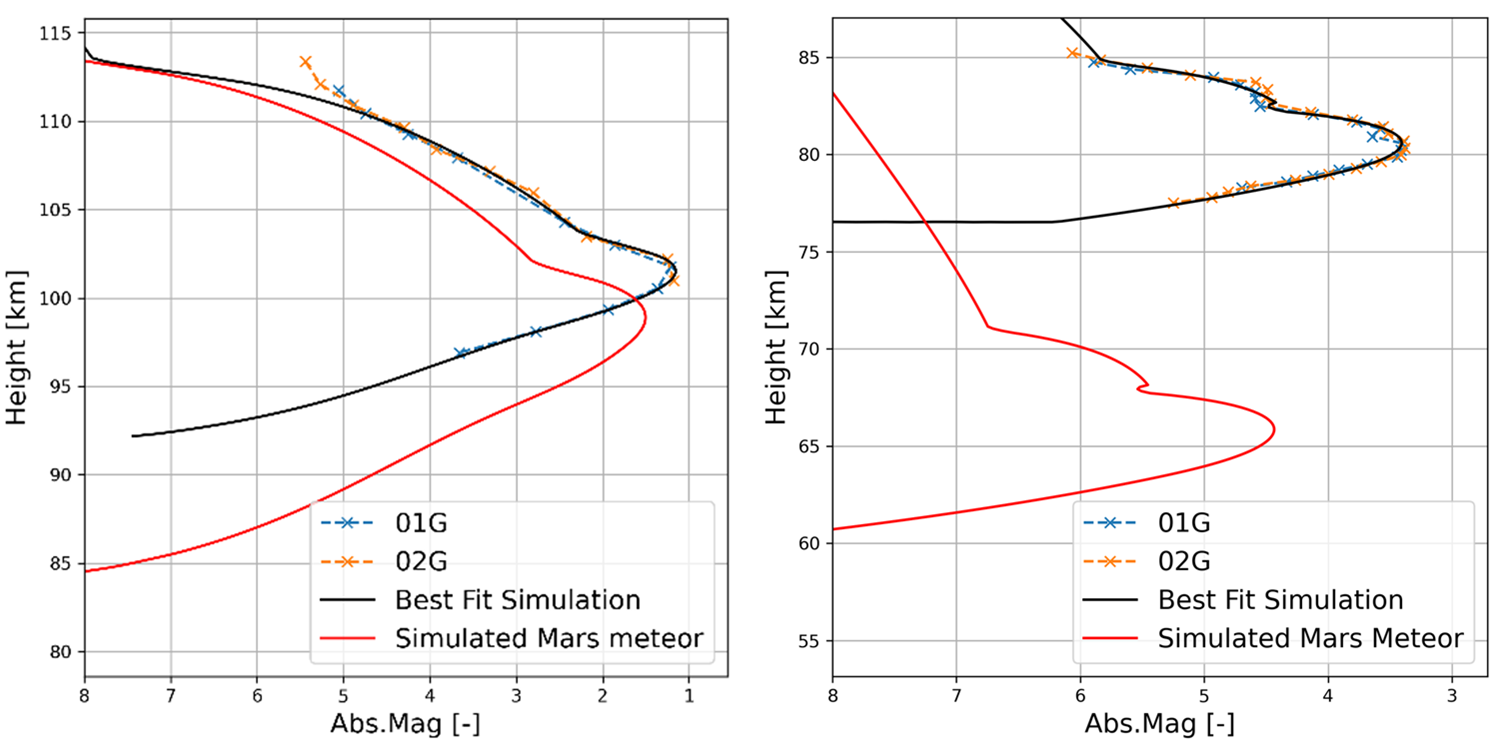
Fig.2 Earth meteors re-simulated in the Martian atmosphere at corrected Mars speeds of 50 and 15 km/s.
To place MeteorCam in a broader measurement context, we also discuss a possible complementary dust analyzer and estimate the meteoroid flux it could encounter at Mars (shown in Fig.3). We consider particles larger than 0.1 mm, which are most relevant to spacecraft risk [5] and aligned with the MEPAG objective [2]. Such measurements would be valuable, but direct in situ detection of a statistically significant number of particles may be challenging because of realistic detector-area and mission-lifetime limits [1].
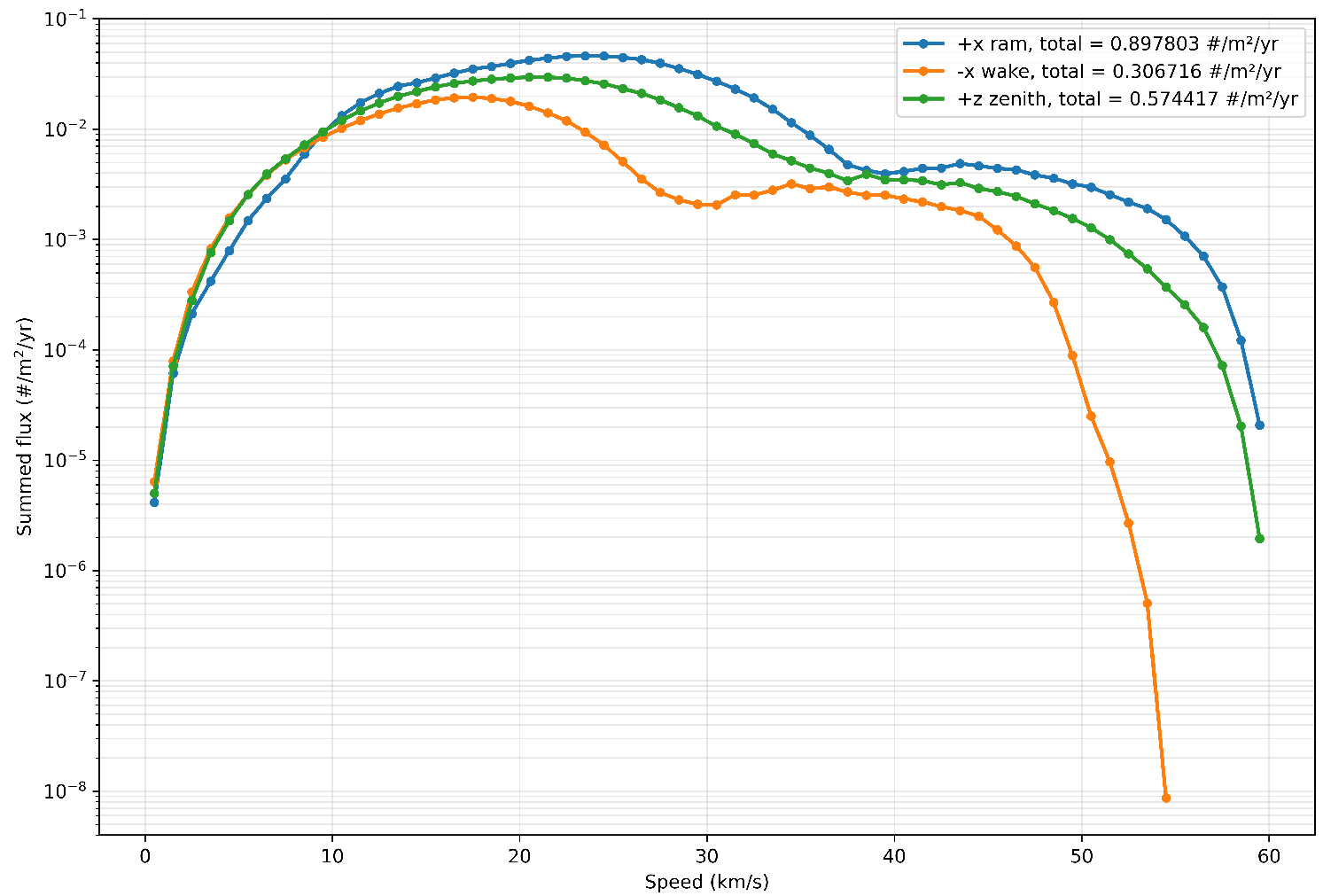
Fig.3 Preliminary Flux results of meteoroids ranging from 10-6 to 10 g, in the ram, wake and zenith direction at 5720 km from Mars
To address these low-number statistics, we compare the potential science return from direct impact measurements with that from observing meteors produced by mm-sized meteoroids, which are expected to be much more readily detectable than direct impacts from mm-sized particles. Our meteor predictions use 144 observed sporadic meteors with peak absolute magnitudes near +2 at Earth. Their physical properties were inferred using an erosion-fragmentation model [6] and dynamic nested sampling [7,8], then re-simulated in the Martian atmosphere [9]. Predicted Martian meteors reach peak absolute magnitudes of +2 to +7 (Median absolute magnitude profiles shown in Fig.4). The fastest events remain similar in brightness to their Earth counterparts, while slower ones become fainter. Most Martian luminous emission occurs between 55 and 110 km altitude, compared with 80 to 120 km at Earth, and trail lengths on both planets average about 20 km [9]. We also examine ground-based, low-orbit, and high-orbit cameras; wide and narrow fields of view; and possible spectral capabilities. This maps trade-offs among detection rate, spatial coverage, brightness sensitivity, and data quality.
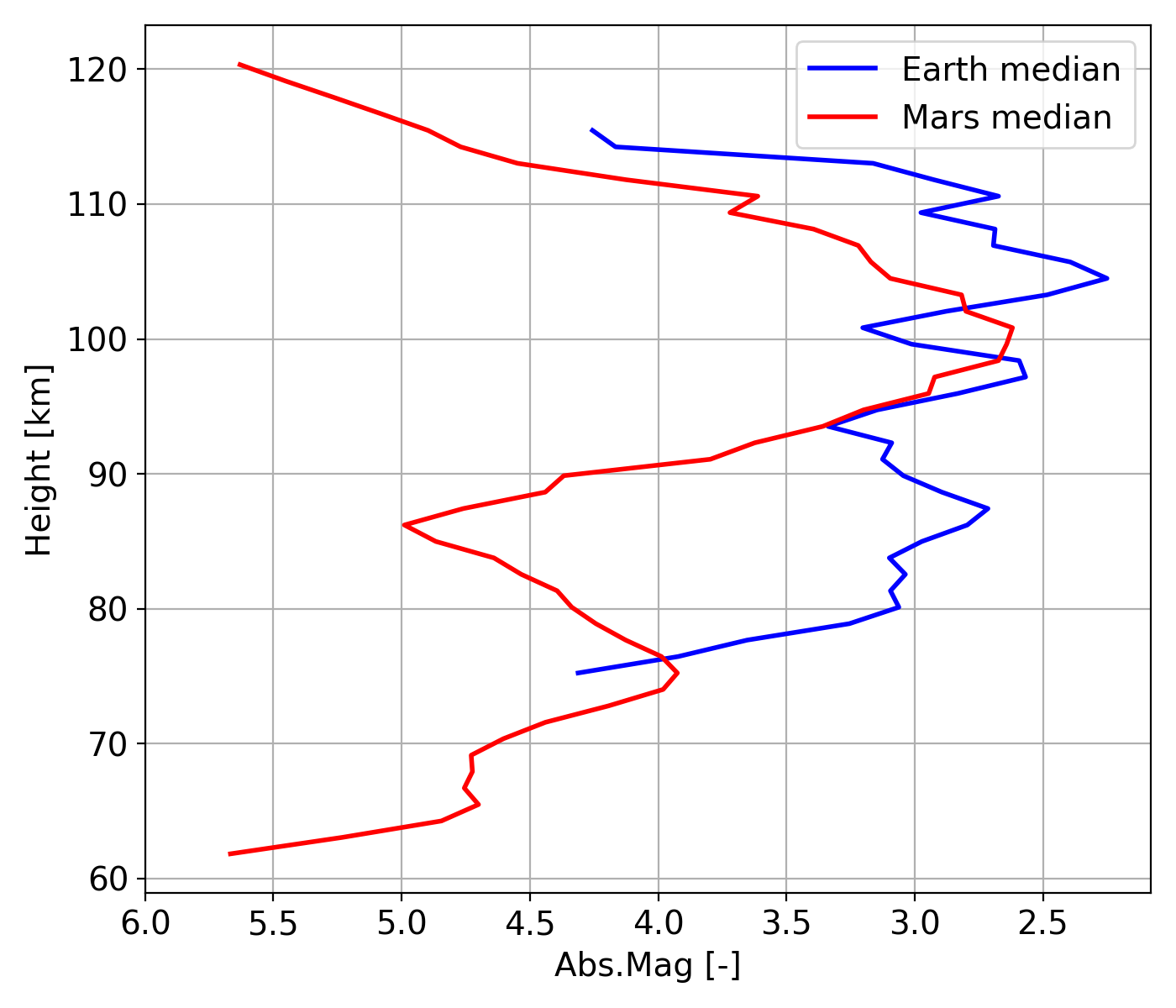
Fig.4 Median absolute magnitude profiles as a function of height for the Earth observations of mm size meteoroids and the corresponding Mars predictions.
References:
[1] Ball, A. J. et al. (2025). A Strawman Mars Dust & Debris Monitor for LightShip. ESA-E3P-LS1-TN-010, Issue 1.0.
[2] Mars Exploration Program Analysis Group (MEPAG) (2020). Mars Science Goals, Objectives, Investigations, and Priorities: 2020 Version.
[3] Oberst, J. et al. (2011). The Smart Panoramic Optical Sensor Head (SPOSH): A camera for observations of transient luminous events on planetary night sides. Planetary and Space Science, 59, 1–9.
[4] Christou, A. A. et al. (2012). Orbital observations of meteors in the Martian atmosphere using the SPOSH camera. Planetary and Space Science, 60, 229–235.
[5] Moorhead, A., Cooke, B., Blaauw, R., Moser, D., & Ehlert, S. (2019). A meteoroid handbook for aerospace engineers and managers. NASA/TM-2019-220142.
[6] Borovička, J., Spurný, P., & Koten, P. (2007). Atmospheric deceleration and light curves of Draconid meteors and implications for the structure of cometary dust. Astronomy & Astrophysics, 473, 661–672.
[7] Speagle, J. S. (2020). dynesty: A dynamic nested sampling package for estimating Bayesian posteriors and evidences. Monthly Notices of the Royal Astronomical Society, 493, 3132–3158.
[8] Vovk, M., Brown, P. G., Vida, D., Lee, D., & Harmos, E. G. (2026). Inferring meteoroid properties with dynamic nested sampling: A case study of Orionid and Capricornid shower meteors. Icarus, 116963.
[9] Vovk, M., Brown, P. G., & Vida, D. (2026). From Earth Meteors to Mars: Predicting Where to See the First Martian Meteors. Manuscript submitted to Advances in Space Research.
How to cite: Vovk, M., Brown, P., Vida, D., Millinger, M., and Koschny, D.: Constraining the Martian Meteoroid Environment: Supporting the Preliminarily Selected MeteorCam for LightShip-1, Europlanet Science Congress 2026, The Hague, The Netherlands, 7–11 Sep 2026, EPSC2026-66, https://doi.org/10.5194/epsc2026-66, 2026.


