
 1,2
1,2- 1Department of Mechanical and Aerospace Engineering, University of Liverpool, Liverpool, United Kingdom (f.saveriano@liverpool.ac.uk)
- 2Department of Electrical Engineering and Electronics, University of Liverpool, Liverpool, United Kingdom
The impact of the Double Asteroid Redirection Test (DART) spacecraft on Dimorphos in 2022 provided the first controlled kinetic-impact experiment on an asteroid and enabled observations of the resulting ejecta environment [1]. The observed momentum transfer [1, 2] and ejecta evolution highlighted the importance of understanding the complex dynamics governing debris transport in binary asteroid systems. In particular, the diversity in ejecta particle sizes produces a wide range of dynamical behaviours, from rapidly escaping micrometre dust to larger boulders primarily influenced by the mutual gravity of the Didymos-Dimorphos system. With ESA’s Hera mission scheduled to arrive at the system in late 2026 [3], understanding the long-term evolution of post-impact ejecta has become increasingly relevant.
In this work, we investigate the possibility of ejecta capture within co-orbital tadpole regions surrounding the equilateral equilibrium points of the post-impact Didymos-Dimorphos system, extending previous studies of ejecta capture in binary asteroid environments [4]. The Circular Restricted Three-Body Problem (CRTBP) [5] with parameters representative of the Didymos binary system is employed to study the dynamics near the L4 and L5 equilibrium regions. Families of periodic tadpole orbits [6] are computed through differential correction and continuation methods [7], and their stability and surrounding dynamical environment are analysed using Poincaré maps. Figure 1 shows representative families of bounded tadpole trajectories around both equilateral equilibrium regions up to nondimensional amplitudes of approximately 0.6 [nd], selected to visualize the transition from near-linear librational motion to increasingly nonlinear co-orbital configurations approaching the horseshoe-transition domain. The surrounding dynamical structure is consistent with KAM-type behaviour [8], indicating the persistence of locally bounded motion in the vicinity of the tadpole families.
To investigate whether DART ejecta can access these regions, multiple trajectories are propagated from the Dimorphos surface at the impact location over a range of ejection velocities and geometries representative of DART-generated debris. The simulations show that a subset of ejecta trajectories naturally enters the tadpole regions surrounding both L4 and L5, where capture and sustained librational motion can occur before eventual escape or re-impact.
Preliminary long-term integrations indicate that some ejecta trajectories may remain confined within the co-orbital regions for extended durations. These results suggest that resonant co-orbital motion may contribute to the long-term evolution of debris in the Didymos system and provide a dynamical framework for understanding ejecta transport and confinement in binary asteroids, with potential relevance for interpreting the debris environment to be encountered by Hera.
Future work will extend this analysis beyond the idealized CRTBP by incorporating additional perturbations relevant to the Didymos-Dimorphos environment, including solar radiation pressure with a double-eclipse shadowing, third-body perturbations, and irregular gravity fields represented by polyhedral models of both primaries. While these perturbations break the idealized CRTBP geometry, the periodic tadpole solutions computed here provide suitable initial guesses for identifying surviving bounded trajectories in the perturbed system.
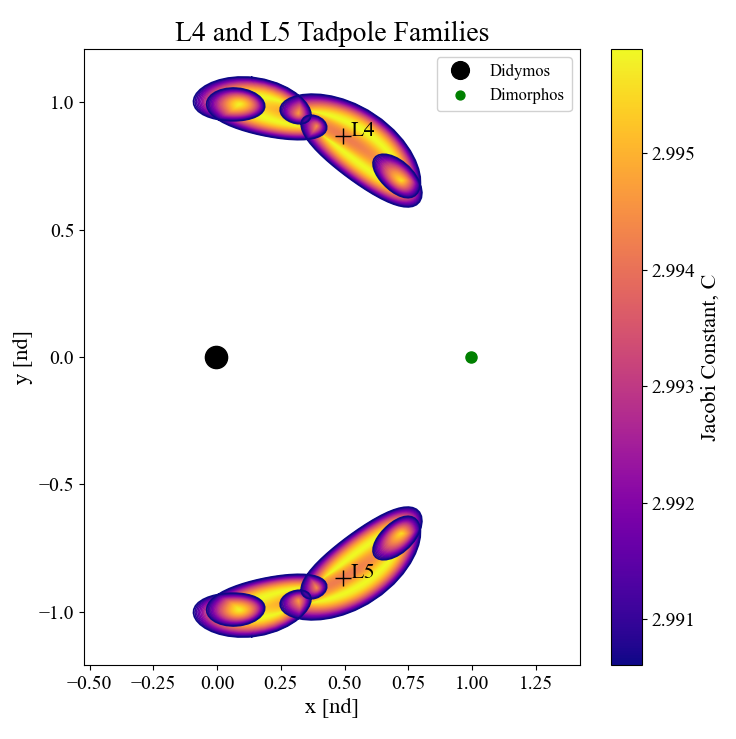
Figure 1: Families of periodic tadpole trajectories around the L4 and L5 equilibrium regions of Didymos-Dimorphos system in the CRTBP. The colour bar represents the Jacobi constant, illustrating the nonlinear growth and deformation of the co-orbital families with increasing amplitude up to 0.6 [nd].
References
[1] Li, Jian-Yang, et al. "Ejecta from the DART-produced active asteroid Dimorphos." Nature 616.7957 (2023): 452-456.
[2] Ferrari, Fabio, et al. "Morphology of ejecta features from the impact on asteroid Dimorphos." Nature communications 16.1 (2025): 1601.
[3] Michel, Patrick, et al. "The ESA Hera mission: detailed characterization of the DART impact outcome and of the binary asteroid (65803) Didymos." The planetary science journal 3.7 (2022): 160.
[4] Fu, Xiaoyu, et al. "Orbital Capture of Ejecta into Periodic Orbits around Binary Asteroid (65803) Didymos." The Planetary Science Journal 6.7 (2025): 174.
[5] Szebehely, Victor, and E. Grebenikov. "Theory of Orbits-The Restricted Problem of Three Bodies." Soviet Astronomy, Vol. 13, p. 364 13 (1969): 364.
[6] Murray, Carl D., and Stanley F. Dermott. Solar system dynamics. Cambridge university press, 1999.
[7] Munoz-Almaraz, Francisco J., et al. "Continuation of periodic orbits in conservative and Hamiltonian systems." Physica D: Nonlinear Phenomena 181.1-2 (2003): 1-38.
[8] Arnold, Vladimir I. "Small denominators and problems of stability of motion in classical and celestial mechanics." Russian Mathematical Surveys 18.6 (1963): 85-191.
How to cite: Saveriano, F., Jump, M., and Devlin, L.: The Fate of DART Ejecta in Co-orbital Tadpole Regions , Europlanet Science Congress 2026, The Hague, The Netherlands, 7–11 Sep 2026, EPSC2026-660, https://doi.org/10.5194/epsc2026-660, 2026.


