
 1,1,1,2,2,3,
- 1University of Bern, Physics Institute, Space Research and Planetology Division, Bern, Switzerland (linus.stoeckli@unibe.ch)
- 2University of Applied Sciences and Arts Western Switzerland Valais, HES-SO Valais-Wallis, Rue de l'Industrie 23, CH-1950 Sion, Switzerland
- 3Institute of Applied Physics, University of Bern, Sidlerstrasse 5, CH-3012 Bern, Switzerland
Context: Comets preserve primordial material essential for understanding planetesimal formation. However, characterizing their internal structure remains a challenge: infrared spectroscopy offers high spatial resolution but lacks penetration, while ground-penetrating radar penetrates deeply into the interior but suffers from meter-scale wavelength limitations. We propose Terahertz time-domain spectroscopy (THz-TDS) as a novel intermediate technique capable of centimeter-scale penetration with sub-centimeter-scale resolution.
Methods: We developed COCoNuT (Characteristic Observation of Cometary Nuclei using THz-spectroscopy), a laboratory facility integrating a commercial THz time-domain spectrometer within a controlled thermal-vacuum environment. Using cometary analog materials, we simulated realistic surface and subsurface conditions to evaluate penetration depth and spatial resolution.
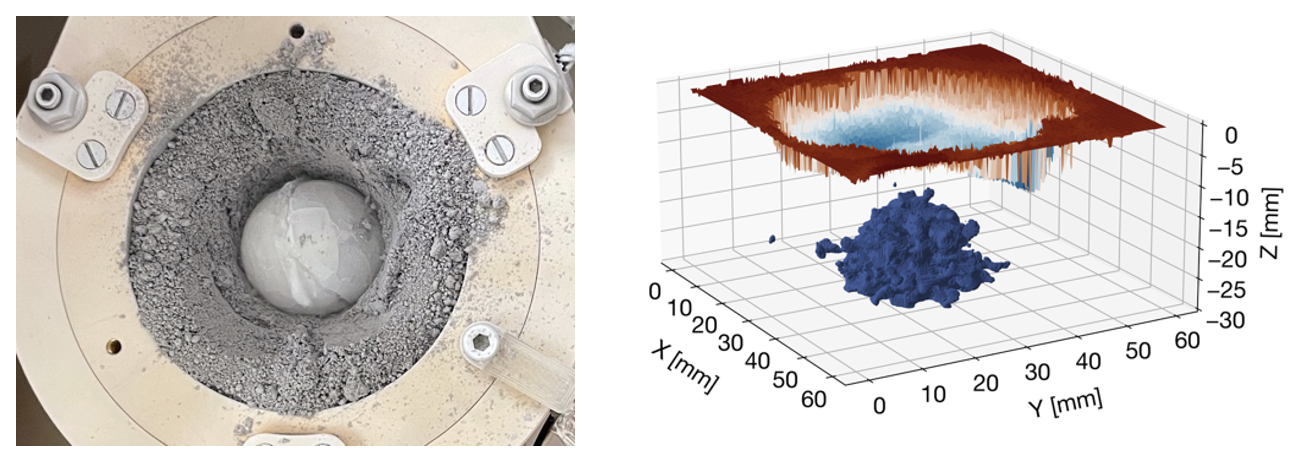
Results: Our proof-of-concept experiments demonstrate that THz-TDS successfully resolves embedded structural heterogeneities, specifically icy pebbles, which are inaccessible to current radar or infrared systems. Figure 1 illustrates the successful reconstruction of an ice pebble buried in a cometary dust analogue, validating the technique's ability to map subsurface morphology.
Conclusions: THz-TDS represents a powerful complementary tool for future in-situ space missions. By bridging the gap between surface spectroscopy and deep-penetration radar, this technology offers a pathway to revolutionize the characterization of small body interiors, providing critical constraints on planetary growth models ranging from hierarchical accretion to pebble-based formation scenarios.
How to cite: Stoeckli, L., Girard, H., Ottersberg, R., Belousov, D., Demion, A., Pommerol, A., Nicollerat, M., Meier, V., Moerschell, J., Murk, A., and Thomas, N.: In-situ THz Spectroscopy: Resolving Sub-surface Icy Pebbles on Cometary Nuclei, Europlanet Science Congress 2026, The Hague, The Netherlands, 7–11 Sep 2026, EPSC2026-667, https://doi.org/10.5194/epsc2026-667, 2026.


