
 ,
,- Armagh Observatory & Planetarium, Armagh, United Kingdom of Great Britain – Northern Ireland (alexander.sivitilli@armagh.ac.uk)
Asteroid families are commonly identified using the Hierarchical Clustering Method (HCM), in which objects are linked in proper orbital element space according to a velocity-like distance metric and a chosen cutoff velocity (Zappalà et al., 1990, 1994). Although HCM has been highly successful in identifying collisional families, the adopted cutoff velocity is not uniquely defined and can strongly affect the resulting family membership, particularly in dynamically crowded regions or in families with extended halo populations. This issue is expected to become increasingly important as the Vera C. Rubin Observatory Legacy Survey of Space and Time is predicted to increase the number of known main-belt asteroids to 5.09 x 10⁶, enhancing the density of objects in proper element space and potentially strengthening chaining effects in HCM-based family identification (Kurlander et al., 2025).
We present a continuous representation of asteroid family membership that reformulates the output of HCM without changing the underlying clustering framework. For each asteroid, we define a joining threshold, vjoin, as the minimum cutoff velocity at which the object becomes connected to a selected family seed. In this formulation, classical HCM membership at any chosen cutoff corresponds to a slice through the distribution of vjoin, while the full set of joining thresholds describes the growth history of the family in cutoff space.
The method is implemented using the standard HCM metric in proper element space introduced by Zappalà et al. and used in modern family catalogues (Nesvorný et al., 2024). Pairwise links are processed in order of increasing HCM distance, and the connected component containing the family seed is tracked as the cutoff velocity increases. This allows vjoin to be assigned to each object in a single pass through the hierarchical connectivity structure. We apply this approach to representative asteroid families using the recent proper-element catalogue of Nesvorný et al. (2024) and compare the resulting vjoin distributions with published family classifications. Population profiles as a function of vjoin reveal distinct regimes corresponding to compact cores, transitional boundary populations, extended halos, and possible large-scale chaining events. Marking published cutoff velocities within these profiles provides a unique way to assess how existing binary family definitions fit within the underlying continuous structure.
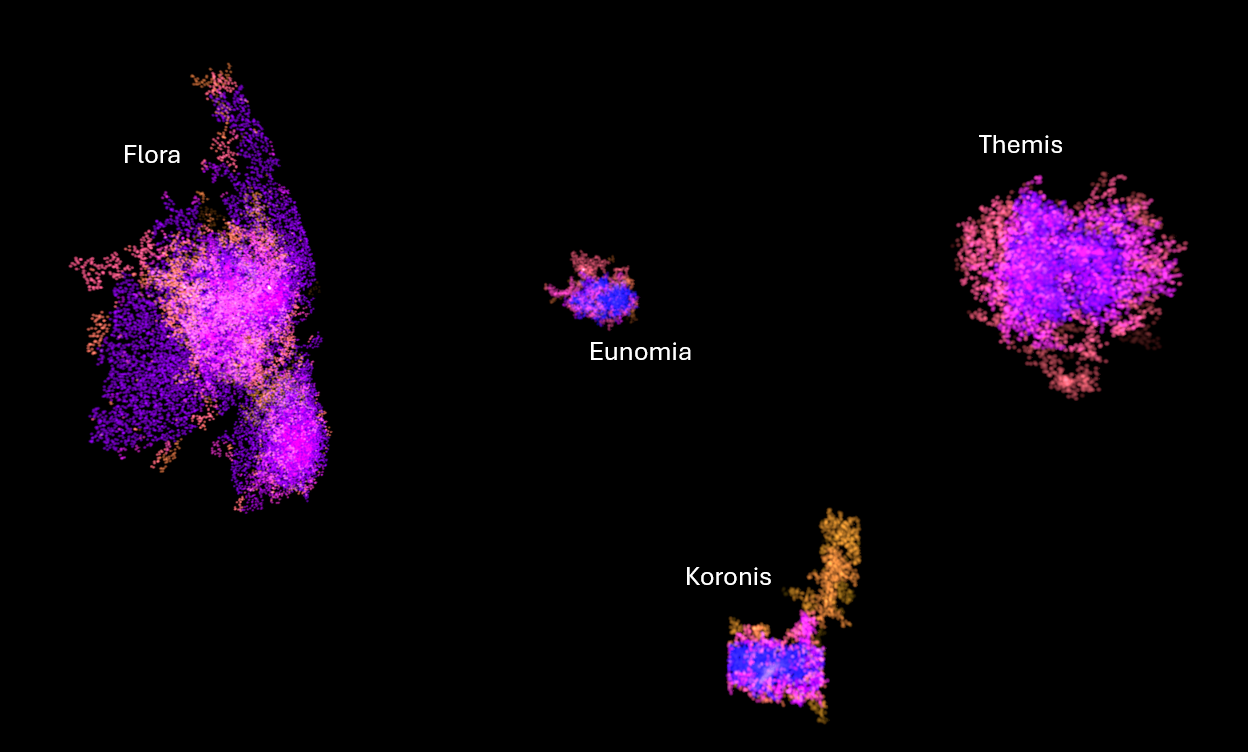
Figure 1. Using iDaVIE to plot four asteroid families in proper orbital space with colour and opacity mapped to vjoin reveal different effects of types of family growth with increasing vjoin.
To aid interpretation, we integrate vjoin into the iDaVIE immersive visualisation platform (Sivitilli et al., 2026). In this environment, opacity, colour, or particle size can be mapped to vjoin, or other independent physical parameters such as spectral slope, albedo, or diameter (see Figure 1). This enables interactive exploration of family growth in proper element space, with selected subsets exported or summarised statistically for quantitative follow-up.
This framework does not replace conventional HCM family classifications, but provides an additional object-level diagnostic of membership robustness. It is particularly relevant for increasingly dense asteroid catalogues, where chaining effects and ambiguous family boundaries are expected to become more prominent.
References
- Zappalà, V., et al., 1990, AJ, 100, 2030.
- Zappalà, V., et al., 1994, AJ, 107, 772.
- Nesvorný, D., et al., 2024, ApJS, 274, 25.
- Kurlander, J. A., et al., 2025, AJ, 170, 99.
- Sivitilli, A., et al., 2026, Astronomy and Computing, 56, 101109.
How to cite: Sivitilli, A., Christou, A., and Marshall-Lee, A.: Continuous representation of asteroid family membership using hierarchical clustering and immersive visualization, Europlanet Science Congress 2026, The Hague, The Netherlands, 7–11 Sep 2026, EPSC2026-672, https://doi.org/10.5194/epsc2026-672, 2026.


