
 1,2,3,4,1,1,1,5
- 1NASA Ames Research Center, Moffett Field, CA, USA
- 2Bay Area Environmental Research Institute, Moffett Field, CA, USA
- 3Centre de Recherche sur les Ions, les Matériaux et la Photonique Université Caen Normandie, ENSICAEN, CNRS, CEA, Normandie Univ, CIMAP UMR6252, Caen, France
- 4Southwest Research Institute, Department of Space Studies, Boulder, CO, USA (ebarth@boulder.swri.edu)
- 5LIRA, Observatoire de Paris, Université PSL, CNRS, Sorbonne Université, Université Paris Cité, Meudon, France
Introduction
Following the northern spring equinox of August 2009, the Cassini Composite Infrared Spectrometer (CIRS) revealed the presence of a benzene (C6H6) ice cloud in Titan's autumn south polar stratosphere. This event increased the mixing ratio of benzene and raised the cloud top near 280 km with an equivalent radius upper limit of ~1.5 μm for pure C6H6 ice particles [1]. In a previous study, we experimentally measured benzene vapor pressures for Titan-relevant temperatures using the NASA Ames Atmospheric Chemistry Laboratory (ACL)[3,4] and then used these new experimental values in the Community Aerosol and Radiation Model for Atmospheres (CARMA)[2] to model the formation of C6H6 cloud particles and investigate the change in their size and number density as a function of altitude in the south. The critical saturation ratio Scrit of species expected to condense (a temperature-dependent value determined by the ratio between the nucleation partial pressure, i.e., when supersaturation is reached, and the equilibrium vapor pressure) is a key input parameter in microphysics models. Continuing our study of C6H6 ice nucleation, we have carried out experimental Scrit measurements of C6H6 ice deposited under vacuum between 138–157 K, on a bare silicon substrate and on Titan aerosol analogues called tholins. The Scrit measurements of benzene ice condensing onto tholins aim to provide a more realistic simulation of cloud condensation processes in Titan’s atmosphere, where C6H6 ice is expected to nucleate and grow on the aerosol particles. The laboratory Scrit measurements were then incorporated in CARMA simulations in order to derive the benzene mixing ratio and the cloud number density at 87º S latitude, for comparison to CIRS data. Here we present the experimental and modeling results and will discuss how these new temperature-dependent measurements impact our understanding of the microphysics controlling the formation of benzene cloud particles in Titan’s stratosphere.
Methods
Titan tholins were produced in COSmIC by plasma chemistry in a jet-cooled (150 K) expansion of N2:CH4 (95:5) gas[5] and deposited for 10 hours on a silicon substrate to produce a ~800-nm layer of material. The tholin-coated substrate was manipulated in an inert atmosphere to minimize air exposure, before being placed inside the ACL chamber[6], on a cold finger located in the path of the IR beam of a Fourier transform infrared spectrometer. Under vacuum conditions (P < 6 x 10⁻⁸ Torr), target temperatures were defined and slowly reached (0.5 K min-1). C6H6 vapor was then introduced into the ACL chamber while monitoring the C6H6 vibrational modes and peak area growth rates between 500–7000 cm-1 (1.4–20 μm) with the FTIR until ice deposition began. This entire process was then repeated for different temperatures, enabling Scrit measurements for nucleation of C6H6 on tholins between 138–157 K. Similar measurements were also conducted on a blank silicon substrate, as a reference, to see the impact of the tholins on the benzene ice nucleation.
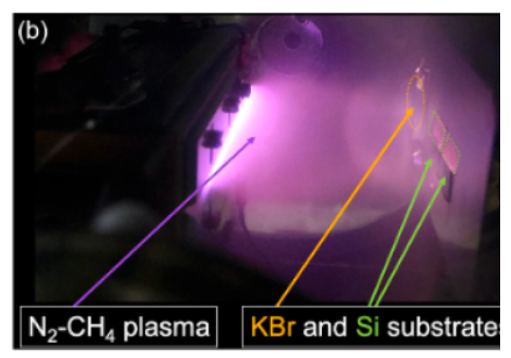
Figure 1. Photograph of the planar plasma expansion during the deposition of solid samples onto substrates (from [6]).
Results
We found a clear influence of tholins on the C6H6 nucleation, where we measured much lower Scrit values for benzene ice deposited on the tholin sample than on the blank silicon. Our nucleation measurements on both the tholin sample and Si substrates over the 138–157 K temperature range allowed us to derive a temperature dependence of Scrit, which increases with decreasing temperature. The Scrit values obtained on the tholin sample are a factor of ~2-3 lower than those measured on the bare Si substrate, which indicates that a lower degree of supersaturation is necessary for nucleation of C6H6 to proceed on the Titan tholin than on the smooth, chemically inert silicon substrate. Based on these laboratory measurements, we also conducted a new analysis of the south polar cloud microphysics with CARMA. We derived a temperature-dependent nucleation contact parameter of m = 2.6e-4 T + 0.9494, which was used to derive the benzene mixing ratio and the cloud particle number density at 87º S. We demonstrate the influence of the laboratory-derived temperature-dependent contact parameter on predicted cloud top height and describe the expected particle sizes.
Acknowledgements
Funding for this project is provided through NASA CDAP.
References
[1] Vinatier et al. 2018, Icarus, 310, 89-104.
[2] Barth, E. L. 2020, Atmosphere, 11(10), 1064.
[3] Iraci, L. T. et al. 2010, Icarus, 210, 985–991.
[4] Dubois et al. 2021, Planet. Sci. J. 2, 121.
[5] Sciamma-O’Brien, E. et al. 2023, The Planetary Science Journal, 4(7), 121.
[6] Dubois et al. 2025, EPSC-DPS Joint Meeting 2025, Helsinki, Finland, 7–12 Sep 2025, EPSC-DPS2025-1248.
How to cite: Dubois, D., Barth, E. L., Iraci, L., Sciamma-O'Brien, E., Salama, F., and Vinatier, S.: Interdisciplinary Study of Benzene Ice Critical Saturation Ratios on Titan Tholins and Microphysical Modeling of Titan's South Polar Benzene Cloud, Europlanet Science Congress 2026, The Hague, The Netherlands, 7–11 Sep 2026, EPSC2026-673, https://doi.org/10.5194/epsc2026-673, 2026.


