
 ,,,
,,,- Technical University of Munich, Ottobrunn, Germany (j.n.brecher@tum.de)
Over the last decades, water and other volatiles on the Moon have been of high scientific interest. They offer potential for in-situ resource utilisation and studying them might provide valuable insights into the formation and evolution of the Moon and the Solar System (e.g. Lunar Exploration Analysis Group, 2017; Reiss, 2024; Merancy et al., 2025). To improve our knowledge of the distribution of water on the Moon, the project VOLARIS (Reiss et al., 2025), funded by the European Research Council, investigates processes involved in the lunar water cycle, combining laboratory experiments with numerical simulations. The experimental investigations will focus on water migration into deeper layers via thermal pumping (Schorghofer et al., 2014; Reiss et al., 2021) and on its thermal release by simulated micrometeorite impacts.
The experimental setup currently under development features a thermal vacuum chamber to represent a relevant environment, with temperatures of ~100 K and pressures of ~10-6 mbar. The target regolith sample size is 25 cm in diameter and 10 cm in height. To investigate thermal pumping effects, a heater will be placed above the sample to establish a representative temperature gradient by exposing it to shortened lunar diurnal temperature cycles on a hours-to-days timescale. The temperature inside the sample will be measured at different depths and lateral positions. Further, the surface temperature will be observed using an infrared camera. Additionally, the water content inside the sample will be measured throughout the experiment. To study thermal release due to micrometeorite impacts, the setup will host an Nd:YAG laser with a wavelength of 1064 nm. Desorption of volatiles from the sample will be measured with a mass spectrometer. The experiments will be correlated with simulations to scale the observed effects to lunar temporal and spatial scales and to constrain influential physical parameters.
A preliminary setup, shown in Fig. 1, is already available for feasibility studies and prototype development. The setup consists of a cylindrical sample holder, 10 cm high and 15 cm in diameter, placed on a copper plate that can be actively cooled to ~200K, inside a vacuum chamber at ~5·10-3 mbar. Temperature sensors are fixed inside the sample holder at different heights and lateral positions. A heating coil is placed above the sample surface to investigate thermal cycling of dry or icy regolith simulant. Further, a COMSOL thermal model was developed to correlate theoretical models with measurements for in-depth analysis and extrapolation to lunar timescales.
In addition, a measurement system is being developed to temporally and spatially resolve water content within a sample using dielectric spectroscopy. Here, the different polarisation behaviour of water ice and lunar regolith at low frequencies is utilised to distinguish the water ice from the regolith simulant. The determination of water content within regolith using electrical permittivity has already been proven feasible (e.g. Lethuillier, 2017; Gscheidle et al., 2024) and is also being employed by missions such as PROSPECT (Trautner et al., 2021; Gscheidle and Reiss, 2021, Eckert et al., 2025).
Together, the preliminary experiments provide important insights for the design of the thermal-vacuum system dedicated to the full-scale VOLARIS experiments, targeted to start in early 2027. These experiments will then help quantify volatile transport and retention in regolith under relevant environmental conditions.
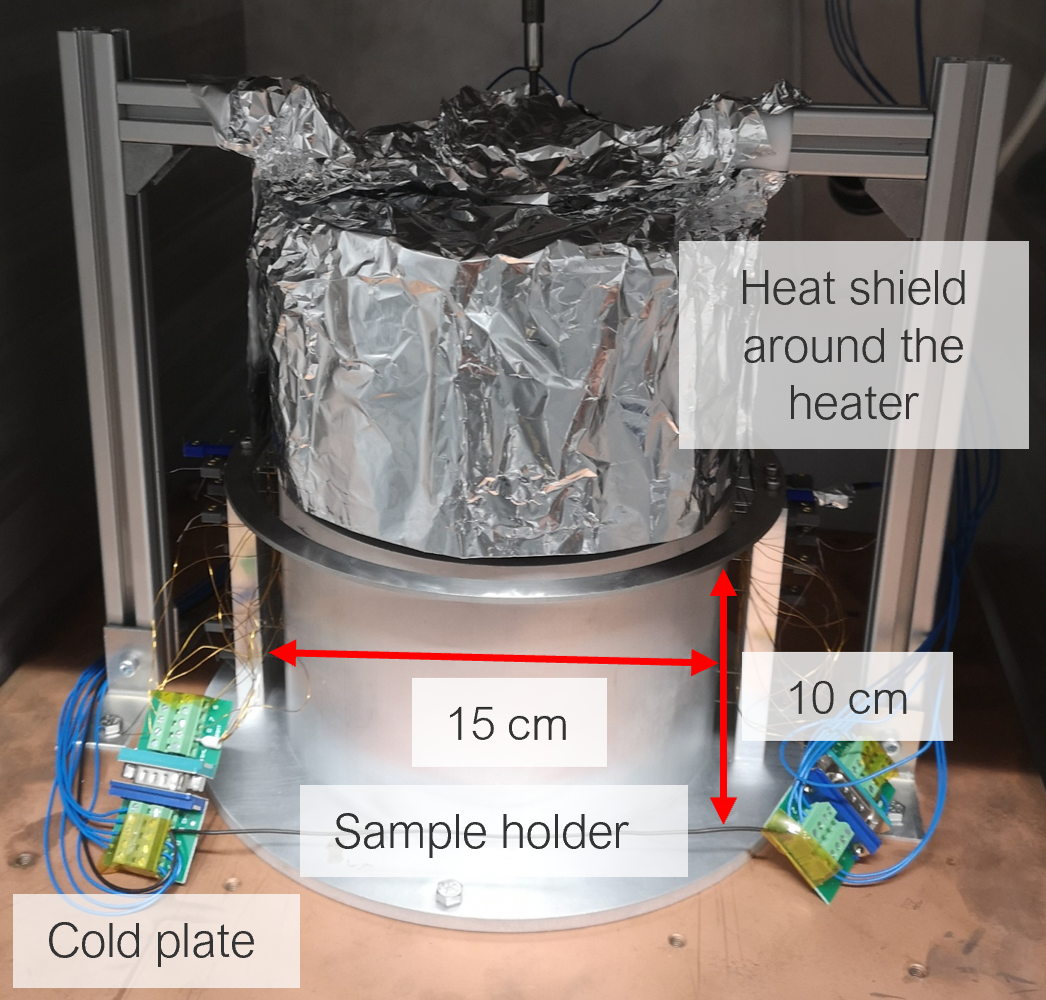
Figure 1: Preliminary experimental setup placed on an actively cooled copper plate inside a thermal vacuum chamber.
Acknowledgements: The project VOLARIS is funded by the European Research Council (ERC) under the European Union’s Horizon Europe research and innovation programme - grant agreement number 101164002. Views and opinions expressed are, however, those of the author(s) only and do not necessarily reflect those of the European Union or the ERC. Neither the European Union nor the granting authorities can be held responsible for them.
References:
Eckert, L. et al. (2025). A Rover Permittivity Sensor for Lunar Water Ice Detection. ELS 2025.
Gscheidle, C. and Reiss, P. (2024). Investigation of Hydrated Regolith Simulant with Patch Permittivity Sensors for Planetary Exploration under Cryogenic Conditions. EPSC2024-559.
Gscheidle, C. et al. (2024). Permittivity sensor development for lunar and planetary surface exploration. In: Frontiers in Space Technologies 4, 1303180.
Lethuillier, A. (2017). Characterization of planetary subsurfaces with permittivity probes: analysis of the SESAME-PP/Philae and PWA-MIP/HASI/Huygens data. PhD thesis. Universite Paris Saclay (COmUE).
Lunar Exploration Analysis Group (2017). Advancing Science of the Moon: Report of the Specific Action Team.
Merancy, N. et al. (2025). Exploration Systems Development Mission Directorate: Moon to Mars Architecture Definition Document ([Technical Publication (TP)] no. ESDMD-001 Rev-B.1, NASA/TP-20240015571).
Schorghofer, N. et al. (2014). The Lunar Thermal Ice Pump. In: The Astrophysical Journal 788.2, p. 169.
Reiss, P. et al. (2021). Dynamics of Subsurface Migration of Water on the Moon. In: Journal of Geophysical Research: Planets 126.5, e2020JE006742.
Reiss, P. (2024). Exploring the lunar water cycle. In: Proc. Natl. Acad. Sci. U.S.A. 121 (52) e2321065121.
Reiss, P. et al. (2025). Insights into the lunar water cycle. In: The Project Repository Journal, vol. 24, pp.86–89.
Trautner, R. et al. (2021). A drill-integrated miniaturized device for detecting ice in lunar regolith: the PROSPECT permittivity sensor. In: Measurement Science and Technology 32.12, p. 125117.
How to cite: Brecher, N., Amorós-Trepat, M., Peschel, A., and Reiss, P.: Preparational Investigations for the Experimental Study of Lunar Water Migration Processes , Europlanet Science Congress 2026, The Hague, The Netherlands, 7–11 Sep 2026, EPSC2026-674, https://doi.org/10.5194/epsc2026-674, 2026.


