

- Department of Earth, Environmental, and Planetary Sciences, Brown University, Providence, RI, USA (emily_fischer@brown.edu)
Mercury is a key target for investigating terrestrial planet formation and differentiation, volatile retention, and atmospheric evolution in the inner solar system. Among the terrestrial planets, Mercury is unique with its high bulk density, low oxygen fugacity, anomalous magnetic field, and evidence of sustained geologic activity [1-3]. MESSENGER and BepiColombo (ongoing) have significantly advanced our understanding of these characteristics, yet gaps persist in spatial resolution, low-altitude access, and orbital flexibility [4-5]. Addressing these gaps requires a mission capable of sustained low-altitude operations beyond what current orbital geometries permit. HERMES builds on the prior Mercury Scout solar sail concept [6] through a novel hybrid architecture that integrates chemical propulsion with solar sail propulsion. This preserves orbital flexibility while reducing transit time and enabling exosphere sample return.
Operations at Mercury demand exceptionally high total Δv due to proximity to the Sun’s gravitational well [7]. Chemical propulsion delivers the high thrust required for orbit insertion but is constrained by finite propellant mass, restricting long-duration orbital flexibility. In contrast, solar sail propulsion exploits continuous low thrust from solar photon momentum transfer, removing propellant dependence for sustained trajectory modification. Previous missions (e.g., IKAROS, LightSail, NEA Scout, Solar Cruiser concept) validated sail deployment and heliocentric maneuvering, though sustained sail operations in planetary orbit have not yet been demonstrated.
HERMES combines solar sail and chemical propulsion to reduce transit time, maximize operational flexibility, and enable propellant-free sample return. The solar sail provides the majority of the mission delta-v budget through continuous photon-pressure acceleration during heliocentric transfer. The chemical stage delivers the high-thrust impulsive burn required for rapid capture into Mercury orbit. Following insertion, the solar sail supports orbit modification and periapsis repositioning at Mercury (Fig. 1, inset), sustained low-altitude reconnaissance, and propellant-free Earth return of collected samples. Solar sail-enabled sample return concepts have been previously investigated for Mercury, demonstrating the feasibility of propellant-free Earth return trajectories [8] (Fig. 1).
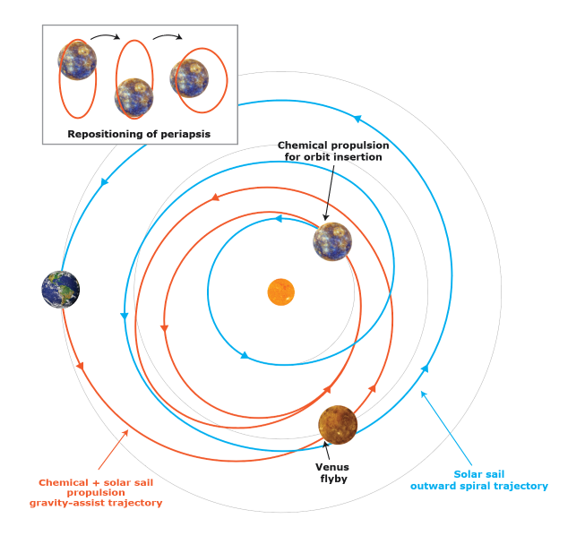
Figure 1. Simplified schematic Earth-Mercury transfer trajectories viewed from the ecliptic plane (not to scale). HERMES travels from Earth to Mercury using chemical and solar sail propulsion along a multi-gravity-assist trajectory with Venus and Mercury flybys (based on MESSENGER [7]). Chemical propulsion is used for orbit insertion. In Mercury orbit, solar sail propulsion enables sustained low-altitude operations and repeated periapsis modification (inset, based on prior concept study [6]). Following orbital reconnaissance, the sail bus separates from the science bus and returns to Earth via a continuous low-thrust outward spiral (trajectory based on Hughes et al. [8]).
The spacecraft is comprised of two functional elements:
- Science and operations bus – Carries the remote sensing instrument suite, including a sub-meter narrow angle camera (<1 m/pixel), thermal radiometer, and laser altimeter, along with subsystems supporting Mercury orbital operations and outbound cruise.
- Solar sail/sample return bus – Delivers propellant-free propulsion for Mercury transit, orbital adjustments, and Earth sample return. Onboard power, avionics, and sail control systems support autonomous Earth-return operations following science bus jettison. The sail also provides an additional possible capability for illumination of permanently shadowed regions (PSRs).
The ~2000 m2 solar sail is baselined on TRL6 Solar Cruiser heritage. The design uses four triangular 2.5-μm CP1 polyimide membranes on carbon-fiber boom supports, with aluminum coating and reflective control devices (RCDs) for attitude management. Membranes and booms are drum-stowed at launch and deployed by unspooling.
Exploration Goal: Sub-meter imaging and laser altimetry will characterize candidate Mercury landing sites. This provides terrain, slope, and hazard assessments to reduce risk for future landed mission.
Primary Science Goals
- Exosphere sample return. HERMES will attempt the first Earth return of exospheric material from Mercury (and Venus), collected during orbital operations and a Venus gravity-assist flyby (Fig. 1). Returned samples will support laboratory constraints on elemental and isotopic composition, solar wind implantation, and escape processes.
- Active and recent geologic processes. Low-altitude, high-resolution (better than 1 m per pixel) imaging and thermal measurements, cross-referenced with MESSENGER and BepiColombo datasets, will extend the observational time baseline for active surface changes, such as tectonic contraction and hollow formation [9-10].
- Polar volatile deposits. Repeat low-altitude passes with high-resolution imaging and thermal radiometry will help constrain the composition, thickness, distribution, and thermal stability of volatile deposits in PSRs, including stratigraphy and temperature variability at fine spatial scales.
Technology Demonstrations
- Solar sail operations at ~0.3 AU. Validates propellant-free orbit maintenance and periapsis adjustment in the inner solar system, advancing precision attitude control of large flexible structures and sail survivability under high thermal and radiation loads.
- Passive exosphere sample return. Establishes a low-mass architecture for sample collected and Earth return from two planetary bodies within a single mission.
- Sail-assisted PSR illumination. Redirecting sunlight into polar cold traps via the sail as a controllable reflector enables direct PSR imaging without dedicated onboard light sources. This extends concepts demonstrated in early Lunar Flashlight mission designs.
HERMES demonstrates a hybrid propulsion architecture that circumvents propellant as a limiting factor for extended orbital science and sample return, broadening the scope of inner solar system exploration. The mission is built on high-TRL technology and established propulsion heritage, and advances low-altitude reconnaissance, sail-enabled orbital maneuvering, and passive exosphere sampling in a single scalable architecture.
Mission maturation steps include: (1) instrument selection across imaging, radiometry, altimetry, and sampling; (2) bus design and systems integration; (3) preliminary orbital analysis for varying hybrid spacecraft masses; (4) trajectory optimization and mission design trades; and (5) thermal and environmental qualification of sail materials and instruments.
[1] Nittler, L.R. et al. (2011) Science, 333, 1847-1850. [2] Anderson, B.J. et al. (2011) Science, 333, 1859-1862. [3] Hauck II, S.A. et al. (2013) JGR: Planets, 118, 1204-1220. [4] Solomon, S.C. et al. eds. (2010) Mercury: The View after MESSENGER, 601 pp. [5] Benkhoff, J. et al. (2021) Space Sci. Rev., 217, 90 pp. [6] Parman, S.W. et al. (2025) 55th LPSC, Abstract #2370. [7] Santo, A.G. et al. (2001) Planet. and Space Sci., 49, 1481-1500. [8] Hughes, G.W. et al. (2006) Acta Astr., 59, 797-806. [9] Watters, T.R. et al. (2016) Nature Geosci., 9, 743-747. [10] Speyerer, E.J. et al. (2022) GRL, 49, e2022GL100783.
How to cite: Fischer, E. and Parman, S.: HERMES: Hybrid Exosphere Reconnaissance and MErcury Scout mission concept, Europlanet Science Congress 2026, The Hague, The Netherlands, 7–11 Sep 2026, EPSC2026-677, https://doi.org/10.5194/epsc2026-677, 2026.


