

- Stellar Inspire Ltd, London, UK (darditti@stellarinspire.com)
Astronomy, planetary science and space science are not widely taught in UK schools. This might be considered an issue, considering the likely future importance of space science to any advanced industrial economy. There is an astronomy GCSE (exam) syllabus, but it is taught in only a few secondary schools, and there is usually some astronomy taught as part of general science and physics courses.
One way to tackle this deficit may be to cover these subjects at after-school clubs and in holiday activities, allowing students to learn about astronomy in an informal setting, unconstrained by the school curriculum, but still developing skills such as team work, scientific method, and communication. This can also provide a way of engaging students who find more formal education settings difficult, and may encourage students towards STEM subjects in general, as well as kindling life-long interests in astronomy and space. The primary school is the optimum stage for developing these interests; children of this age have a natural fascination with space.
Stellar Inspire Ltd
Stellar Inspire Ltd (SI) was set up in April 2025, following discussion of the above by the authors, who are the Directors of the company, as a commercial entity to operate after-school clubs and holiday workshops (‘camps’) to teach primary-age school children about astronomy and space science, and also to run workshops for groups of adults on similar themes, using hands-on activities to educate in a fun but effective way.
The main motivation for the company was not significant profit, but effective management of the various elements needed for effective, safe engagement once the work developed beyond the initial single school club. SI currently runs clubs in seven primary schools in London across both the state and private sectors, involving around 130 students.
The clubs are usually run once a week for an hour in each school, except that in some schools separate clubs operate on different days for different age groups. SI has also worked with charities supporting the children of asylum-seekers and autistic children. In this latter work it has been supported financially by the Royal Astronomical Society, building on earlier support from the British Astronomical Association. It has also collaborated with companies in the educational sector in India.
Methods and challenges
In general the activities are funded by the parents, either paying the company directly, or via schools. SI develops the educational content for the clubs and employs the educators to deliver it. These are usually recent graduates or students looking for experience in working in the educational sector, but not necessarily graduates in space sciences. The content is developed such that non-specialists can lead the activities.
Direct observational astronomy in this context is problematic, given the unpredictable UK weather, and the fact the clubs take place in the day time, and mostly indoors, though schools sometimes do offer suitable outdoor spaces. However there are some opportunities for students to make optical observations of the Sun and Moon, and use of remote telescopes is a possibility.
Another challenge is the transport and storage of equipment. Schools will often store small equipment items, but larger items that the company uses, such as telescopes, can only be used occasionally, because of the brief nature of the clubs and issues of transport and set-up and take-down time. Hence activities have been developed that do not have these issues.
One successful activity has been the use of Universe Sandbox app, which enables children to design planets and planetary systems according to their arbitrary wishes and to experiment with them, all consistent with the laws of physics. In general balance is sought in the sessions between passive learning activities, questions and answers, screen (PC or tablet) activities, and hands-on craft-style activities, such as making models, designs and drawings. A popular practical activity, where outdoor space allows, has been building and launching rockets.
Mars Colony Project
From a desire to have a coherent activity that lasts a whole term, delivered in parallel in all the clubs, a programme was created on the theme of developing a Mars space colony. The students were taught about the fundamental differences between Mars and Earth and how these impact on the essentials for life. They then were required to design Martian bases, justifying their choices, and explaining how oxygen, water, food and power would be supplied. These bases were built as physical models, using recycled household objects. Students in larger clubs were divided into teams, each working on their own Mars colony concept. Along the way the opportunity was taken to grow plants in the classroom, allowing for discussion of both terrestrial and astro-biology. Photos of the students’ work were submitted to the ESA ‘Moon Camp’ project and students received certificates from ESA.
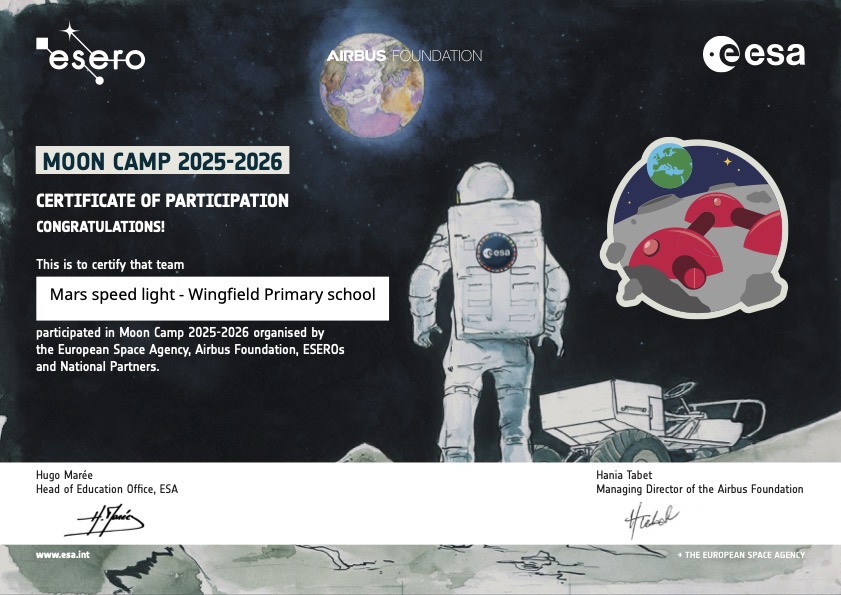
Certificate from ESA
Telescope-making Project
Another whole-term programme conducted in all the clubs has been a telescope making and using project. This allows for simple optical experiments, explanations of the principles of optics, how telescopes work and the history of telescopic astronomy. The telescopes that the students actually build are Galilean and Keplarian refractors made from cardboard kits with acrylic lenses. With these instruments (or others, such as ordinary household binoculars) the students are helped to develop skills of observation and scientific recording.
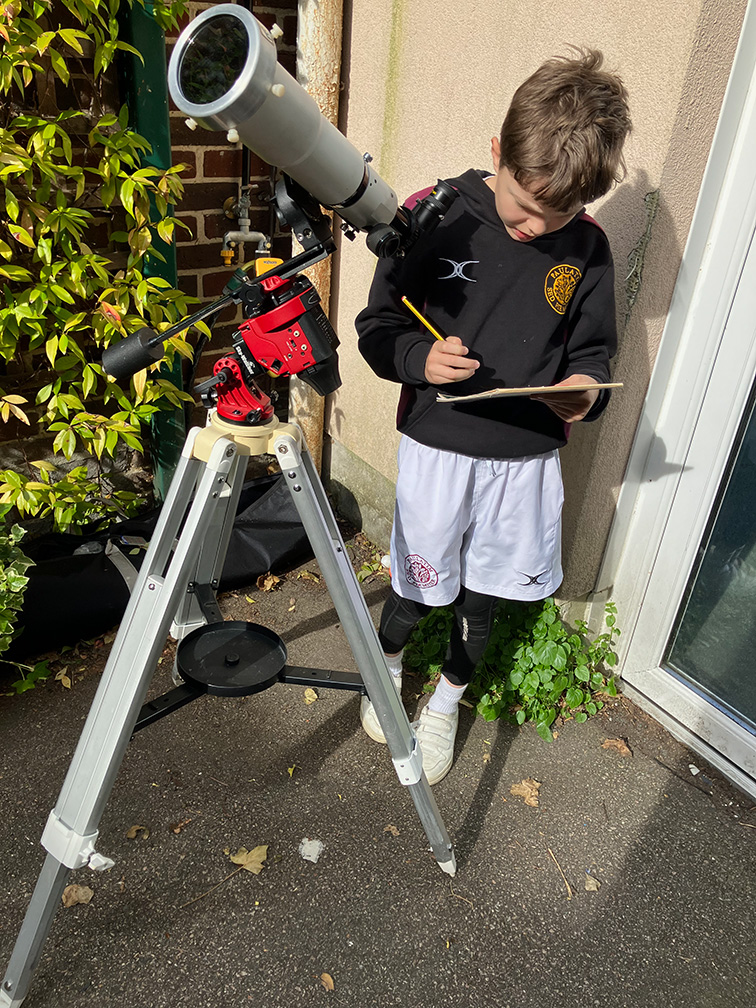
Drawing sunspots
Concluding remarks
Primary-school students constantly ask questions, often very sophisticated ones that are beyond the likely knowledge of the educator. This is treated as a positive feature of the sessions, and a challenge. The questions are all written down and, if they cannot be answered immediately, they are answered systematically in subsequent sessions, encouraging discussion amongst the students.
Developing new activities that meet the constraints mentioned and are genuinely educational is a challenge, but the popularity of the club concept seems clear and there is no shortage of demand. We look forward to hearing experiences from others at the Congress who have been working on similar lines elsewhere.
How to cite: Arditti, D., Ramakrishnan, S., and Usher, H.: Setting-up a network of astronomy clubs in London primary schools, Europlanet Science Congress 2026, The Hague, The Netherlands, 7–11 Sep 2026, EPSC2026-685, https://doi.org/10.5194/epsc2026-685, 2026.


