
 1
1- 1University of Belgrade, Faculty of Mathematics, Department of Astronomy, Belgrade, Serbia (dusan.marceta@matf.bg.ac.rs)
- 2Astronomical Observatory Belgrade, , Belgrade, Serbia (marko.gavrilovic@aob.rs)
The orbital evolution of potentially hazardous asteroids is strongly affected by the Yarkovsky effect, which plays a key role in long-term trajectory prediction and impact risk assessment. Modeling this effect becomes particularly challenging for asteroids in complex rotational states, such as tumbling objects. The close encounter of 99942 Apophis on 13 April 2029 is expected to significantly modify its rotational state (Benson et al. 2023), providing a unique opportunity to investigate how changes in tumbling dynamics influence the resulting Yarkovsky acceleration and the subsequent orbital evolution. Building on the open-source thermophysical model TEMPEST(Lyster et al. 2025), we present a new numerical framework specifically designed for tumbling rotational states. The model enables the implementation of full tumbling dynamics, as illustrated in Fig. 1 for the case of 99942 (Pravec et al. 2014).
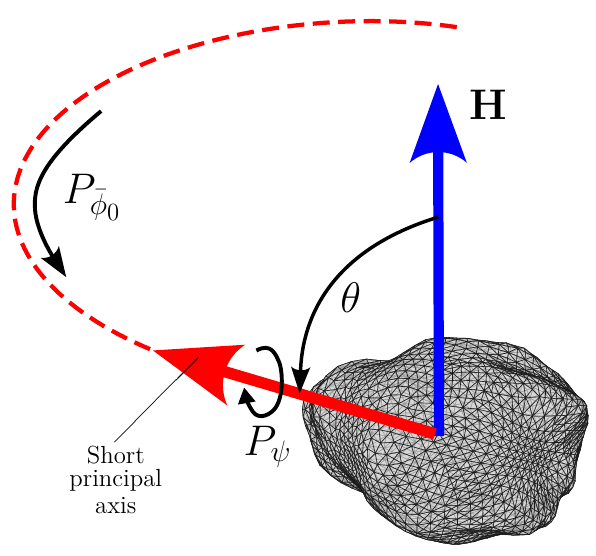
Figure 1. Short-principal-axis tumbling period convention illustrated for the case of 99942 Apophis
This framework explicitly accounts for the dual-frequency nature of non-principal axis rotation by integrating both the average precession period (Pφ0) of the asteroid’s inertia axis around the angular momentum vector H and the intrinsic rotation period (Pψ) about that axis. By continuously propagating the asteroid’s heliocentric orbit while simultaneously resolving its complex rotational motion, the model naturally captures the total Yarkovsky acceleration.
Numerical simulations are being performed to investigate the sensitivity of the semi-major axis drift to variations in the tumbling parameters, representing the range of possible states Apophis might adopt after its 2029 close approach. Preliminary analysis suggests that expected shifts in the orientation of the angular momentum vector or the ratio of rotation periods can noticeably alter the magnitude of the Yarkovsky effect, and in certain cases might even reverse the direction of the resulting acceleration. These findings contribute to more reliable orbit determination and long-term impact risk analysis, providing a robust framework to maintain accurate trajectory prediction across the 2029 close encounter and beyond.
Acknowledgements: This research is supported by The Science Fund of the Republic of Serbia through Project No. 7453 Demystifying enigmatic visitors of the near-Earth region (ENIGMA)
References:
Benson, C. J., Scheeres, D. J., Brozović, M., et al. (2023). Spin state evolution of (99942) Apophis during its 2029 Earth encounter. Icarus, 390, 115324.
Lyster, D., Howett, C., Penn, J. (2025). TEMPEST: A Modular Thermophysical Model for Airless Bodies with Support for Surface Roughness and Non-Periodic Heating. EPSC-DPS Joint Meeting 2025, EPSC-DPS2025-1479.
Pravec, P., Scheirich, P.,Ďurech, J., et al. (2014). The tumbling spin state of (99942) Apophis. Icarus, 233, 48-60.
How to cite: Marceta, D. and Gavrilovic, M.: Numerical Modeling of the Yarkovsky Effect for Tumbling Asteroids: The Case of 99942 Apophis, Europlanet Science Congress 2026, The Hague, The Netherlands, 7–11 Sep 2026, EPSC2026-689, https://doi.org/10.5194/epsc2026-689, 2026.


