
 1,1,
1,1,- 1Dipartimento di Matematica e Fisica, Università degli Studi Roma Tre, Roma, Italy
- 2Dipartimento di Scienze, Università degli Studi Roma Tre, Roma, Italy
- 3Laboratorio di Telerilevamento e Planetologia Dip. di Scienze, Universita` G. d’Annunzio, Pescara, Italy
The Subsurface Radar Sounder (SRS) onboard the European Space Agency’s EnVision mission will investigate the shallow subsurface of Venus using low-frequency radar signals operating at a central frequency of 9 MHz with a bandwidth of 5 MHz. Venus is characterized by widespread volcanic terrains and extremely high surface temperatures, reaching up to ~500 °C. The performance and interpretation of radar signals strongly depend on prior knowledge of the dielectric properties of surface and subsurface materials, which remain poorly constrained under Venus-like conditions. This gap can be addressed through laboratory measurements of terrestrial analogue rocks.
Terrestrial analogue materials were selected based on surface compositions measured by the Venera 13, Venera 14, and Vega 2 landers (Surkov et al., 1984). Representative lithologies of the Venusian crust include basalt, basaltic trachyandesite, and rhyolite.Samples were prepared as polished slabs (~10 × 10 cm). Reflection coefficients were measured using a laboratory setup specifically developed for high-temperature experiments (Baniamerian et al., 2025). Measurements were conducted using an Agilent E5071C vector network analyzer (VNA) over the 1–100 MHz frequency range, employing a logarithmic sweep with 1601 frequency points. A Rohde & Schwarz VNA was also used over the same frequency range with 10,000 frequency points. Prior to measurements, calibration was performed to remove the effects of cables, connectors, adapters, and systematic VNA errors.
For high-temperature experiments, samples were placed inside an insulated Nabertherm furnace, designed to ensure uniform heating from all sides. Measurements were collected at temperatures between ~30 °C and 700 °C, in increments of 100 °C. Calibration was conducted using open, short, and load standards.
These measurements provide key constraints for electromagnetic wave propagation models and support the interpretation of future EnVision SRS observations. As an example, for a basaltic trachyandesite analogue, Figure 1 presents the real part of the complex relative permittivity (ε′ᵣ) and the loss tangent (tan δ) as functions of frequency at various temperatures. The results demonstrate a strong temperature dependence of dielectric properties: both ε′ᵣ and tan δ increase significantly with temperature, particularly at low frequencies, with no evidence of a relaxation mechanism across the measured frequency range.
The complex dielectric permittivity is defined as

The temperature dependence following an Arrhenius-type relation can be formulated as (Parkhomenko, 1967; Jonscher, 1981)

where and are coefficients, here E is activation energy in eV, eV/K is Boltzmann's constant, and T is absolute temperature in Kelvin. This formulation enables modeling of dielectric properties under Venusian thermal conditions.
Figure 2 shows the dielectric properties of basaltic trachyandesite and rhyolite analogues at the SRS operating frequency (9 MHz). The loss tangent increases by up to an order of magnitude across the investigated temperature range. This behavior follows an Arrhenius-type relationship, allowing estimation of activation energies for different lithologies. The results indicate a strong increase in attenuation with temperature, which reduces radar signal penetration depth under Venus surface conditions.
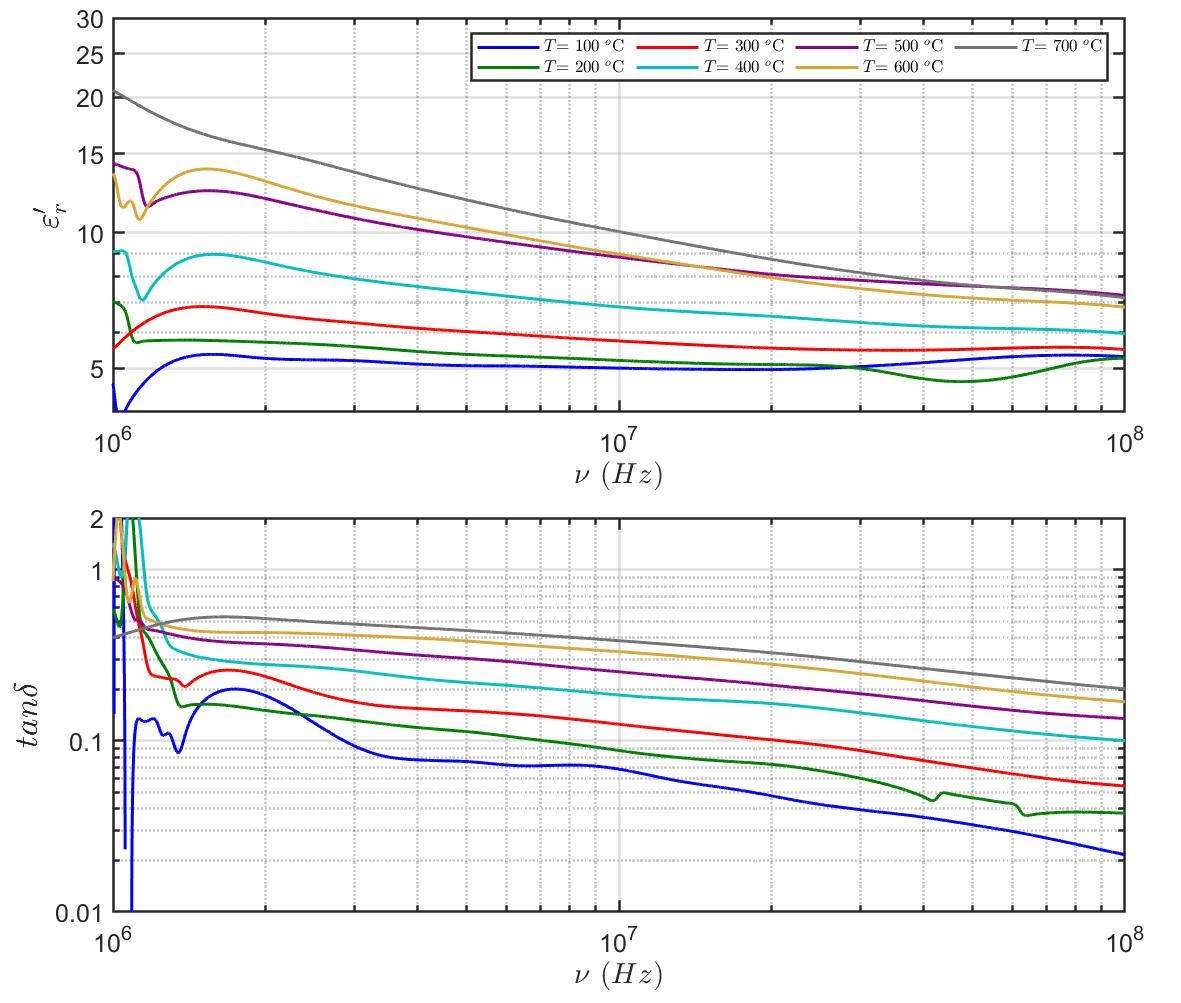
Figure 1. Dielectric properties of Venusian analogues as a function of temperature and frequency: (top) real permittivity and (bottom) loss tangent.
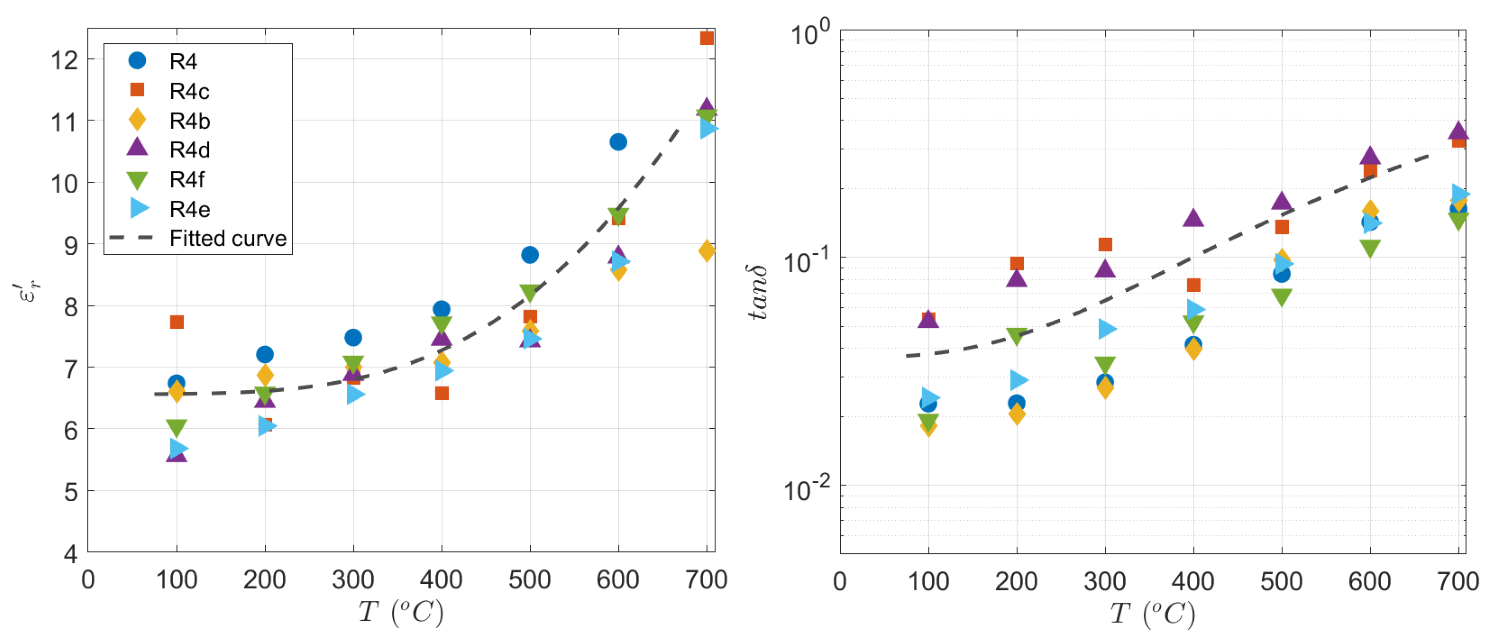
Figure 2. Dielectric properties of basaltic trachyandesite analogues as a function of temperature at 9 MHz: (left) real permittivity and (right) loss tangent.
Acknowledgements
This work was supported by the Italian Space Agency (ASI) under the agreements Accordo Attuativo ASI–UNITrento/DISI n. 2022-23-HH.0 and Addenda n. 2022-23-HH.1-2023 and n. 2022-23-HH.2-2025, for the project “Attività scientifiche per il radar sounder di EnVision Fase B2/C.
References
- Jamaledin Baniamerian, Sebastian E Lauro, Barbara Cosciotti, Alessandro Brin, Carlo Lefevre, Elisabetta Mattei, and Elena Pettinelli. A new experimental setup for high-temperature dielectric characterization of Venus analogs. Journal of Geophysical Research: Planets, 130(7): e2024JE008545, 2025.
- I. Parkhomenko. Electrical Properties of Rocks. Springer, 1967. doi: 10.1007/978-1-4615-8609-8.
- K. Jonscher. The ’universal’ dielectric response. Nature, 267:673–679, 1977. doi: 10.1038/267673a0.
- Yu A Surkov, VL Barsukov, LP Moskalyeva, VP Kharyukova, and AL Kemurdzhian. New data on the composition, structure, and properties of venus rock obtained by venera 13 and venera 14. Journal of Geophysical Research: Solid Earth, 89(S02):B393–B402, 1984.
How to cite: Baniamerian, J., Emanuel Lauro, S., Rabiee, A., Cosciotti, B., Pettinelli, E., Marinangeli, L., Baliva, A., and Mattei, E.: High-Temperature Dielectric Characterization of Venusian Crust Analogues for Subsurface Radar Sounding, Europlanet Science Congress 2026, The Hague, The Netherlands, 7–11 Sep 2026, EPSC2026-69, https://doi.org/10.5194/epsc2026-69, 2026.


