

- Imperial College, Earth Science and Engineering, United Kingdom of Great Britain – England, Scotland, Wales (kwl22@ic.ac.uk)
Introduction
The sizes of small craters are sensitive to near-surface target properties, making them valuable probes of subsurface structures [1,2]. Recent studies have demonstrated that target rheology and layering can significantly modify the radial extent of the ejecta blanket [3,4]. These findings revealed that buried layers can influence ejecta dynamics and size. Ejecta facies were previously thought to reflect only excavated material, they may also indicate deeper underlying structure. However, these studies have only quantified these effects in the context of Mars.
Lunar regolith covers the surface of the Moon, with estimated average depths of 10 meters in the mare and 13 meters in the highlands [5]. Many newly discovered craters, fall within the 5- to 15-meter diameter range [6,7], implying excavation depths of 0.5 - 1.5m. Although these craters are unlikely to excavate underlying bedrock, their ejecta size could potentially provide insights if it is shown to be sensitive to the underlying structure.
In this study, we calculate the critical regolith thickness required to decouple ejecta dynamics from the underlying material properties under lunar conditions. We use the example of a crater analogous to one that formed on March 17, 2013 (Figure 1), with a diameter of 18.8 meters [8].
Methods
Simulations. We conducted numerical simulations using the iSALE-2D shock physics code [9,10]. Layered targets consisting of regolith over basalt were modeled with systematically increasing regolith thickness, alongside homogeneous benchmark cases. Material parameters were adapted from previous iSALE studies and laboratory studies [3,4,11,12]. The cases explored include one-layer models (“Regolith” and “Basalt”) and two-layer models (“RegXmBas”), where “X” being regolith thickness, ranging from 0.5 to 8 meters. The simulations were conducted at 5 CPPR resolution, each taking 200 hours of runtime. Solid basalt impactors hit the targets at 20 km/s.
Ejecta analysis. Ejecta trajectories were reconstructed using velocities and launch angles of tracer particles recorded at a height of one projectile radius above the pre-impact target surface. This enabled ballistic projections of ejecta distance and thickness[3]. Following the methodology outlined in [4], ‘Ejecta mobility’ (EM), was quantified at multiple ejecta thickness thresholds (1 cm, 1 mm, ,100 µm). EM is defined as the physical distance at which ejecta thickness reaches the specified threshold, scaled by crater radius.
Preliminary results
Consistency between models. The simulations considered in this study resulted in craters ranging from 5.2 - 24 meters in diameter. For two-layer subsurface models with regolith thickness of >2m, we observed no excavation of underlying bedrock. All observables progressively transitioned from basalt-like to regolith-like values with increasing regolith thickness, shown in Table 1.
In particular, thinner reglotith layers produced basalt-like ejection veolcities and angles, wheras thicker layers behaved like regolith. This phenomenon is influenced by energy transmission through and reflection off the material boundary, which modifies the target's thermodynamic history , as illustrated in (Figure 2). At certain depths, reflections occur at lower wave amplitudes, and explains why the peak pressures for the model Reg8mBas (8 meters of regolith over basalt) resembles the “Regolith only” diagram in the target.
EM variations. At 1 µm threshold, the difference in ejecta mobility (EM) between basalt- and regolith-only models is 20 times the crater radius in physical distance. A very thin layer of regolith overlying basalt would be indistinguishable from pure basalt in the EM space, meaning that the error in calculation exceeds EM difference. However, with a regolith thickness of 2 meters or more, the relative differences in EM3 between models surpass the measurement errors, making them significant.
For instance, differences in EM3 between Reg2mBas (2 meters of regolith) and Reg8mBas (8 meters of regolith) models is approximately EM = 15.0±4.6. For a crater measuring 18.8 meters in diameter (or 9.4 meters in radius), this implies a difference of 141±43m. If the deposit thickness threshold necessary to create an albedo feature in the Lunar Reconnaissance Orbiter’s NAC camera [12] is set at 1 µm, such an ejecta radius could be captured by 282±96 pixels.Critical regolith depth. At around 8 meters of regolith thickness, crater morphology, ejecta velocity distribution, and EM values become nearly indistinguishable from those observed in a homogeneous regolith scenario. This suggests in this specific scenario ∼8m is a critical depth beyond which ejecta dynamics become decoupled from underlying material properties.
Preliminary conclusions
Results indicate that the ejecta size of new impact craters on the Moon, similar to findings on Mars [4], can be sensitive to the underlying subsurface structure. We identified significant differences in ejecta radii (EM) even in cases where the underlying bedrock was not excavated. Furthermore, we demonstrated the existence of a critical thickness within lunar regolith, beyond which, properties of the underlying bedrock have little to no significant influence on ejecta dynamics for small lunar craters. The fact that 1) this threshold is measured in several meters of depth, and 2) it exceeds the crater excavation depth, supports the potential use of ejecta radius as a diagnostic tool for constraining near-surface lunar structure.
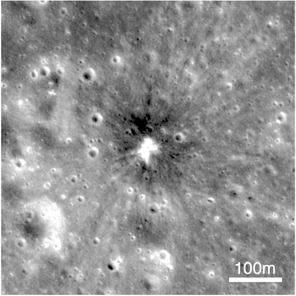
Figure 1. An example of a new impact site on the Moon, featuring a crater surrounded by extensive ejecta (image credit: NASA/GSFC/Arizona State University).
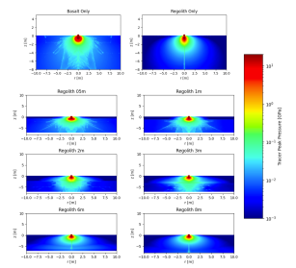
Figure 2. Diagrams illustrating the maximum shock pressures attained during impact as a function of their provenance (i.e., original pre-impact positions) .
| Simulation | Dcr [m] | d [m] | EM1 | EM2 | EM3 | ΔEM3 |
| Regolith | 24 | 8 | 5.56 | 12.8 | 30.5 | 2.05 |
| Basalt | 5.5 | 2 | 3.26 | 14.14 | >50 | 1.82 |
| Reg05mBas | 5.2 | 2.65 | 6.52 | 18.5 | >50 | 1.81 |
| Reg2mBas | 18 | 2 | 4.44 | 15.5 | 41.07 | 3.86 |
| Reg3mBas | 20 | 3 | 5.55 | 17.8 | 39.4 | 4.23 |
| Reg6mBas | 22 | 6 | 4.44 | 13.8 | 31.1 | 2.10 |
| Reg8mBas | 22 | 7 | 6.11 | 12.22 | 26.1 | 0.73 |
Table 1. Results of size measurements of craters and ejecta. Dcr: crater diameter, d : crater depth, EM1/2/3 : ejecta mobility at 1cm, 1mm and 1µm ejecta thickness cutoff, and ∆EM: error term of EM3 calculation.
References: [1] Housen & Holsapple (2011) [2] Prieur et al. (2018), 10.1029/2017JE005463 [3] Sokołowska et al. (2024), 10.1016/j.icarus.2024.116150 [4] Sokołowska et al. (2025), 10.1029/2024JE008561 [5] Venkatraman et al. 2023, 10.1016/j.pss.2023.105662 [6] Speyerer et al. (2016) [7] Sokolowska A. (2025), 10.5281/zenodo.15755155 [8] Robinson et al. (2015), 10.1016/j.icarus.2015.01.019 [9] Wuennemann et al. (2006), 10.1016/j.icarus.2005.10.013 [10] Collins et al. (2011), 10.1016/j.ijimpeng.2010.10.013 [11] Plescia et al. (2023), 10.2138/rmg.2023.89.15 [12] Robinson et al. (2010),10.1007/s11214-010-9634-2 [13] Gao & Sokołowska LPSC 2025, Abst.#2692
Acknowledgements: A.J.S. is funded by a UKRI Fellowship & Horizon Europe Guarantee EP/Z003180/1. We thank iSALE developers, including G. Collins, K. Wünnemann, D. Elbeshausen, T. Davison, B. Ivanov and J. Melosh.
How to cite: Lee, K., Sokolowska, A., and Collins, G.: Critical lunar regolith depth for decoupling ejecta dynamics from properties of underlying substrate, Europlanet Science Congress 2026, The Hague, The Netherlands, 7–11 Sep 2026, EPSC2026-695, https://doi.org/10.5194/epsc2026-695, 2026.


