
 1,2,4,5,
- 1University of Liverpool, Liverpool, United Kingdom (f.saveriano@liverpool.ac.uk)
- 2Max Planck Institute for Solar System Research, Göttingen, Germany
- 3University College London, London, United Kingdom
- 4Institut für Planetologie, University of Münster, Münster, Germany
- 5Luleå University of Technology, Kiruna, Sweden
- *A full list of authors appears at the end of the abstract
CIRCE (Centaurs’ Investigation, Reconnaissance and Compositional Exploration) is a mission concept for long-duration close-up exploration of the active Centaur 29P/Schwassmann-Wachmann, developed within the ESA Academy framework. The mission investigates the feasibility of sustained operations around an active icy small body beyond the water ice line through a combination of low-thrust trajectory design, close-proximity operations, and a multi-instrument payload for simultaneous surface, coma, dust, and plasma characterization. Centaurs represent a dynamically transitional population between Kuiper Belt Objects and Jupiter-family comets, preserving key records of icy planetesimal formation and early Solar System evolution (see Figure 1). Despite their scientific importance, no spacecraft mission has yet explored a Centaur in situ.
29P/Schwassmann-Wachmann is an exceptional target because it exhibits persistent and episodic activity at heliocentric distances near 6 AU, where water-ice sublimation alone cannot efficiently drive cometary activity. Observations suggest that supervolatile sublimation, crystallization of amorphous water ice, and localized venting processes may contribute to the observed outbursts, but the physical mechanisms governing this activity remain unresolved. Recent ground-based [1] and JWST [2] observations further indicate strong compositional heterogeneity and complex temporal variability in the coma and active regions.
CIRCE aims to constrain the origin and evolution of Centaurs by combining global surface characterization, compositional mapping, coma analysis, and temporal monitoring of activity. The mission science objectives include determining the volatile and isotopic composition of the coma, investigating the mechanisms driving activity beyond the water ice line, characterizing the internal structure and thermal state of the nucleus, and studying the interaction between the coma and the solar wind environment. The proposed payload includes visible imaging systems, infrared spectroscopy, and thermal mapping to characterize surface morphology and thermophysical properties; mass spectrometry to constrain volatile and isotopic composition; a dust impact analyser to investigate ejected material during activity; and plasma instrumentation to detect interactions between the coma and the solar wind.
The mission concept employs a low-thrust trajectory with a Mars gravity assist, enabling rendezvous with 29P and extended orbital operations around the nucleus. Long-term monitoring from close orbital distances would provide an unprecedented opportunity to observe recurrent outbursts, characterize active regions, and investigate the transition of icy bodies from the outer Solar System into the Jupiter-family comet population. CIRCE would therefore bridge key knowledge gaps between relatively pristine Kuiper Belt objects and evolved inner Solar System comets, while expanding the exploration of primitive small bodies into a population not yet visited by spacecraft.
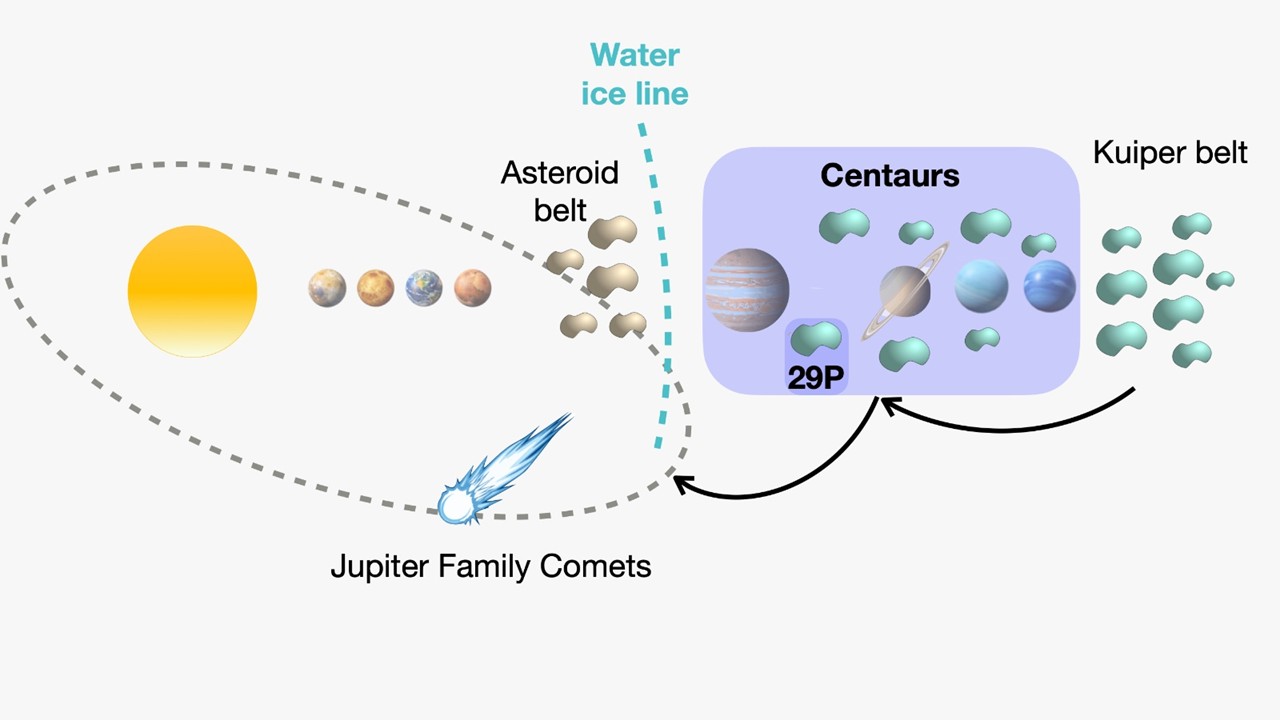
Figure 1: Schematic overview of the heliocentric distances of the Centaur population, highlighting 29P/Schwassmann-Wachmann.
References:
[1] Paganini, Lucas, et al. "Ground-based infrared detections of CO in the Centaur-comet 29P/Schwassmann-Wachmann 1 at 6.26 AU from the Sun." The Astrophysical Journal 766.2 (2013): 100.
[2] Faggi, Sara, et al. "Heterogeneous outgassing regions identified on active centaur 29P/Schwassmann–Wachmann 1." Nature Astronomy 8.10 (2024): 1237-1245.
Audrey E. Aebi, Sven Amberg, Felix Johann Arch, Kamal El Bakkoury, Alessandro Beolchi, Elsa Blond Hanten, Robin F. Bonny, Alessia Cremasco, Michal Filipiak, Jaroslaw Gierulski, Elisabeth Gmeiner, Jordi González de Regàs, Charlotte Herrmann, Marin Hubert, Johannes Kramer, Christina Vejby Larsen, Andrés Pintado Lázaro, Matous Moravec, Denis Práznovský, Lidia Ramírez Arroyo, Anastasios Faidon Retselis, Vincent Schulz, Sabrina Sughi, Hugo Testa, Alina Vassiljeva.
How to cite: Saveriano, F., Gurrutxaga, N., Beaumont, M., Goldmann, M., and Reis, M. and the CIRCE Mission Concept Team: CIRCE: A Mission Concept for In Situ Exploration of the Active Centaur 29P/Schwassmann-Wachmann, Europlanet Science Congress 2026, The Hague, The Netherlands, 7–11 Sep 2026, EPSC2026-696, https://doi.org/10.5194/epsc2026-696, 2026.


